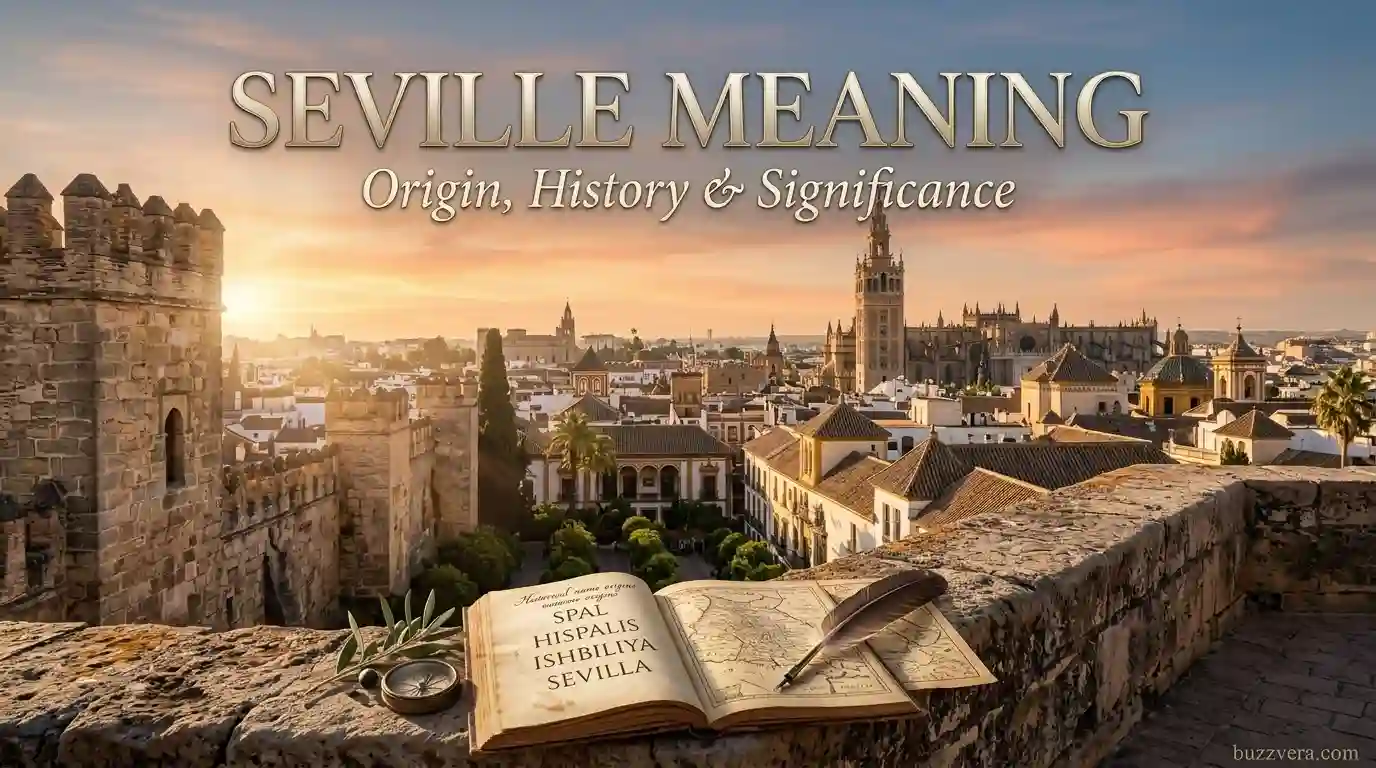
Have you ever wondered what Seville means and where this distinctive name comes from? Seville is the English name for Sevilla, a historic city in Andalusia, southern Spain. Its name has a fascinating history shaped by different languages and civilizations over many centuries. It is commonly linked to a proposed Phoenician origin, with a possible meaning related to a plain or valley. However, its exact etymology is not completely certain.
Throughout history, the name appeared in different forms, including Hispalis during Roman times and Ishbiliya during the Arabic period. Today, Seville is recognized for its Spanish heritage, historic architecture, and cultural importance. It can also attract attention as an unusual, place-inspired personal name. In this article, we will explore the Seville meaning, its linguistic roots, historical development, pronunciation, and possible significance as a baby name so you can understand the name from every angle.
What Does Seville Mean?
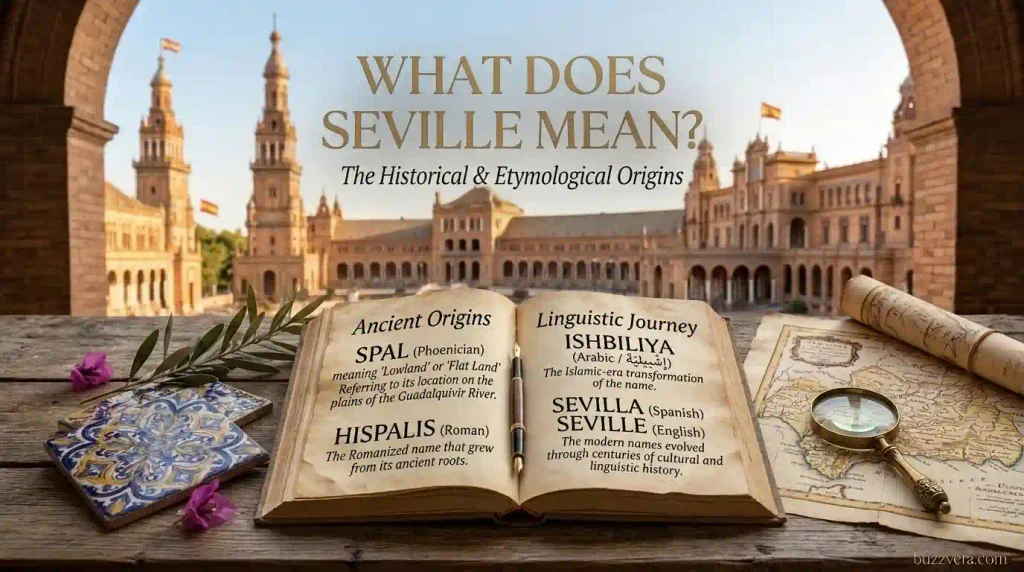
Seville is the English name for Sevilla, a historic city in southern Spain. The name is commonly associated with a proposed Phoenician origin, connected to the word sefela, which is believed to mean plain or valley. This interpretation relates to the geographical landscape associated with the area’s early history. However, the exact origin of the name remains uncertain, so this meaning should be treated as a historical theory rather than a confirmed translation.
Today, Seville primarily identifies a Spanish city known for its rich heritage, architecture, traditions, and cultural influence. As a personal name, Seville may appeal to parents who like distinctive names inspired by famous places. Its associations with Spanish culture, history, and individuality can give it personal significance.
In simple terms, Seville is a historic geographical name with a possible ancient meaning related to a plain or valley. Its modern significance comes mainly from its connection to Spanish history and culture rather than a fixed dictionary definition.
What Is the Origin of the Name Seville?
The name Seville has a long history influenced by several ancient civilizations and languages. Its development reflects the different cultures that ruled and shaped the region over many centuries. Although its exact earliest origin is debated, historians commonly associate the name with ancient Phoenician, Roman, Arabic, and Spanish influences.
Phoenician Roots
One proposed explanation connects Seville to the Phoenician word sefela, which is associated with the meaning plain or valley. The Phoenicians were ancient traders who established settlements and trading connections throughout the Mediterranean. Their presence in the region may have influenced some of its earliest place names. However, this linguistic connection is not universally accepted as proven.
Roman Influence: Hispalis
During the Roman period, the city was known as Hispalis. It became an important settlement in the Roman province of Hispania, benefiting from trade, agriculture, and its location along the Guadalquivir River. Roman influence helped establish the city’s importance as a regional center.
Arabic Influence: Ishbiliya
Following the Muslim conquest of the Iberian Peninsula in the eighth century, Seville came under Islamic rule. Its name developed into Ishbiliya, the Arabic form associated with the city’s historical identity. During this period, Seville became an important center of commerce, learning, architecture, and culture.
Development of the Modern Name: Sevilla
After the Christian conquest of Seville in 1248, the Spanish form Sevilla gradually became established. Over time, this spelling remained the standard name in Spanish. English speakers adopted the form Seville, which is still widely used today.
Overall, the origin of Seville reflects centuries of linguistic and cultural change. Its journey from ancient historical forms to the modern names Sevilla and Seville makes it a fascinating example of how place names evolve over time.
What Does Seville Mean in Different Languages?
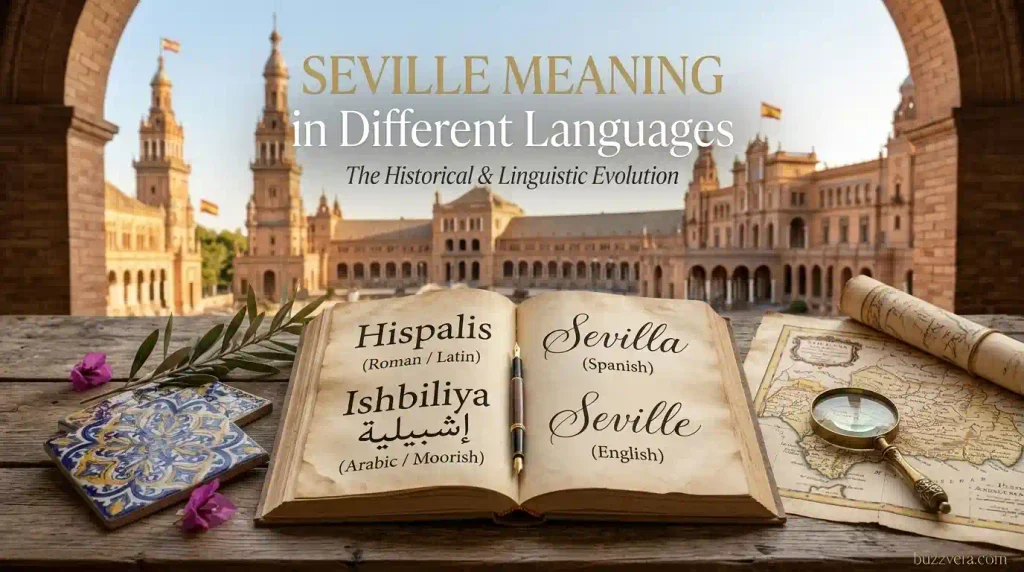
The meaning and spelling of Seville vary depending on the language and historical period. Although the modern name is strongly connected to Spain, its roots reflect the influence of several civilizations that lived in or influenced the region. Understanding these different forms helps explain why Seville has such a rich linguistic history.
Seville Meaning in English
In English, Seville is the established name for a historic city in southern Spain. It does not have a separate, commonly accepted English dictionary meaning. Its possible ancient association with a plain or valley comes from a proposed Phoenician etymology rather than a direct English translation.
Sevilla Meaning in Spanish
In Spanish, the city is called Sevilla. This is the original modern Spanish spelling and refers to the same place as the English name Seville. The name represents the city’s identity, history, and cultural heritage rather than a separate descriptive word.
Seville Meaning in Phoenician
The name is sometimes connected to the Phoenician word sefela, which is associated with a plain or valley. This proposed connection offers a possible explanation for the name’s ancient roots. However, its exact linguistic development remains uncertain.
Seville Meaning in Arabic
During the period of Islamic rule in Spain, the city was known as Ishbiliya. This historical Arabic form developed from the earlier name and influenced the later Spanish form Sevilla. It reflects the important role of Arabic language and culture in the region’s history.
Seville Meaning in Latin
During Roman rule, the city was known as Hispalis. This was its historical Roman name, not a direct Latin translation of the modern English word Seville. The Roman period played an important role in the city’s development and historical identity.
Overall, Seville does not have five separate meanings in these languages. Instead, its different forms represent the linguistic and historical changes that shaped the name over time.
Is Seville a Spanish Name?
Yes, Seville is strongly associated with Spain because it is the English name of Sevilla, a historic city in the Andalusia region of southern Spain. Although the English spelling is slightly different, both names refer to the same place and share the same historical background.
Seville has deep connections to Spanish language, architecture, traditions, and cultural heritage. The city is particularly famous for flamenco, traditional festivals, historic buildings, and its distinctive Andalusian identity. These cultural associations have helped make the name recognizable around the world.
However, there is an important difference between a Spanish place name and a traditional Spanish personal name. Seville is primarily known as a geographical name rather than a widely established traditional first name. Nevertheless, some parents may choose it as a distinctive, place-inspired name for a child.
The Spanish spelling is Sevilla, while Seville is the form commonly used in English. Both versions carry the same geographical identity and historical associations.
Therefore, Seville can certainly be described as a Spanish-associated name. Its strongest connection comes from the famous Spanish city, although its use as a personal name is a more modern and uncommon choice.
How Do You Pronounce Seville?
The English pronunciation of Seville is suh-VIL. It has two syllables, with the strongest emphasis on the second syllable. The name is relatively easy to pronounce once you understand how its letters sound together.
Seville Pronunciation in English
In English, Seville is commonly pronounced suh-VIL. The first syllable sounds like the beginning of the word support, while the second rhymes with hill. The final e is silent.
- Word: Seville
- Pronunciation: suh-VIL
- Syllables: Se-ville
- Stress: Second syllable
- Language: English
Sevilla Pronunciation in Spanish
The Spanish spelling, Sevilla, has a slightly different pronunciation. It is commonly pronounced seh-BEE-yah in English phonetic approximation. It also has three syllables, with emphasis on the middle syllable.
- Word: Sevilla
- Pronunciation: seh-BEE-yah
- Syllables: Se-vi-lla
- Stress: Second syllable
- Language: Spanish
Common Pronunciation Mistakes
Some people pronounce Seville as see-vil or seh-vil because they are unfamiliar with its English pronunciation. Others confuse the English spelling with the Spanish form Sevilla. Remember that Seville has two syllables, while Sevilla has three.
Overall, both pronunciations are straightforward. Use suh-VIL when speaking English and seh-BEE-yah when using the Spanish name.
Is Seville a Boy’s or Girl’s Name?
Seville is primarily a geographical name, but it can also be considered as a modern personal name for a boy or a girl. Unlike traditional names with well-established gender classifications, Seville does not have a widely recognized gender association. Its use as a first name is relatively uncommon, which gives it a distinctive and unconventional appeal.
Is Seville a Girl’s Name?
Some parents may find Seville appealing as a girl’s name because of its elegant sound and connection to Spanish culture. Its association with a historic European city can give it a sophisticated and distinctive feel. However, it is not traditionally established as a feminine Spanish name.
Is Seville a Boy’s Name?
Seville can also be chosen as a boy’s name. Parents who prefer geographical names or uncommon choices may appreciate its historical background and recognizable spelling. Its sound does not restrict it to a particular gender.
Is Seville a Unisex Name?
Seville can be used as a unisex name in a modern, creative sense. However, this describes its potential use rather than an established naming tradition or widespread usage pattern.
Ultimately, whether Seville is suitable for a boy or girl depends on personal preference and cultural context. Its strongest identity remains its connection to the Spanish city of Sevilla, while its use as a personal name offers parents an unusual place-inspired option.
What Does Seville Mean as a Baby Name?
As a baby name, Seville offers a distinctive choice for parents who appreciate geographical names, Spanish heritage, and unusual spellings. Although it is primarily recognized as the English name of a historic Spanish city, some parents may choose it as a personal name because of its cultural background and pleasant sound.
Meaning and Personal Significance
Seville does not have a universally established baby-name meaning separate from its geographical origin. Its possible historical association with a plain or valley comes from a proposed Phoenician etymology. Parents may also connect the name with qualities such as elegance, individuality, cultural richness, and historical depth. These are personal interpretations rather than confirmed literal meanings.
Why Parents Might Choose Seville
There are several reasons why Seville may appeal to modern parents:
- Distinctiveness: It is an uncommon choice compared with many familiar first names.
- Cultural connection: It reflects an association with Spanish and Andalusian heritage.
- Pleasant sound: Its short, recognizable pronunciation makes it easy to remember.
- Historical background: Its connection to different ancient civilizations gives it an interesting story.
- Place-inspired appeal: It may suit parents who appreciate names inspired by meaningful destinations.
Is Seville a Good Baby Name?
Seville can be an interesting option for parents who want something different from traditional names. It has recognizable spelling, a connection to a famous European city, and an unusual personal-name style. However, parents should consider how comfortably it fits their language, culture, and family naming traditions.
Overall, Seville is best understood as a modern, place-inspired baby-name choice rather than a traditional name with a firmly established personal meaning. Its appeal comes from its distinctive identity, historical associations, and connection to Spanish culture.
What Is the Historical Significance of Seville?
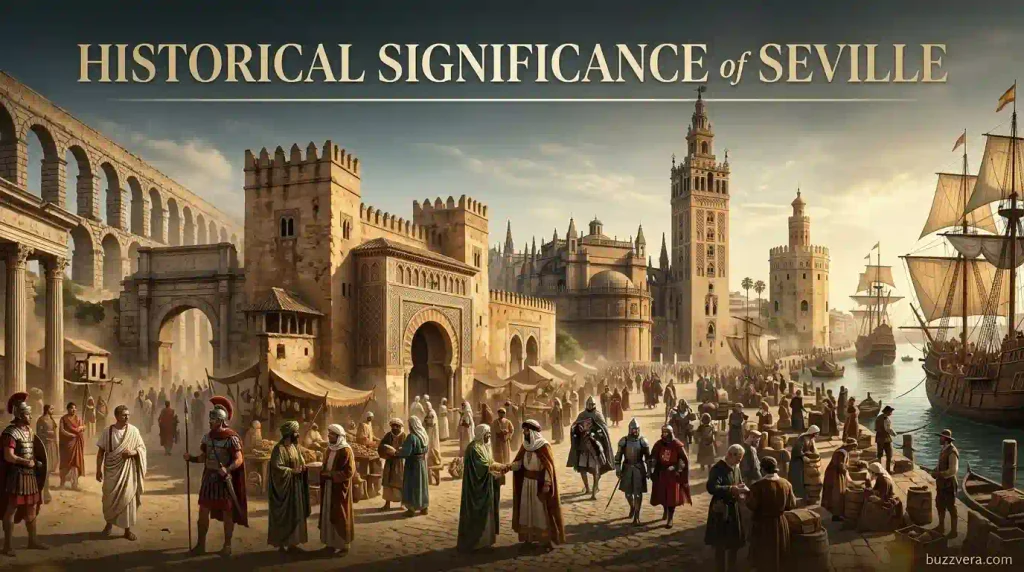
Seville has an important place in European and Spanish history because of its location, cultural development, and influence across different historical periods. Situated along the Guadalquivir River in Andalusia, southern Spain, the city became an important center of trade, government, architecture, and cultural exchange. Its history also helps explain why the name remains recognizable around the world.
Seville During the Roman Period
During Roman rule, Seville was known as Hispalis. It developed into an important settlement within the Roman province of Hispania. Its location near the Guadalquivir River supported agriculture, transportation, and commercial activities. Roman influence also contributed to the city’s urban development and lasting historical importance.
Seville During Islamic Rule
In the eighth century, Seville came under Muslim rule and became known by the Arabic form Ishbiliya. During this period, the city experienced significant cultural, architectural, and economic development. Islamic influence can still be seen in parts of its historic architecture and artistic heritage.
Seville After the Christian Conquest
In 1248, Christian forces under King Ferdinand III conquered Seville. The city subsequently became an important center of Christian Spain. Its architecture, religious institutions, and cultural traditions continued to develop during the following centuries.
Seville During the Age of Discovery
Seville gained exceptional commercial importance during Spain’s Age of Discovery. Its position along the Guadalquivir River made it a major center for trade with the Americas. Merchants, sailors, and explorers passed through the city, contributing to its wealth and international influence.
Seville’s Cultural Importance Today
Today, Seville is widely recognized for its historic landmarks, flamenco traditions, festivals, and distinctive Andalusian culture. Famous attractions such as the Cathedral of Seville, the Giralda, and the Royal Alcázar reflect its layered history.
Overall, Seville’s historical significance comes from centuries of cultural exchange and transformation. Its Roman, Islamic, and Spanish heritage has shaped the identity of the city and given its name lasting historical and cultural recognition.
What Does Seville Symbolize?
Seville can symbolize history, cultural diversity, heritage, and individuality because of its connection to one of Spain’s most historically significant cities. Although the name does not have one officially established symbolic meaning, its associations with Andalusian traditions and centuries of cultural development give it several interesting interpretations.
History and Heritage
Seville represents a long history shaped by Roman, Islamic, and Spanish influences. Its historical background can symbolize a connection to the past, cultural preservation, and respect for different civilizations. For people who appreciate meaningful place names, this association can make Seville particularly appealing.
Culture and Tradition
The city is closely associated with flamenco, traditional festivals, Spanish music, and Andalusian customs. As a result, Seville may symbolize artistic expression, cultural pride, and a strong sense of identity.
Beauty and Architecture
Seville is famous for its impressive architecture, historic streets, gardens, and landmarks. These features can inspire personal associations with beauty, elegance, creativity, and artistic appreciation. However, these qualities are symbolic interpretations rather than literal translations of the name.
Diversity and Cultural Exchange
Different civilizations have influenced Seville throughout history. Its Roman, Arabic, and Spanish connections can symbolize diversity, cultural exchange, and the blending of traditions.
Individuality and Uniqueness
When used as a personal name, Seville may represent originality and individuality. Its uncommon use as a first name can appeal to parents who prefer distinctive, place-inspired choices instead of more traditional names.
Overall, Seville can carry personal associations with heritage, culture, history, beauty, and individuality. These symbolic interpretations come from the city’s identity and historical background rather than a fixed dictionary definition.
What Is the Difference Between Seville and Sevilla?
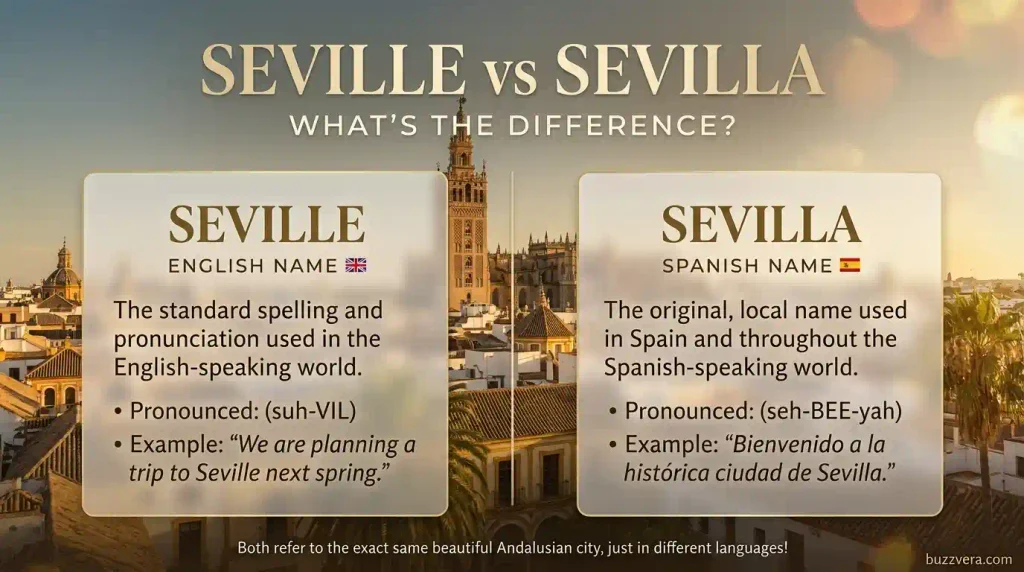
Seville and Sevilla are two names for the same historic city in southern Spain. The main difference is their language and spelling, not their geographical location or meaning. Seville is the English form, while Sevilla is the original modern Spanish spelling.
Seville: The English Spelling
Seville is the name commonly used in English-language books, articles, maps, and travel publications. It refers to the capital of Andalusia and carries the same historical and cultural associations as the Spanish version. Its pronunciation in English is suh-VIL.
Sevilla: The Spanish Spelling
Sevilla is the official Spanish name of the city. It is used throughout Spain and in Spanish-language communication. The pronunciation is approximately seh-BEE-yah, with the middle syllable receiving the strongest emphasis.
Key Differences Between Seville and Sevilla
| Feature | Seville | Sevilla |
| Language | English | Spanish |
| Spelling | Seville | Sevilla |
| Pronunciation | suh-VIL | seh-BEE-yah |
| Reference | Spanish city | Same Spanish city |
| Usage | English writing | Spanish writing |
Which Spelling Should You Use?
Choose Seville when writing in English, especially for articles, educational content, and general communication. Use Sevilla when writing in Spanish or referring to the city by its Spanish name.
Both spellings identify the same destination and share the same historical background. Neither represents a different city or a separate meaning.
In simple terms, Seville is the English version of Sevilla. Understanding this distinction makes it easier to recognize the name in different languages and appreciate its Spanish origins.
Names Similar to Seville
If you like the name Seville, you may also enjoy other names with a similar sound, distinctive spelling, geographical connection, or cultural background. Some are inspired by famous cities and regions, while others share the soft and elegant sound that makes Seville appealing as a possible personal name.
Here are some interesting alternatives to consider:
| Name | Meaning or Connection |
| Sevilla | Spanish form of Seville |
| Savannah | A name associated with a tropical grassland |
| Valencia | Spanish geographical name |
| Sienna | Inspired by the Italian city of Siena |
| Selene | Greek name meaning moon |
| Vienna | Inspired by the Austrian capital |
| Sicily | Inspired by the Italian island |
| Solana | Spanish name associated with a sunny place |
| Sierra | Spanish word meaning mountain range |
| Florence | Inspired by the historic Italian city |
Names With a Similar Sound
If you prefer the sound of Seville, names such as Selene, Sienna, and Solana may appeal to you. They have a similarly smooth pronunciation and distinctive style. These alternatives can work well for parents looking for uncommon or elegant-sounding names.
Names Inspired by Places
If the geographical connection is what attracts you to Seville, consider Valencia, Vienna, Florence, and Sicily. These names are also associated with well-known places and have their own cultural and historical backgrounds.
How to Choose an Alternative
Think about the sound, spelling, cultural connection, and personal meaning you want a name to carry. Some parents prefer names with historical significance, while others look for something short, recognizable, or unusual.
Ultimately, these alternatives offer different qualities, but none is an exact synonym for Seville. The best choice depends on your personal taste and the associations you want the name to represent.
Common Misconceptions About Seville Meaning
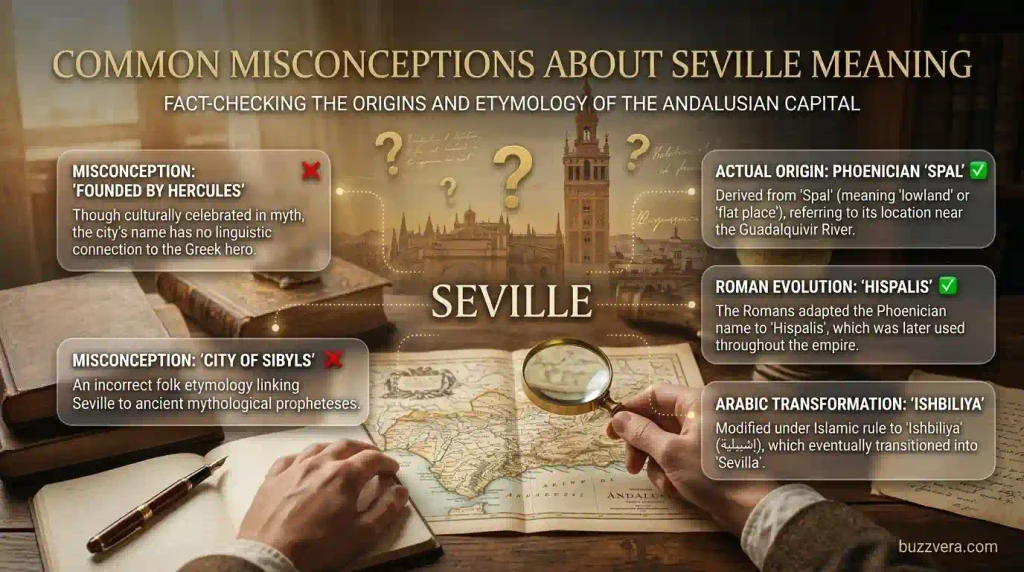
Although Seville has a fascinating linguistic and historical background, several misunderstandings can arise when people research its meaning. Some explanations confuse its proposed ancient origin with modern interpretations, while others mix its identity as a Spanish city with its possible use as a personal name. Understanding these differences helps readers get a more accurate picture.
1. Seville Literally Means Beautiful
One common misconception is that Seville directly translates to beautiful or elegant. Although people may associate the name with beauty because of the city’s architecture and cultural heritage, this is not an established literal meaning.
2. Seville Definitely Means Valley
The proposed Phoenician connection with sefela, meaning plain or valley, is often mentioned when discussing the name’s origin. However, this explanation is not universally confirmed. It is more accurate to describe it as a possible historical connection.
3. Seville and Sevilla Are Different Places
Seville and Sevilla are not two separate cities. Seville is the English spelling, while Sevilla is the Spanish spelling. Both names refer to the same historic city in Andalusia, Spain.
4. Seville Is Traditionally Only a Girl’s Name
Another misunderstanding is that Seville is exclusively a feminine name. In reality, it is primarily a geographical name rather than a traditional first name with an established gender classification. It may be adopted as a personal name for a child of any gender.
5. Seville Has a Direct Arabic Translation
The historical Arabic form Ishbiliya is connected to the city’s naming history. However, this does not mean that Seville has a separate, universally accepted Arabic dictionary meaning. The Arabic form reflects a historical stage in the development of the place name.
6. Seville Is a Common Traditional Spanish First Name
Seville is strongly associated with Spanish culture, but its primary identity is that of a city name. Its use as a personal name is better understood as an uncommon, modern place-inspired choice rather than a widely established traditional Spanish naming practice.
Understanding these misconceptions makes the meaning of Seville easier to explain. Its strongest identity comes from its geographical history, linguistic development, and connection to Spanish culture rather than unsupported symbolic or literal translations.
Frequently Asked Questions About Seville Meaning
1. What Does Seville Mean in English?
Seville is the English name for Sevilla, a historic city in southern Spain. It does not have a separate, established English dictionary meaning. Its proposed ancient origin is sometimes associated with a plain or valley.
2. Does Seville Mean Valley?
Seville is commonly linked to a proposed Phoenician origin involving the word sefela, which is associated with a plain or valley. However, this explanation is not completely confirmed, so it should be treated as a possible etymology.
3. Is Seville a Spanish Name?
Yes, Seville is strongly associated with Spain. It is the English form of Sevilla, the Spanish name of the historic Andalusian city. Its primary identity is geographical rather than that of a traditional Spanish first name.
4. Is Seville a Girl’s Name?
Seville can be used as a girl’s name by parents who appreciate unusual, place-inspired names. However, it is not traditionally established as a feminine name. Its use as a personal name is relatively uncommon.
5. Can Seville Be a Boy’s Name?
Yes, parents may also choose Seville as a boy’s name. It does not have a widely recognized traditional gender classification, making it a possible modern unisex choice.
6. What Is the Spanish Spelling of Seville?
The Spanish spelling is Sevilla. Both Sevilla and Seville refer to the same city in southern Spain. Sevilla is used in Spanish, while Seville is commonly used in English.
7. How Do You Pronounce Seville?
In English, Seville is pronounced suh-VIL, with emphasis on the second syllable. Its Spanish counterpart, Sevilla, is pronounced approximately seh-BEE-yah, with three syllables.
8. Is Seville a Rare Baby Name?
Seville is an uncommon personal-name choice compared with many traditional first names. It is primarily recognized as a geographical name, so reliable popularity statistics may be limited. Its distinctive spelling and Spanish connection may appeal to parents seeking an unusual name.
9. What Is the History Behind the Name Seville?
The name has a complex historical background. The city was known as Hispalis during Roman rule and Ishbiliya during the Arabic period. Its modern Spanish name is Sevilla, from which the English form Seville developed.
10. What Does Seville Symbolize?
Seville may symbolize history, cultural heritage, artistic expression, individuality, and Spanish traditions. These associations come from the city’s identity and historical importance rather than a fixed literal meaning.
Conclusion
The Seville meaning is closely connected to the history and cultural identity of Sevilla, a famous city in southern Spain. Its proposed ancient roots may relate to a plain or valley, although the exact etymology remains uncertain.
From its historical forms, including Hispalis and Ishbiliya, to its modern Spanish and English spellings, the name reflects centuries of cultural influence. As a personal name, Seville offers an uncommon, place-inspired choice associated with Spanish heritage, history, and individuality. Understanding its linguistic roots and historical background helps explain why this distinctive name continues to attract interest.

Mafia Noor is an experienced content writer and author at BuzzVera.com, with 3 years of experience creating helpful and easy-to-understand content. Mafia specializes in texting slang, internet abbreviations, modern expressions, and text meanings, helping readers understand today’s digital language clearly and confidently.