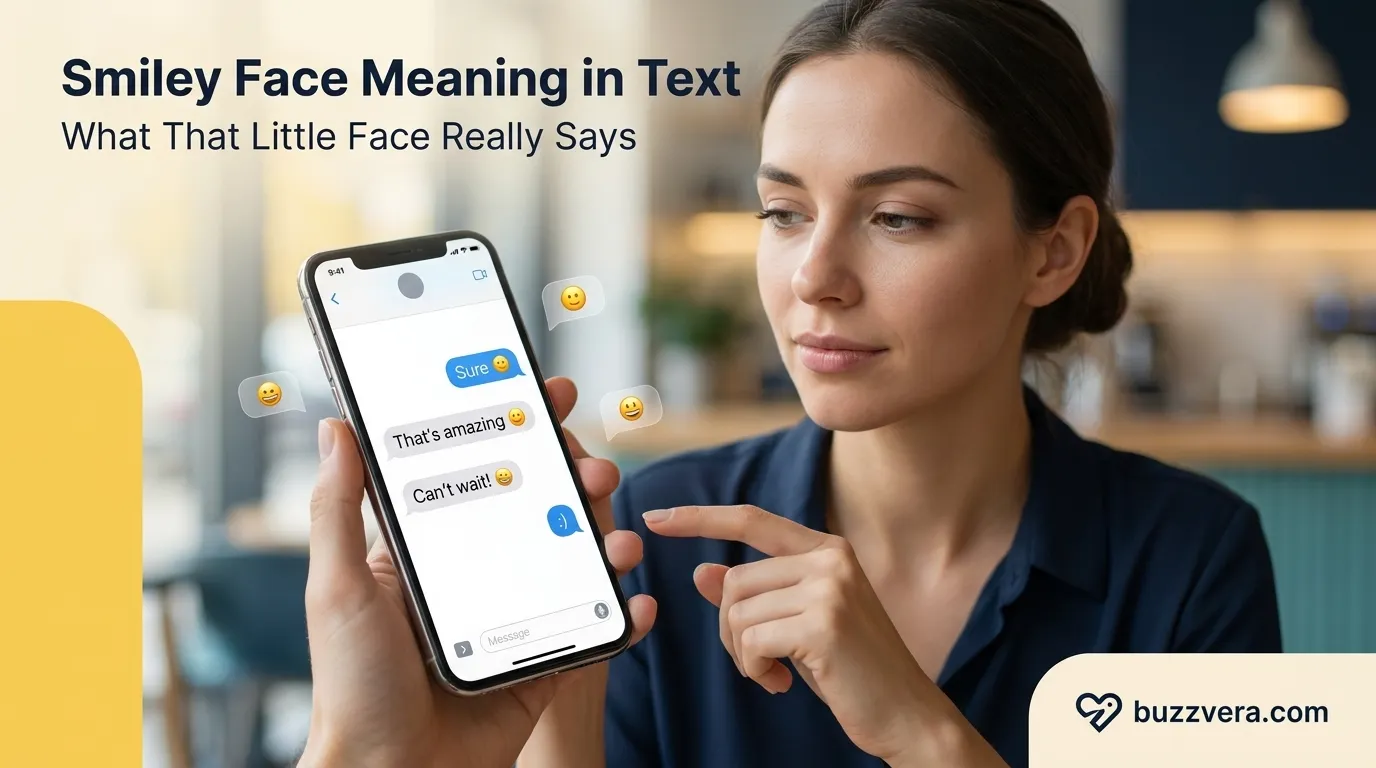
You get a text. It ends with a tiny yellow face. 🙂
What does it mean? Is the person happy? Are they being polite? Are they upset and hiding it?
The smiley face meaning in text seems easy. It is not always easy. One small face can say “I’m glad,” “I’m fine,” or “I’m done with you.”
People use smiley faces every day. They use them in texts, on social media, in games, and even in work chats. A smiley can warm a message. It can also change the whole tone.
That is why it helps to know the details. A wrong guess can start a fight over nothing. A right guess can save a friendship.
In this guide, you will learn what each smiley means. You will see real examples. You will learn how to reply. You will also learn when to skip the smiley.
Let’s decode it.
What Is the Smiley Face Meaning in Text? (Definition & Meaning)
A smiley face is a small picture of a face with a smile. People add it to messages to show a feeling.
The word “smiley” covers many faces. Here are the main ones:
- 🙂 is the classic typed smile.
- 🙂 is the slight smile. It is calm and mild.
- 😊 is the smiling face with smiling eyes. It is warm.
- 😀 is the big grin. It is loud and happy.
- 😄 is the grin with open mouth and happy eyes.
So what is the smiley face meaning in text? At its core, it means happiness, friendliness, or approval. It tells the reader, “I mean this in a good way.”
Text has no voice. It has no face. A smiley fills that gap. It does the job of a smile in real life.
Here are some simple examples.
Example 1: Warm and happy
Anna: I got the job!
Ben: That’s amazing 😊
Ben is truly glad. The smile is warm.
Example 2: Soft and polite
Mia: Can you send the file by noon?
Tom: Sure 🙂
Tom is calm and polite. He is not excited. He is just friendly.
Example 3: Softening a message
Sam: You forgot the milk again 🙂
Sam is teasing. The smile says, “I’m not mad.”
Remember this: the smile softens words. It makes a message feel safer. But the shape of the face matters. A slight smile 🙂 is not the same as a big grin 😀. We will explore that below.
Background & History: Where the Smiley Face Meaning in Text Began
The smile is older than phones. It started long before texting.
The yellow smiley (1963). An artist named Harvey Ball drew a yellow smiling face in 1963. He made it for a company that wanted to lift worker mood. The design was simple: a yellow circle, two dots, and a curved smile. It spread fast. It showed up on buttons, mugs, and posters.
The typed smile (1982). A computer scientist named Scott Fahlman suggested using 🙂 in an online message board post. People were making jokes online. Others missed the joke. He proposed using 🙂 to mark a joke and 🙁 to mark a serious note. People loved it. The idea spread across early online groups.
The nose gets dropped. Over time, people dropped the little nose. 🙂 became 🙂. It was faster to type.
Emoji arrive (late 1990s). In Japan, a designer named Shigetaka Kurita made a set of small picture symbols for a mobile service. These were called emoji. They gave people real pictures instead of typed marks.
Smartphones take over. Later, phones added emoji keyboards. Now anyone can send 🙂 or 😊 in one tap.
How the meaning has changed. The smile used to mean one thing: “I’m happy.” Today it can mean much more. Some young people now see the plain 🙂 as cold or fake. We will cover that soon.
Where it is used today. You will see smiley faces in text messages, chat apps, comments, games, emails, and work tools. They are everywhere. The smiley face meaning in text has grown from one idea into a full set of moods.
Smiley Face Meaning in Text Across Different Situations (Usage in Various Contexts)
A smiley face works differently in each place. Let’s look at the main ones.
Texting friends
With friends, a smile is usually warm and playful.
Lily: Pizza tonight?
Jack: Yes please 😊
It shows joy. It shows you are glad to hang out.
Texting family
Family members often use smileys to show love or care.
Mom: Did you get home safe? 🙂
Dan: Yes, Mom. Just got in 🙂
The smile here says, “I care about you.”
Social media
On social posts, a smile is often a kind reaction.
Comment: Congrats on the new puppy 😊
It is a quick way to be nice. It is also a way to say “I saw this.”
Gaming
In games, players use a smile after a match. It can mean good sportsmanship.
Player 1: gg 🙂
Player 2: gg, nice shot!
Sometimes, though, it is a sneaky smile. A player may send 🙂 after winning to rub it in. Tone matters.
Casual chats
In normal chats, a smile keeps things light.
Zoe: I’ll be five minutes late 🙂
Kai: No problem 🙂
The smile says, “Please don’t be upset.”
Passive-aggressive use
This one is tricky. Sometimes a smile hides anger.
Ella: I waited an hour for you.
Max: Sorry 🙂
Ella: It’s fine 🙂
Here, “It’s fine 🙂” may mean the opposite. Ella may be upset.
Quick tip: Read the words around the smiley. Read the history between you two. The smile alone does not tell the whole story.
Common Misconceptions About the Smiley Face Meaning in Text
Many people think a smiley always means happy. That is not always true. Here are the most common mix-ups.
Myth 1: “A smile always means they’re happy.”
Not so. A smile can hide sadness, anger, or stress. People often use it to stay polite.
Boss: Please redo the report 🙂
The boss may be calm. Or the boss may be annoyed. Context decides.
Myth 2: “All smileys mean the same thing.”
They do not. Compare these:
- 😊 feels sincere and warm.
- 🙂 feels mild and neutral.
- 😀 feels loud and excited.
- 🙂 feels casual and old-school.
Think of them as different volumes of joy.
Myth 3: “The slight smile is always friendly.”
Many young people see 🙂 as cold, fake, or sarcastic. It can look like a forced smile. A smile through gritted teeth. So a person might say, “Why are you sending me that face?”
Chloe: I told you I’d be late.
Ryan: Okay 🙂
Chloe: Why the weird face?
Myth 4: “Older and younger people read it the same way.”
Not at all. Older users often use 🙂 and 🙂 to be kind. Younger users often read the same face as sarcasm. This gap causes real confusion.
Myth 5: “A smile is always safe.”
A smile in the wrong moment can look rude.
Friend: My dog is sick.
You: Oh no 🙂
That reply feels cold. A sad or caring face would fit better.
The takeaway: A smiley is a tone marker, not a promise. Match it to the moment. When unsure, pick a warmer face like 😊 or add clear words.
Similar Terms & Alternatives to the Smiley Face Meaning in Text
Sometimes a smile is not the best choice. Here are other ways to show a happy mood.
Other faces:
- 😁 Beaming face. Big joy.
- 😆 Laughing face. Something is funny.
- 😂 Tears of joy. Very funny.
- 🥰 Smiling face with hearts. Love and care.
- 😌 Relieved face. Calm and content.
- 😎 Cool face. Confident and chill.
Typed alternatives:
- 😀 Big open grin.
- 😛 Playful, tongue out.
- 😉 Wink. Flirty or joking.
- ^_^ Soft, cute smile. Common in anime fans.
Word alternatives:
- “Haha”
- “Love it”
- “So happy for you”
- “That made my day”
Here is a table to compare them.
| Symbol | Feeling | Best used for |
| 🙂 | Calm, mild | Polite replies |
| 😊 | Warm, sincere | Kind messages |
| 😀 | Excited | Good news |
| 😂 | Very funny | Jokes |
| 🥰 | Loving | Close friends, partners |
| 😉 | Playful | Teasing or flirting |
| 🙂 | Casual | Quick, light texts |
Pick the one that fits your real feeling. It makes your message clearer.
How to Respond to the Smiley Face Meaning in Text
Not sure how to reply to a smiley? Here are four styles.
Casual reply
Keep it light. Send a smile back.
Friend: See you at 7 🙂
You: See you then 😊
Funny reply
Add a joke or a goofy face.
Friend: Nice shirt 🙂
You: Thanks, I dressed for my own party 😂
Professional reply
Be clear and calm. Use few emoji, or none.
Coworker: Thanks for your help 🙂
You: You’re welcome. Happy to help.
Privacy-conscious reply
If you feel unsure, you do not have to share feelings. Keep your reply short and neutral.
Acquaintance: Hope you’re doing well 🙂
You: Thanks. Hope you are too.
When the smile feels fake
If a smile seems off, ask kindly.
You: That 🙂 felt a bit odd. Everything okay?
This opens the door. It shows you care. It also clears up tension fast.
Simple rule: Mirror the other person’s energy. Then add your own honesty. That works almost every time.
Regional & Cultural Differences in Smiley Face Meaning in Text
A smile feels simple. But cultures read it in different ways.
United States and Western countries
Here, a smile usually means friendliness. But among younger users, plain 🙂 can feel sarcastic.
Japan
Japan has a rich history of emoticons. They are called kaomoji. A famous one is (^_^). Japanese users read faces by the eyes more than the mouth. So ^_^ is a warm smile.
Western vs. Eastern styles
- Western style: 🙂 turned sideways.
- Eastern style: ^_^ or (^‿^) facing forward.
China
On Chinese apps, a slight smile can feel mocking. Some users read it as a polite “I don’t agree.” The same face can feel kind in one place and cold in another.
Latin America and Spain
People often use lots of smiles and hearts. Warm, friendly texting is the norm. A single plain smile may feel short.
Middle East and South Asia
Smiles are common in polite chats. Heavy emoji use is friendly and normal. In formal chats, people may use fewer.
Slang variations
- “Smiley” is the common English word.
- “Smilie” is another spelling.
- “Emoticon” is the typed version.
- “Emoji” is the picture version.
Lesson: If you chat across cultures, pick clear words. A smile alone may be misread.
Smiley Face Meaning in Text vs. Similar Expressions (Comparison)
Let’s compare smiley faces with close cousins. Small differences matter.
| Face | Meaning | Tone | Risk of misread |
| 🙂 | Slight smile | Neutral, polite | High (can seem fake) |
| 😊 | Smiling eyes | Warm, kind | Low |
| 😀 | Grin | Excited | Low |
| 😁 | Beaming | Very happy | Low |
| 🙃 | Upside-down | Sarcastic, silly | Medium |
| 😏 | Smirk | Cheeky, flirty | Medium |
| 😬 | Grimace | Awkward | Low |
Key differences
🙂 vs. 😊. The first is calm. The second is warm. If you want to be kind, use 😊.
🙂 vs. 🙃. The upside-down smile shows irony. It says, “This is silly” or “I’m hiding stress.”
🙂 vs. 😏. The smirk is flirty or teasing. It has attitude.
🙂 vs. 🙂. The typed one feels softer and older. The emoji feels cooler to some people.
Ava: I’m totally fine 🙃
Noah: Are you sure?
The upside-down face tells Noah that Ava is not fine. A normal smile might not have done that.
Tip: Think about the feeling you want. Then pick the face that matches it.
Smiley Face Meaning in Text on Dating Apps & Online Communities
Smileys are big in online spaces. Here is how they work.
Tinder and other dating apps
On dating apps, a smile is a green light. It says, “I’m friendly and open.”
Match: Hey, I love your travel photos 😊
You: Thank you! Where’s your favorite place?
A warm 😊 shows interest without pressure.
A wink 😉 adds flirting. Use it with care. Do not overdo it early on.
A plain 🙂 can feel flat. If it is your only reply, the other person may think you are bored.
Match: How was your day?
You: Good 🙂
Add more. “Good! Busy but fun. How was yours?” is better.
Twitter / X and social media
Here, smileys can be sincere or sarcastic. Replies that say “Great job 🙂” under an angry post may be mocking.
Gaming communities
Smiles show good vibes or smug wins. Read the match. If the game was tense, a 🙂 may be a taunt.
Group chats and forums
A smile helps keep a friendly mood. Many moderators like it. It makes the chat feel safe.
Tips for responding
- Match the energy. Big joy gets a big smile.
- Add words. A face alone can feel empty.
- Ask a question. It keeps the chat going.
- Watch for sarcasm. Check the earlier messages.
Small steps make online chats smoother.
Hidden or Offensive Meanings of the Smiley Face Meaning in Text
Most smiley faces are harmless. But a few hidden meanings exist. It helps to know them.
Passive-aggression
This is the biggest hidden meaning. A smile can mask anger.
Lena: You ignored my message.
Omar: Sorry, was busy 🙂
Lena: Sure 🙂
Both are using smiles to hide irritation.
Sarcasm
The slight smile and the upside-down smile 🙃 can mean “I don’t believe you” or “Whatever.”
Mockery
A smile after bad news can seem like laughing at someone. Be careful.
Friend: I failed my test.
You: Oh 🙂
That hurts. Avoid it.
Flirty or suggestive faces
Some faces look friendly but carry a naughty feel. The wink 😉 and the smirk 😏 can read as flirty. In the wrong setting, that may feel unwelcome.
Culture-based offense
In some places, a smile in a serious talk may seem rude. A formal chat may need a calm tone.
Why tone and context matter
A smiley has no voice. So the reader guesses. These things shape the guess:
- Your past chats with the person
- The words in the message
- The topic (happy or sad)
- Your relationship (friend, boss, stranger)
Safe habit: If the topic is serious, skip the smile. Use clear, kind words instead. If you are not sure how it will land, ask or pick a warmer face.
Is the Smiley Face Meaning in Text Suitable for Professional Communication?
Short answer: sometimes.
When it is okay
- With coworkers you know well
- In friendly team chats like Slack
- After thanking someone
- When the company culture is relaxed
Manager: Great work on the deck 🙂
You: Thank you! Glad it helped.
That is fine and warm.
When to avoid it
- In first emails to a client
- In formal letters or legal messages
- When you share bad news
- When you write to someone senior and are not sure of the tone
- In complaints or serious talks
A smile there can feel unserious or even sarcastic.
Which smiley is safest?
If you use one at work, pick 🙂 or 🙂. Keep it to one. Avoid big grins, winks, or hearts. Avoid 🙃 completely. It can look sarcastic.
Professional alternatives
Use words to show warmth:
- “Thank you so much.”
- “I appreciate your help.”
- “Happy to assist.”
- “Glad to hear it.”
- “Great news!”
Instead of: “Thanks 🙂”
Try: “Thanks. I appreciate your quick help.”
A simple rule
Read the room. Follow the lead of the other person. If they use smileys, you may use one too. If they write plain and formal, match them.
FAQs About the Smiley Face Meaning in Text
1. What does a smiley face mean in a text?
It usually means happiness, kindness, or approval. It softens a message and shows a friendly tone. But it can also show politeness, sarcasm, or hidden annoyance, depending on context.
2. What does 🙂 mean from a guy or a girl?
It often means calm and polite. It may show mild interest or friendliness. It can also be sarcastic. Look at the words around it and at your past chats.
3. Is the slight smile 🙂 rude?
Not by itself. But many younger users read it as cold or fake. If you want to be warm, use 😊 instead.
4. What is the difference between 😊 and 🙂?
😊 shows warm, real happiness. 🙂 is calmer and more neutral. Think of 😊 as a hug and 🙂 as a polite nod.
5. What does 🙂 mean in a text?
It is the classic typed smiley. It means friendly, light, and casual. It is older in style but still very common.
6. Can a smiley face mean someone is angry?
Yes. A smile can hide anger in what people call passive-aggressive texting. Watch for phrases like “It’s fine 🙂” or “Sure 🙂.”
7. Should I use smiley faces at work?
Sometimes. Use one if the team is friendly and relaxed. Skip it in formal or serious messages. When in doubt, write kind words instead.
Conclusion: Smiley Face Meaning in Text, Wrapped Up
The smiley face meaning in text is simple at heart. It shows a friendly feeling. It softens words and adds warmth.
But it is not always simple. A 🙂 can feel cold. A 🙃 can feel sarcastic. A 😉 can feel flirty. Culture, age, and context all change the meaning.
Here are the key points to remember:
- 😊 is warm. 🙂 is mild. 😀 is excited.
- Context decides the meaning.
- A smile can hide anger or sarcasm.
- Skip smileys in serious or formal moments.
- Add words to make your feelings clear.
Next time you get a tiny yellow face, read the whole message first. Then reply with care. A little thought turns one small smile into a clear, kind chat. 😊

Mafia Noor is an experienced content writer and author at BuzzVera.com, with 3 years of experience creating helpful and easy-to-understand content. Mafia specializes in texting slang, internet abbreviations, modern expressions, and text meanings, helping readers understand today’s digital language clearly and confidently.