You open a chat. A friend writes, “how r u?” You know what it means. But have you ever stopped to think about it?
That tiny letter “u” stands for “you.” It is one of the oldest and most common shortcuts in texting. The you meaning in text is simple, yet it shows up everywhere. You see it in texts, tweets, game chats, and dating apps.
People use it because it is fast. One letter beats three. When you type on a small phone screen, every tap counts.
Why does this matter? Because tone changes with style. “Thank you” feels warm. “Thx u” feels quick and casual. And “u” in a work email can look sloppy. Knowing the you meaning in text helps you pick the right style for the right person.
In this guide, you will learn what “u” means, where it came from, how to answer it, and when to skip it. Let’s start.
What Is the You Meaning in Text? Definition and Meaning
The you meaning in text is easy. “U” means “you.” That’s it. It is a one-letter shortcut. The letter “u” sounds just like the word “you” when you say it out loud.
People use it in many ways:
- As a subject: “u coming tonight?” means “Are you coming tonight?”
- As an object: “I miss u” means “I miss you.”
- With other words: “ty” and “u” can join into “thank u.”
- In short combos: “ily” (I love you), “ru” (are you), “wru” (where are you), “hru” (how are you).
Here are some real-life examples in dialogue form:
Example 1: Plans
Mia: r u free tmrw? Sam: yeah, what’s up? Mia: wanna get lunch?
Example 2: Checking in
Dad: hru? Leo: good! u? Dad: all good here.
Example 3: Sweet message
Ava: I really miss u Noah: miss u too!
Notice something. Most of these use lowercase letters. That is part of the style. A lowercase “u” feels relaxed and friendly. A capital “U” can feel a bit louder, or even like you are stressing the word.
The you meaning in text also shows up in the ending of words. For example, “thank u,” “love u,” and “see u soon.” In all of them, “u” just replaces “you.”
The You Meaning in Text: Background and History
Where did “u” come from? It did not start with smartphones.
Shortcuts for “you” are very old. People used letter sounds in telegrams more than a hundred years ago. Telegrams charged by the word. So people cut words short to save money.
Then came pagers and early cell phones. In the 1990s, texts were limited to 160 characters. Many phones had no full keyboard. You had to press a number key several times to type one letter. So “u” was a gift. It was one tap on the “8” key, three times. Much faster than typing “you.”
Next came chat rooms and instant messengers. Sites like AOL Instant Messenger and MSN Messenger made quick typing a skill. People raced to reply. Short forms like “u,” “r,” “k,” and “2” (to) spread fast.
Then social media took over. Twitter once capped posts at 140 characters. So “u” stayed popular. Texts, memes, and captions all used it.
Today, phones have autocorrect and predictive text. You can type “you” in a blink. So is “u” fading? Not really. It now works as a style choice. It tells the reader, “I’m relaxed. This is casual.”
You will still see the you meaning in text most often among teens and young adults. But people of all ages use it. Parents, coworkers, and grandparents use “u” now and then. It has become a normal part of modern writing.
Using the You Meaning in Text in Various Contexts
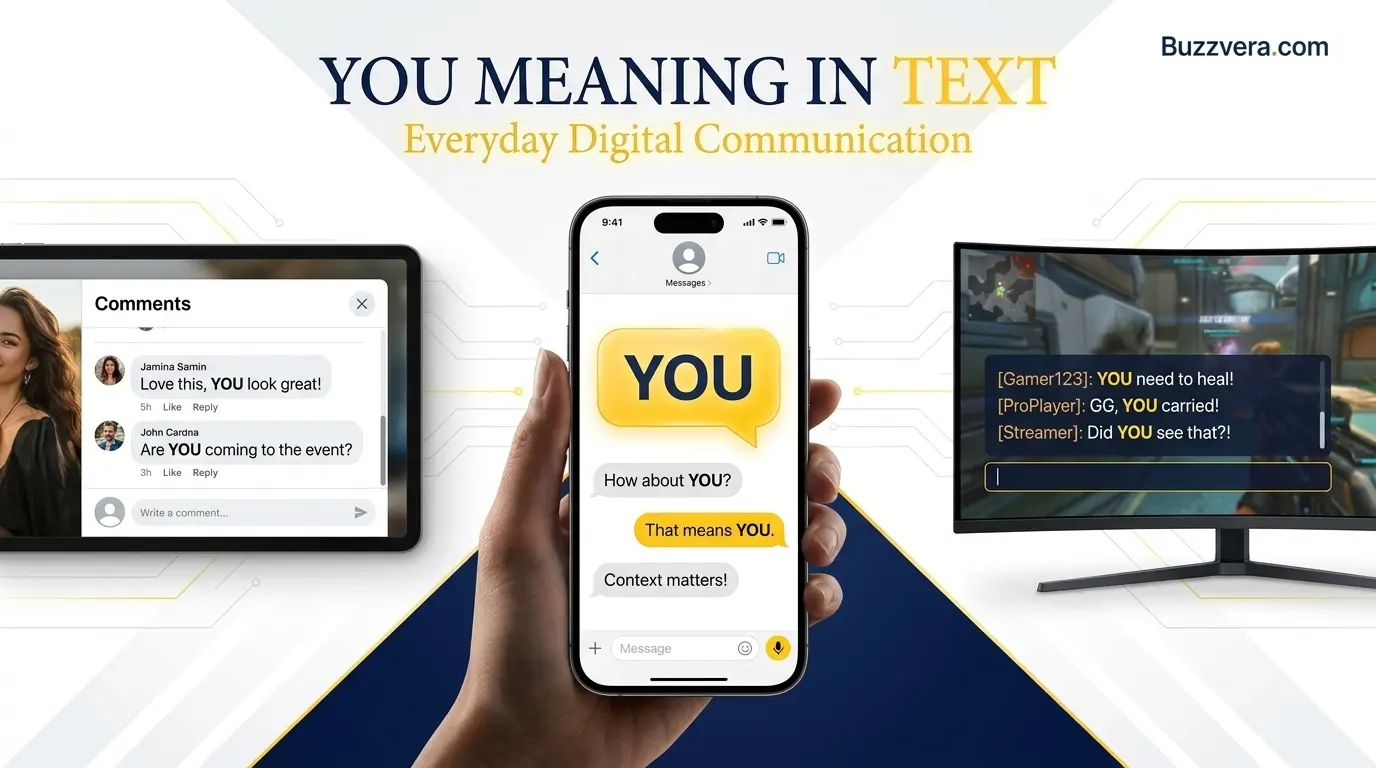
The you meaning in text changes a little based on where you use it. Let’s look at each place.
In Texting
This is where “u” lives. Friends and family use it all day.
Jake: u up? Tina: yep, can’t sleep Jake: same lol
On Social Media
On Instagram, TikTok, and X (Twitter), “u” shows up in captions and comments.
Comment: this made my day, thank u!! Reply: love u too 💛
Creators use it to feel friendly and close to fans.
In Gaming
Gamers type fast. Chat moves quickly during a match. So “u” saves time.
Player 1: u got the flag? Player 2: ya, cover me Player 1: ok behind u
In Casual Conversation Online
On forums and group chats, “u” keeps things light.
Rita: did u see the game last night? Omar: omg yes, what a finish
In Professional Settings
This is the tricky one. Most workplaces want full words. In a formal email, “u” can look careless. We will cover this in a later section.
Quick tip: Match your style to the person. If they write “u,” you can too. If they write full words, do the same.
Common Misconceptions About the You Meaning in Text
Even a simple word can cause mix-ups. Here are the most common ones.
Misconception 1: “U” always means “you.” Mostly, yes. But not always. Sometimes “U” stands for something else. In school, “U” can mean “university” or a grade. In sports, “U” can mean a school, like “U of M.” In math, “U” can mean a union of sets. Context tells you which one.
Misconception 2: “U” is rude. No. It is not rude by itself. But it can feel less caring in serious talks. If someone shares sad news, “sorry for ur loss” can feel cold. “I’m so sorry for your loss” feels kinder.
Misconception 3: Only kids use it. Not true. Adults use it all the time in quick texts.
Misconception 4: “U” and “ur” are the same. They are close but different. “U” means “you.” “Ur” means “your” or “you’re.” Mixing these up can cause confusion.
Mia: is that ur dog? Sam: yep, he’s 3.
Here “ur” means “your.”
Misconception 5: “U” is only for English. It is mostly an English trick. It works because the letter name sounds like the word. Other languages have their own tricks.
Clarification: If you are not sure what someone means, ask. A quick “what do you mean?” fixes most mix-ups.
Similar Terms and Alternatives to the You Meaning in Text
“U” has many cousins. Here are common words that work like it.
- Ur: “your” or “you’re”
- Yu: a typo or playful spelling of “you”
- Ya: a casual “you” or “yeah”
- Youu / Youuu: “you” with extra letters for feeling
- Y’all: “you all,” mostly in the U.S. South
- Yous / Youse: “you” (plural) in some regions
- Thee: an old-style “you”
- Ye: an old word for “you”
Here is a simple table to compare them:
| Term | Meaning | Tone | Example |
| U | You | Casual, quick | “love u” |
| Ur | Your / You’re | Casual | “ur so funny” |
| Ya | You / Yeah | Very casual | “see ya” |
| Youuu | You (with feeling) | Playful, warm | “I missed youuu” |
| Y’all | You all | Friendly, group | “y’all coming?” |
| You | Full word | Neutral | “I miss you” |
Which one should you pick?
Use “u” for fast, friendly chats. Use “you” when you want to sound clear and polite. Use “ya” for a warm, laid-back feel. Use “y’all” when you speak to a group.
There are also combo shortcuts built on “u”:
- ily = I love you
- ily2 = I love you too
- hru = how are you
- wru = where are you
- wyd = what are you doing
- ty / thx u = thank you
- cu / cya = see you
- idk about u = I don’t know about you
All of them rest on the same you meaning in text.
How to Respond to the You Meaning in Text
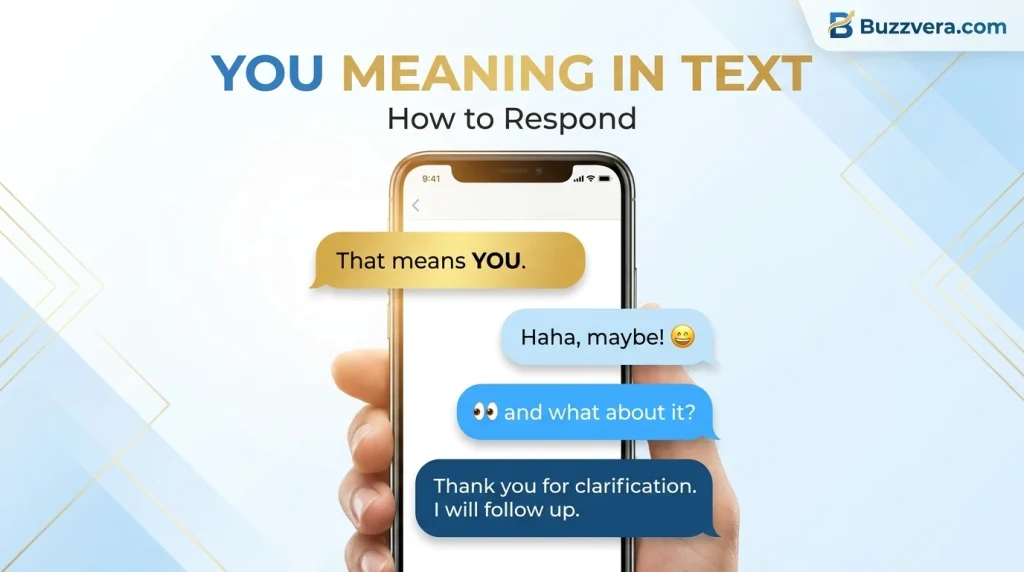
How do you answer a message with “u” in it? It depends on the person and the mood. Here are four easy styles.
Casual Replies
Keep it short and friendly.
Friend: hru? You: good! u?
Funny Replies
Add some humor.
Friend: r u alive? You: barely lol. coffee pending ☕
Friend: u coming tonight? You: wouldn’t miss it unless pizza runs out 🍕
Professional Replies
Use full words. Stay polite.
Coworker: thx u for the update! You: You’re welcome! Let me know if you need anything else.
Privacy-Conscious Replies
Sometimes the message is nosy. You can stay vague.
Stranger: where r u? You: Out and about. Why do you ask?
Stranger: what do u do? You: I’d rather chat about something else first.
Pro tips for replying:
- Mirror the tone. If they are playful, be playful.
- Do not overshare with someone you do not know.
- Ask a question back. It keeps the chat alive.
- Take a breath. If a message feels odd, you do not have to answer right away.
Regional and Cultural Differences in the You Meaning in Text
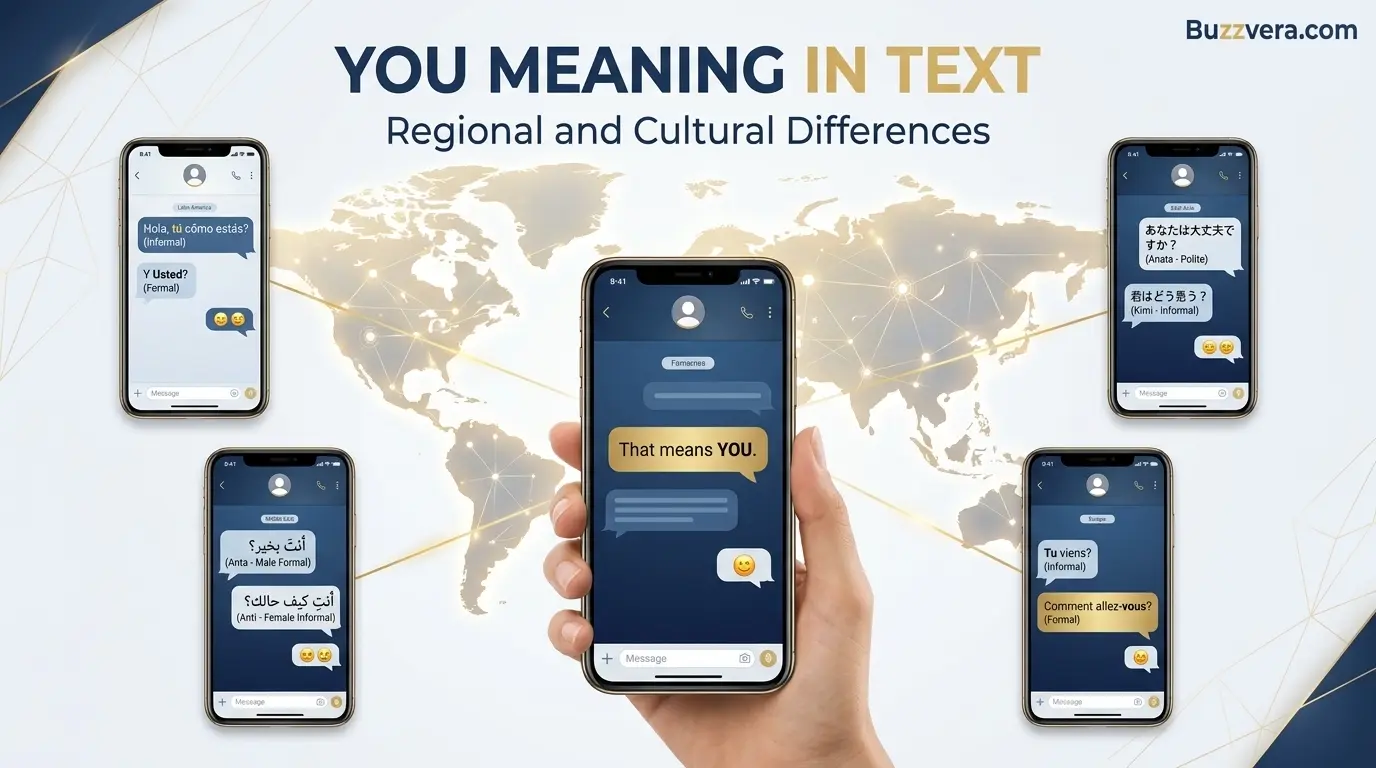
Does the you meaning in text work the same everywhere? Mostly yes in English. But there are fun twists.
In the United States: “U,” “ya,” and “y’all” are common. “Y’all” is big in the South. “You guys” is common in the North.
In the United Kingdom: People often say “ta” for thanks and “you alright?” as a hello. You may see “u alright?” in texts.
In Ireland: “Yous” is a common plural for “you.” You may see “yous coming?”
In Australia: People use “ya” often. “See ya later” is very normal.
In India, Pakistan, and South Asia: Many people text in English mixed with local languages. You might see “u kya kar rahe ho?” (what are you doing?). The English “u” blends with Hindi or Urdu words.
In Spanish-speaking places: The shortcut is different. People use “tú” or “q tal?” instead. The English “u” is not used the same way, though young people borrow it online.
In French: People shorten “tu” or use “stp” (s’il te plaît). The idea is the same, but the letters differ.
In Arabic, Chinese, and other languages: Many use their own slang. Some use numbers or sounds. For example, in Mandarin, “520” sounds like “I love you.”
Key point: The idea of shortening “you” is global. The exact letters change. If you chat with people from other countries, ask or watch how they write before you copy.
You Meaning in Text vs. Similar Terms: A Quick Comparison
Let’s compare “u” with its closest relatives. This helps you see small but real differences.
| Expression | Meaning | Formality | Best for |
| U | You | Low | Friends, quick texts |
| You | You | Medium–High | Everyone, work, school |
| Ur | Your / You’re | Low | Casual talk |
| Ya | You / Yeah | Very low | Warm, relaxed chats |
| Y’all | You all | Low–Medium | Groups |
| Yu | You (typo/playful) | Very low | Jokes, memes |
| Thou | You (old English) | Very formal/old | Poems, jokes |
Key differences:
- “U” vs. “You”: “U” is faster. “You” is clearer and more polite.
- “U” vs. “Ur”: “U” is a person. “Ur” shows ownership or “you are.”
- “U” vs. “Ya”: “Ya” feels warmer and more spoken. “U” feels typed.
- “U” vs. “Y’all”: “U” is one person. “Y’all” is many people.
Example in dialogue:
Chris: hey, u coming? Dana: yeah! r y’all leaving now? Chris: ya, see u there.
Three styles. One simple chat. Everyone understands.
You Meaning in Text on Dating Apps and Online Communities
Now let’s talk about places where tone really counts.
On Tinder, Bumble, and Hinge
Dating apps love short messages. The you meaning in text is everywhere.
Match: hey, how r u? You: good! u? Match: nice, what do u do for fun?
Many people feel “u” is relaxed and fun. But some see it as low effort. If you want to make a good first impression, use full words in your opening message. Then relax into “u” as you get comfortable.
Tips for dating apps:
- Open with “you,” not “u.” It shows care.
- Match their style. If they use “u,” you can too.
- Ask real questions. “What do you love to do on weekends?” beats “wyd?”
- Watch for red flags. If someone pushes for your number, address, or money fast, slow down.
On Twitter / X and Social Media
On X, people use “u” to save space and sound casual. You may see “f u,” which is rude. We will cover that next. You may also see “thank u” under kind posts.
In Gaming Communities
In Discord, Twitch chat, and in-game chats, “u” is normal.
Gamer 1: u wanna duo? Gamer 2: sure, add me Gamer 1: gg, thx u
Tips for gaming:
- Keep it friendly.
- Avoid tone that feels like an insult.
- Mute or report toxic players.
In Group Chats and Forums
On Reddit, WhatsApp, and Telegram, “u” is common. People will not mind it. Just keep your tone kind.
Hidden or Offensive Meanings of the You Meaning in Text
On its own, “u” is harmless. But combined with other words, it can change the feeling.
Some examples:
- “F u” or “fu” is a rude phrase. It is an insult. Avoid it with people you respect.
- “Screw u” is also rude.
- “U suck” is mean, even if you mean it as a joke.
- “Shut u” is rude.
- “Thanks, u” can sound sarcastic in the wrong tone.
Why tone matters
In person, we hear a voice. We see a face. In text, we have none of that. A short “u” can feel cold when you do not intend it.
Look at this example:
Alex: u really did that? Jordan: ??
Alex may mean, “Wow, you did that?” Jordan may hear, “You did THAT?” in a mean way. Same words. Different feelings.
How to keep it safe:
- Add an emoji or a friendly word. “u really did that?! 😄” feels warmer.
- Avoid “u” when you are upset. Full words show you are calm.
- Avoid it in serious or sad talk.
- Read your message once before sending. Ask: “Could this sound rude?”
Does “U” ever have a secret meaning?
Not really. It does not hide a coded message. But “U” in some groups can stand for “unknown,” “uncle,” or “university.” Context will tell you. If you are unsure, ask.
Is the You Meaning in Text Suitable for Professional Communication?
Short answer: usually no.
In work emails, reports, and messages to clients, use full words. “You” looks neat. “U” can look careless.
Compare:
- ❌ “Can u send the file by 5?”
- ✅ “Can you send the file by 5 PM?”
When it might be okay:
- In a quick chat with a close coworker.
- In a team messaging app where the culture is relaxed.
- When your boss uses it first.
When to avoid it:
- Job applications and resumes.
- Emails to clients or customers.
- Formal reports.
- Messages to teachers or professors.
- Messages to people you do not know well.
Professional alternatives
| Casual | Professional |
| “thx u” | “Thank you” |
| “hru?” | “How are you?” |
| “can u help?” | “Could you please help?” |
| “see u soon” | “See you soon.” |
| “u free?” | “Are you available?” |
Example in dialogue:
Manager: Can you join the call at 3? You: Yes, I can. Thank you for letting me know.
Simple. Clear. Polite.
Rule of thumb: If you would wear a suit to the situation, skip the “u.”
FAQs About the You Meaning in Text
1. What does “u” mean in text? “U” means “you.” It is a quick shortcut that sounds like the word.
2. Is it rude to use “u” in texts? No. It is fine for casual chats with friends and family. But avoid it in serious talks or formal messages.
3. What is the difference between “u” and “ur”? “U” means “you.” “Ur” means “your” or “you’re.”
4. Can I use “u” in a work email? It is best not to. Use “you” so you look clear and polite.
5. What does “hru” mean? “Hru” means “how are you.” You can answer, “good! u?”
6. Why do people use “u” instead of “you”? It is faster. It started when texts had limits and phones had no full keyboards. Today, it is also a style choice.
7. Does “u” ever mean something else? Sometimes. It can mean “university” or a school name, like “U of M.” Context shows which meaning fits.
Conclusion: Key Takeaways on the You Meaning in Text
The you meaning in text is simple. “U” means “you.” It began as a shortcut for old phones. Today, it is a friendly, casual style.
Here is what to remember:
- “U” = you. “Ur” = your or you’re.
- Use it with friends. Skip it at work.
- Tone matters. Add warmth with emojis or kind words.
- Match the other person’s style.
- Watch out for rude combos like “f u.”
- When unsure, write “you.” Full words never hurt.
Now you know how to read it, use it, and answer it. Next time a friend writes, “how r u?” you will know just what to say. Short, sweet, and smart.

Mafia Noor is an experienced content writer and author at BuzzVera.com, with 3 years of experience creating helpful and easy-to-understand content. Mafia specializes in texting slang, internet abbreviations, modern expressions, and text meanings, helping readers understand today’s digital language clearly and confidently.