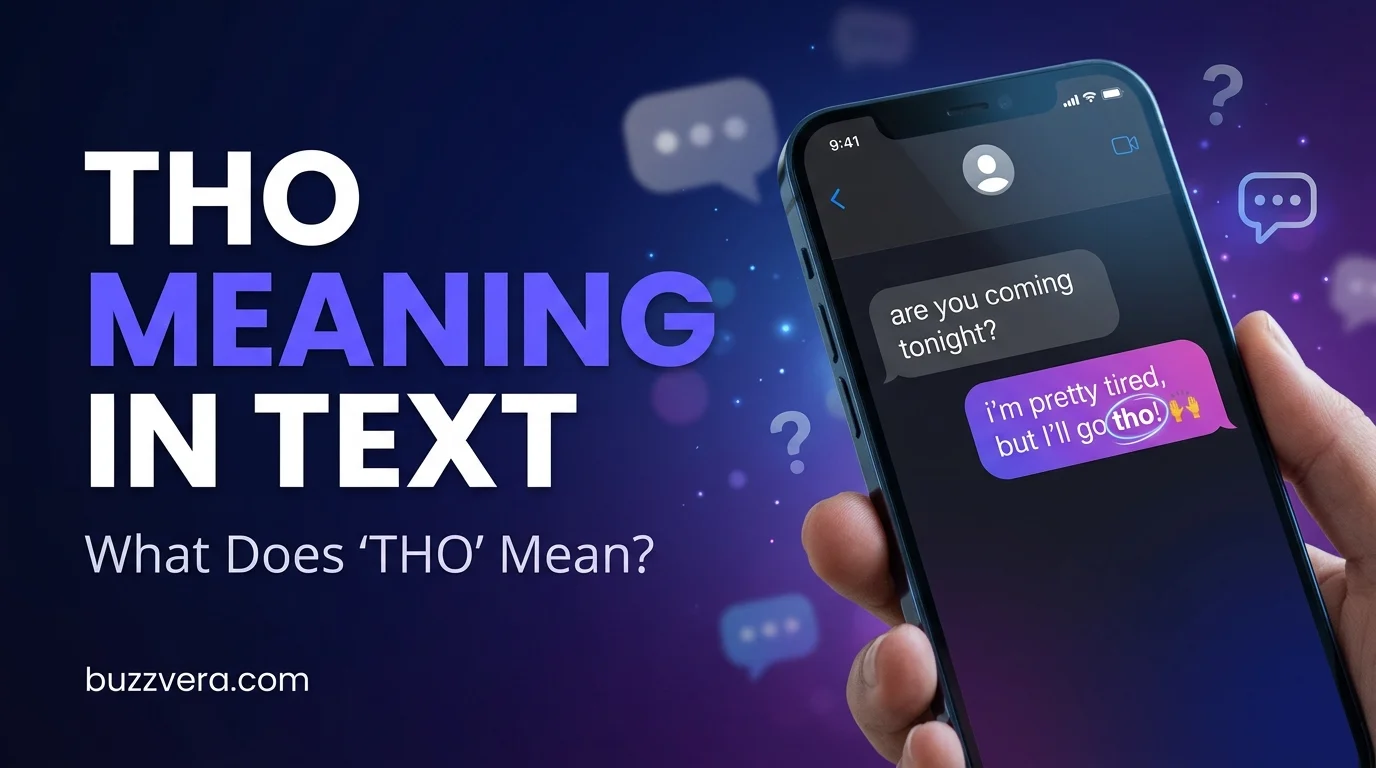
You are texting a friend. They write, “That movie was long tho.” You stop for a second. Is “tho” a code? Is it slang? Is it a typo?
Relax. “Tho” is just a short way to write “though.” That is all.
People use it every day. You will see it in texts, on TikTok, on Instagram, in game chat, and in tweets. It is quick. It is casual. It adds a small twist to a sentence.
For example: “I like pizza. I’m full tho.” The word “tho” tells you something changed. The second part pushes back on the first.
Why does this matter? Because tone matters in text. One small word can make a message sound soft, funny, sad, or rude. When you know the tho meaning in text, you read messages better. You also write better ones.
This guide keeps it simple. You will learn what it means, where it came from, and how to reply. Let’s start.
What Is the Tho Meaning in Text? Definition and Meaning
“Tho” means “though.” It is a short spelling. People drop the “ugh” and keep the “tho.”
The word “though” has a few jobs. In texting, “tho” does the same jobs. Let’s look at each one.
Job 1: It Means “But” or “However”
You use “tho” to show a twist. The second idea goes against the first one.
Example:
Mia: Did you like the new cafe? Zoe: The coffee was great. Super pricey tho.
Here, “tho” means “but.” The coffee was good. The price was bad.
Job 2: It Means “Even Though” or “Although”
You can put “tho” at the start of a sentence. It then works like “although.”
Example:
Sam: Tho it was raining, we still went to the park.
This use is less common in texts. But you will still see it.
Job 3: It Softens a Message
This is the most common use. People add “tho” at the end of a line. It makes the line feel lighter.
Example:
Leo: You’re late again. Ava: I know. I’m on my way tho!
“Tho” here says, “I get it, but look at the good side.”
Job 4: It Adds a Small Surprise
Sometimes “tho” just adds flavor. It shows you did not expect something.
Example:
Dan: I tried sushi for the first time. Kim: And? Dan: I loved it tho.
Dan did not think he would like it. The “tho” shows that surprise.
Quick Summary
- Full word: though
- Part of speech: a conjunction or an adverb
- Tone: casual and friendly
- Where it goes: most often at the end of a sentence
- Meaning: but, however, even so
Now you know the basics. Next, let’s see where this word came from.
The History Behind Tho Meaning in Text

Here is a fun fact. “Tho” is older than texting. It is not a new slang word. It is an old spelling shortcut.
The Spelling Reform Era
In the late 1800s and early 1900s, some people wanted to make English spelling simple. They thought English had too many silent letters. Why write “though” when “tho” sounds the same?
Groups pushed for simpler spellings. “Tho” was on their lists. So were “thru” for “through” and “altho” for “although.” Some newspapers even used these short forms in print for years.
The big change never happened. Most people kept the long spellings. But “tho” never fully died. It stayed alive in notes, letters, and quick writing.
The Texting Boom
Then came cell phones. Early text messages had tight limits. You had a small number of characters. Typing on number keys was slow too. People cut words short to save time and space.
“Tho” was a perfect fit. It saved three letters. It looked clear. It was easy to read.
The Social Media Boom
Next came instant messaging, forums, and Twitter. Twitter once had a strict character limit. Short words helped a lot. “Tho” spread fast.
Later, Instagram captions and TikTok comments made it even more common. Today, many people write “tho” without thinking. It feels natural.
Where It Stands Today
Today, “tho” is normal casual English. You will find it in:
- Text messages
- Social media posts
- Comment sections
- Video game chat
- Memes and captions
It has lost its “reform” feel. Now it just feels friendly and relaxed.
How to Use Tho Meaning in Text in Different Contexts
The word “tho” shows up in many places. The meaning stays the same. But the vibe can change. Let’s walk through the main settings.
In Texting
Texting is where “tho” lives. Friends and family use it all the time.
Jay: Are you coming tonight? Rina: I’m tired tho. Maybe.
Mom: Did you eat? Ben: Yes. Not much tho.
On Social Media
On Instagram, X (Twitter), and TikTok, “tho” often sits at the end of a caption or comment.
Caption: Monday again. Coffee helps tho.
Comment: This song is old but it still slaps tho.
In comments, “tho” often adds a bit of humor or opinion.
In Gaming
Gamers type fast. They want short words. “Tho” fits right in.
Player 1: Nice shot! Player 2: Lucky tho.
Player 1: That boss was hard. Player 2: Fun tho.
In Casual Talk With Friends
Friends use “tho” to joke, tease, or share opinions.
Chloe: Your haircut looks different. Max: Good different, I hope? Chloe: Good tho. Really good.
In Group Chats
In group chats, “tho” helps keep the mood light.
Alex: We could meet at 6. Priya: 6 is early tho. Alex: Fine, 7?
Key Takeaway
The meaning of tho never changes. The tone does. Pay attention to the words around it. They tell you if the speaker is happy, sad, or joking.
Common Misconceptions About Tho Meaning in Text
Short words cause confusion. “Tho” is no different. Let’s clear up the common mix-ups.
Misconception 1: “Tho” Is a Typo
It is not a typo. It is a real, accepted short form of “though.” People use it on purpose. Some dictionaries even list it as a variant spelling.
Misconception 2: “Tho” Means “Thou”
“Thou” is an old English word for “you.” You see it in old poems and in the Bible. It has nothing to do with “tho” in texts.
Misconception 3: “Tho” Is an Acronym
Many texting terms are acronyms, like LOL or BRB. But “tho” is not an acronym. It is a spelling shortcut. No hidden words stand behind each letter.
Misconception 4: “Tho” Means “Thought”
Some people read “tho” as “thought.” That is wrong. If someone wants to say “thought,” they write “thought” or “thot” or “tht.” Context almost always clears it up.
Misconception 5: “Tho” Is Rude
On its own, “tho” is not rude. It is neutral and casual. It can feel sharp only if the message around it is sharp.
Example:
“Nice job tho.” (Kind, maybe a little teasing) “Whatever tho.” (Could feel cold)
Misconception 6: “Tho” Is Only for Young People
Many adults use it too. Parents, coworkers, and older friends type “tho” in casual chats. It is not limited by age.
A Quick Clarification
If you are ever unsure, ask. A short “What do you mean?” works fine. Texting loses tone. A quick check keeps things friendly.
Similar Terms and Alternatives to Tho Meaning in Text
Many words do the same job as “tho.” Some are formal. Some are casual. Let’s compare them.
Words That Mean the Same Thing
- Though: the full, correct spelling
- Although: a longer, more formal word
- But: short and direct
- However: formal and polished
- Still: shows contrast in a soft way
- Anyway: shifts the topic or the mood
- Even so: a calm, steady contrast
- Altho: another short spelling, less common
Texting Phrases With a Similar Feel
- ngl (not gonna lie): adds honesty
- tbh (to be honest): adds an honest opinion
- idk tho: shows doubt
- lowkey: adds a quiet, soft tone
Comparison Table
| Term | Meaning | Tone | Best Used In |
| Tho | though, but | casual, light | texts, social media |
| Though | but, however | neutral | writing, speech |
| Although | even though | formal | emails, essays |
| But | contrast | direct | anywhere |
| However | contrast | formal | work emails |
| Still | even so | calm | casual and formal |
| Altho | although | casual | texts |
Example Sentences
- Tho: “It’s cold tho.”
- Though: “It’s cold, though.”
- But: “It’s cold, but I like it.”
- However: “It’s cold; however, I like it.”
All four say nearly the same thing. Only the style changes.
How to Respond to Tho Meaning in Text Messages
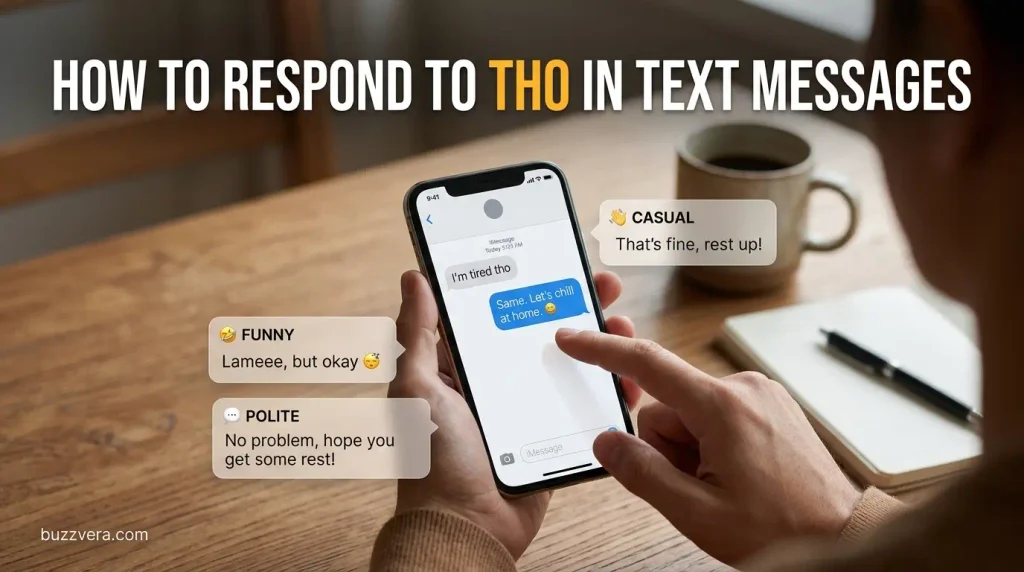
Got a message with “tho”? You do not need a special reply. Just answer the idea in the message. But your tone can change how it lands.
Here are four styles.
1. Casual Replies
Keep it easy and friendly.
Friend: I’m tired tho. You: Same. Let’s chill at home.
Friend: The pizza was cold tho. You: Ugh, that’s the worst.
2. Funny Replies
Add a joke. Keep it kind.
Friend: I woke up early tho. You: Who are you and what did you do with my friend?
Friend: I cooked dinner tho. You: Should I call the fire department?
3. Professional Replies
At work, keep it clear and polite. You can reply to a casual “tho” with a calm answer.
Coworker: The plan works, tho the timing is tight. You: Agreed. I’ll check if we can move the deadline.
4. Privacy-Conscious Replies
Sometimes “tho” comes with a personal question. You may not want to share.
Person: You’re busy tonight tho? You: I have plans. Let’s catch up another time.
That reply is polite. It gives no extra details.
Tips for Better Replies
- Read the whole message first. The “tho” only makes sense with the rest.
- Match the mood. If they are joking, joke back.
- Do not overthink it. “Tho” is a small word.
- Ask if you are lost. A quick question beats a wrong guess.
Regional and Cultural Differences in Tho Meaning in Text
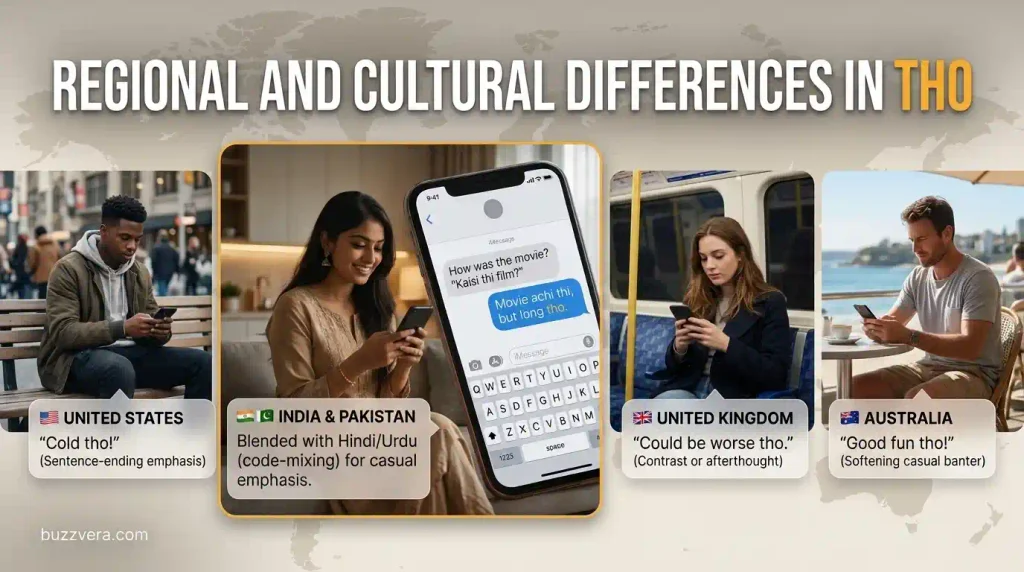
Language changes from place to place. “Tho” does too. But the core idea stays the same.
In the United States
“Tho” is very common in American texting. It feels natural at the end of a line. Many young Americans use it every day. It also shows up a lot in online slang and meme culture.
In the United Kingdom, Canada, and Australia
People in these places also use “tho.” But some write “though” more often, even in texts. Both versions are understood. You will not confuse anyone.
In India and Pakistan
English is widely used in texting in South Asia. Many people mix English with local languages. A sentence might look like this:
“Movie achi thi, but long tho.”
Here, “tho” works the same way. It means “though.” Local words like “lekin” or “magar” (both mean “but” in Urdu and Hindi) may sit nearby. People blend them freely in chats.
In Non-English Languages
“Tho” is an English word. Other languages have their own short forms for “though.” For example:
- Spanish: “aunque” (although), sometimes shortened in texts
- French: “mais” (but), “quand même” (even so)
- German: “trotzdem” (still)
These do not use “tho.” But the idea of a short contrast word exists everywhere.
Dialect Notes
In some English dialects, speakers add “though” at the end of a sentence in speech. Texting simply copies that rhythm. Writing “tho” at the end of a line mirrors how many people talk.
Key Takeaway
“Tho” is mostly an English texting habit. It is easy to learn and easy to spot. If you chat with people from other countries, you will likely see it used the same way.
Tho vs. Similar Terms: A Clear Comparison
Many small words feel alike. Let’s look at how “tho” differs from its close cousins.
Tho vs. Though
- Same meaning.
- “Tho” is casual. “Though” is standard.
- Use “though” in essays and formal emails. Use “tho” in texts.
Tho vs. But
- “But” is a hard stop. It cuts the first idea short.
- “Tho” is softer. It adds a twist but keeps the first part alive.
Example:
“I like him, but he’s late.” (Feels firm) “I like him. He’s late tho.” (Feels lighter)
Tho vs. Tbh
- “Tbh” shares your honest view.
- “Tho” shows contrast.
- They can team up: “Tbh it was fun. Long tho.”
Tho vs. Ngl
- “Ngl” means “not gonna lie.” It signals honesty or a bold opinion.
- “Tho” signals a twist.
Tho vs. Still
- “Still” says “even so.”
- “Tho” says “but here’s a twist.”
Comparison Table
| Term | Core Idea | Strength of Contrast | Common Spot in Sentence |
| Tho | though | soft | end |
| But | contrast | strong | middle |
| Tbh | honest view | none | start or end |
| Ngl | honest or bold view | none | start |
| Still | even so | medium | middle or end |
| Anyway | move on | low | start |
What This Shows
“Tho” is the gentlest of the group. It lets you share a twist without a hard stop. That is why people love it in friendly chats.
Tho Meaning in Text on Online Communities and Dating Apps
Online spaces move fast. People write short. “Tho” fits right in.
On Tinder and Other Dating Apps
On dating apps, tone is everything. “Tho” can make a message sound playful or flirty.
Match: I’m not a big dancer tho. You: Good news. I’m not either. We’ll be bad together.
It can also soften a bold line:
You: I’m not good at small talk tho. Don’t judge me. Match: No judging. Tell me about your dog.
On Twitter (X)
On X, “tho” often shows up in short, witty posts.
“Mondays are rough. Mondays with coffee are okay tho.”
It adds a punch to a joke or a take.
On Instagram and TikTok
Captions and comments use “tho” to add personality.
“Got up at 5 a.m. Worth it tho.”
In Gaming Communities
Gamers use “tho” in voice-to-text and quick chats.
“We lost tho GG.”
It softens a loss. It also shows good sportsmanship.
On Reddit and Forums
People use “tho” in comment threads to push back gently.
“Good point tho I disagree with the second part.”
Tips for Responding Online
- Keep it light. “Tho” often signals a friendly tone.
- Match the energy. If they are playful, be playful.
- Do not read too much into it. One word rarely hides a secret meaning.
- Stay safe. On dating apps, never share private details too early. A kind “Let’s chat here first” is enough.
Key Takeaway
Online, “tho” is a tone tool. It helps people sound relaxed and real, even in a short message.
Hidden or Offensive Meanings of Tho in Text
Good news first. “Tho” has no hidden offensive meaning. It is a harmless short form of “though.”
But a few things are worth knowing.
Confusion With Other Words
Some words look close to “tho.” They can cause mix-ups.
- “Thot” is a slang word that is insulting when used about a person. It is not the same as “tho.” If you see “thot,” that is a different message with a rude meaning. Always check the spelling.
- “Tho” has one “t” and one “h,” followed by “o.” No extra letters.
If someone uses “thot” and you think it says “tho,” you could miss an insult. Read carefully.
Tone Can Turn Sharp
The word itself is mild. But tone can change meaning.
“You’re fine tho.” (Kind) “Sure, whatever tho.” (Dismissive) “Cool tho.” (Could be sincere or sarcastic)
A short reply with “tho” and a period can feel cold. For example, “Fine tho.” might sound annoyed.
Sarcasm
Sarcasm is common online. A line like “Great job tho” could be real praise. Or it could be a dig. Look at the whole chat. Look at emojis. Look at how the person usually writes.
Why Context Matters
- Words: What else did they say?
- Punctuation: A period can feel harsh. An exclamation mark feels friendly.
- Emojis: A smile or laugh usually signals kindness.
- Relationship: A close friend and a stranger may use the same word in different ways.
What to Do If You Feel Hurt
If a “tho” message stings, ask. Try:
“Did you mean that nicely? Just checking.”
That one line can stop a lot of drama.
Key Takeaway
The word is safe. The tone is what counts. Read the whole message before you decide how it feels.
Is Tho Meaning in Text Suitable for Professional Communication?
Short answer: usually no.
“Tho” is casual. It works well with friends. It does not fit most formal settings.
Where “Tho” Does Not Belong
- Job applications and cover letters
- Emails to clients, bosses, or teachers
- Reports, essays, and formal documents
- Official letters
In these places, write “though” in full. It looks polished and careful.
Where It Might Be Okay
- A relaxed team chat on Slack or Teams with close coworkers
- A quick text to a friendly colleague
Even then, watch your company culture. Some workplaces are relaxed. Others are strict. When unsure, play it safe.
Professional Alternatives
| Casual | Professional |
| “It’s good tho.” | “It’s good, though it needs one change.” |
| “Busy tho.” | “I’m busy, but I can help.” |
| “Not bad tho.” | “It’s not bad, though there is room to improve.” |
| “Fun tho.” | “It was enjoyable, however it ran long.” |
Examples at Work
Too casual:
“The report is done tho it needs a review.”
Better:
“The report is done, though it needs a review.”
Even better (more formal):
“The report is complete. However, it still needs a review.”
A Simple Rule
Ask yourself one question: Would I say this in a meeting with my boss? If the answer is no, skip “tho.”
Key Takeaway
“Tho” is great for friends. For work, choose “though,” “but,” or “however.” Your message will look sharp and respectful.
Tho Meaning in Text: FAQs
1. What does “tho” mean in text?
“Tho” means “though.” It is a short, casual spelling. It shows a twist or contrast, like “but” or “however.”
2. Is “tho” a real word?
Yes. It is an accepted variant spelling of “though.” It is informal. Many people use it in texts and on social media. For formal writing, use “though.”
3. Is “tho” slang?
It is informal, but not exactly slang. Slang means new or unusual words. “Tho” is just a short spelling of an old word. Still, it lives mostly in casual chats.
4. Can I use “tho” at the start of a sentence?
You can. For example, “Tho it was late, we stayed.” But most people put “tho” at the end of a sentence. That sounds more natural in texts.
5. Is “tho” rude?
No. The word is neutral and friendly. It can feel sharp only if the message around it is harsh or sarcastic.
6. Is “tho” the same as “thot”?
No. They are very different. “Tho” is a short form of “though.” “Thot” is a slang term that is often used as an insult. Always check the spelling.
7. Should I use “tho” in emails?
For friends, maybe. For work, school, or business, no. Write “though,” “but,” or “however” instead.
Final Thoughts on Tho Meaning in Text
Let’s wrap it up with the key points.
- “Tho” means “though.” It is a short, casual spelling.
- It shows a twist, like “but” or “however,” in a soft way.
- It is old. Spelling reformers liked it long before phones did.
- It is everywhere in texts, social media, and gaming chat.
- It is not rude on its own. Tone and context decide how it feels.
- Do not confuse it with “thot,” which has a very different meaning.
- Skip it at work. Use “though,” “but,” or “however” in formal writing.
So the next time a friend writes, “I’m tired tho,” you will know the answer. They are tired, but something else is true too. Now you can reply with confidence, a smile, or a joke.
Small words carry big feelings. Knowing the tho meaning in text helps you read people better and write like a pro.

Mafia Noor is an experienced content writer and author at BuzzVera.com, with 3 years of experience creating helpful and easy-to-understand content. Mafia specializes in texting slang, internet abbreviations, modern expressions, and text meanings, helping readers understand today’s digital language clearly and confidently.