Ever got a text that just said “DWAI”? You stare at it. Is it good? Is it rude? Is it a typo?
Relax. DWAI means “Don’t Worry About It.” It is a short, kind way to say, “It’s fine.”
People use it every day. You will see it in texts, DMs, group chats, and even game lobbies. Someone says sorry for being late. You type “dwai.” Done. No long speech needed.
But there is a catch. The same four letters can mean something very different in a legal setting. Tone also changes everything. A warm “dwai” feels sweet. A cold “DWAI.” can feel sharp.
That is why the DWAI meaning in text matters. When you know what it says, you reply with the right mood. You avoid mix-ups. And you sound natural.
Let’s break it down in simple words.
What Is the DWAI Meaning in Text? (Definition & Meaning)
DWAI stands for “Don’t Worry About It.”
It is an acronym. Each letter stands for one word:
- D = Don’t
- W = Worry
- A = About
- I = It
People use it to calm someone down. They also use it to say a small problem is no big deal.
Think of it as a verbal pat on the back. It says, “I’m not mad. Let it go.”
What Does DWAI Really Say?
DWAI does three jobs:
- It reassures. It tells the other person they are okay.
- It dismisses. It says the issue is too small to care about.
- It ends talk. It closes a topic fast.
Real-Life Examples
Example 1: Running late
Mia: Sorry! Stuck in traffic. I’ll be 10 minutes late. Jake: dwai, I just got here too.
Example 2: A small mistake
Sam: I forgot to bring your book. My bad. Lena: DWAI. Bring it Monday.
Example 3: Splitting a bill
Omar: I owe you $5 for lunch. Ben: dwai, it’s on me.
Example 4: Showing care
Zoe: I think I messed up the project. Chris: dwai. We’ll fix it together.
Notice how short each reply is. That is the whole point. DWAI saves time and keeps things light.
Case and Punctuation
You can write it three ways:
- dwai (lowercase) feels soft and casual.
- DWAI (caps) feels firm or loud.
- DWAI. (with a period) can feel cold or even annoyed.
The letters stay the same. The feeling changes.
Background & History of DWAI

DWAI is a child of the early texting age.
Back in the days of old flip phones, each text had a tight limit. You had to say more with less. So people made shortcuts. “BRB.” “LOL.” “IDK.” “TTYL.” Each one saved a few taps.
“Don’t worry about it” is a very common phrase. People say it all the time out loud. So it was a perfect fit for a short form. Four words became four letters.
No one knows who first typed DWAI. Most slang has no clear author. It just spreads. One person uses it. Their friends copy it. Then it moves on.
How It Changed Over Time
Early on, abbreviations were about saving space. Today, space is not the issue. Phones have no real limit.
So why do people still use DWAI? Because of speed and tone.
- Typing four letters is faster than four words.
- It feels relaxed, like a friend talking.
- It keeps a chat flowing without a heavy mood.
Where It Is Used Today
You will find DWAI in:
- Texting between friends and family
- Social media comments and DMs
- Gaming chats when a teammate makes a mistake
- Work chats among close coworkers (more on this later)
It is not as famous as “LOL” or “OMG.” It is more of a quiet, steady slang. Many people know it. Fewer people use it. That is why some folks get confused when they see it.
A Note on the Other DWAI
There is another DWAI. In New York, it is a legal term. It stands for Driving While Ability Impaired. It is a driving charge, and it is less serious than a DWI.
This is old, formal language. It was around long before text slang. Today the two meanings sit side by side. We will cover how to tell them apart below.
DWAI Meaning in Text Across Different Contexts
The meaning stays the same. The feel changes with the place. Let’s look at each one.
In Texting
This is the home of DWAI. It shows up when someone says sorry, asks for help, or feels bad.
Ava: Sorry I didn’t text back yesterday. Long day. Noah: dwai! Hope you rested.
On Social Media
On Instagram, TikTok, or X, people use DWAI in comments and DMs. It is often a gentle reply to an apology.
Fan: Sorry to bother you, I know you’re busy! Creator: dwai, thanks for the message 💛
In Gaming
Gamers use quick words. A match moves fast. DWAI is perfect.
Player 1: oops I died again Player 2: dwai, we still got this Player 1: ok let’s go
Here it keeps the team calm. It stops blame before it starts.
In Casual Talk With Friends
Friends use DWAI to drop a topic.
Tara: I might not make it to the party. Liam: dwai, we’ll catch up later.
In Group Chats
In a group chat, DWAI keeps the peace.
Eli: I forgot to bring the snacks 😬 Priya: dwai, I’ve got extras. Dan: dwai, pizza is on the way anyway.
When It Means “Stop Asking”
Sometimes DWAI is a polite wall. It means, “Don’t dig into this.”
Kate: You look upset. What’s wrong? Ben: DWAI.
Here the tone is flat. Ben is not reassuring Kate. He is closing the door. Watch for this. It is a key part of the DWAI meaning in text.
Common Misconceptions & Clarifications
A short word can cause big mix-ups. Here are the most common ones.
Misconception 1: “DWAI Is Always Nice”
Not true. Tone is everything.
- Warm DWAI: “dwai, happy to help!”
- Cold DWAI: “DWAI.” (with no emoji, after a long fight)
If someone says it after a hard talk, they may be hurt. They may just want the chat to end. Read the whole mood, not just the word.
Misconception 2: “DWAI Means the Problem Is Gone”
Not always. Saying “don’t worry about it” does not fix a problem. It only says the person will not make a fuss. Sometimes a real issue still needs a talk.
Misconception 3: “DWAI Is the Same as DWI”
No. These are different.
- DWAI (in text slang) = Don’t Worry About It
- DWI (in law, and sometimes in text) = Driving While Intoxicated, or in slang, “Deal With It”
One letter changes the whole thing. A reply of “DWI” can sound harsh. A reply of “DWAI” sounds kind.
Misconception 4: “It Only Has One Meaning”
DWAI has a second, legal meaning: Driving While Ability Impaired. In New York, this is a driving charge. It is lower than a DWI charge.
You will mostly see this meaning in news, legal papers, and serious talk.
Example of the legal meaning:
Rob: Did you hear about Mike? Jen: Yeah, he got a DWAI last weekend.
Here, no one is saying “don’t worry.” They are talking about a traffic charge.
How to Tell Which One It Is
Ask yourself:
- Is someone saying sorry or feeling bad? It likely means “Don’t Worry About It.”
- Is the talk about driving, police, or court? It likely means “Driving While Ability Impaired.”
Context solves almost every case.
Misconception 5: “It Is Rude”
DWAI is not rude by itself. It becomes rude only if the tone is cold or if you use it to brush off a real feeling. If a friend shares a big worry, “dwai” can feel like you don’t care. Pick a longer, kinder reply in those moments.
Similar Terms & Alternatives to DWAI
DWAI has many cousins. Some mean the same thing. Some are close but not exact.
Words That Mean About the Same
- NP = No Problem
- NBD = No Big Deal
- IDC = I Don’t Care (stronger, can sound rude)
- NVM = Never Mind
- ITS FINE = It’s fine (can be warm or sarcastic)
- ALL GOOD = Everything is okay
- NW = No Worries
Comparison Table
| Term | Full Form | Feel | Best Use |
| DWAI | Don’t Worry About It | Calm, kind | Replying to an apology |
| NP | No Problem | Friendly, quick | Small favors |
| NBD | No Big Deal | Easygoing | Minor mistakes |
| NW | No Worries | Warm, relaxed | Casual chats |
| NVM | Never Mind | Neutral, can feel closed | Dropping a topic |
| IDC | I Don’t Care | Cold, blunt | Rarely a good choice |
Longer Phrases People Use Instead
- “It’s okay.”
- “Don’t sweat it.”
- “Forget about it.”
- “No stress.”
- “You’re good.”
Which One Should You Pick?
- Want to sound warm? Use “no worries” or “you’re good.”
- Want to sound quick? Use “np” or “dwai.”
- Want to sound chill? Use “nbd.”
- Want to avoid hurt feelings? Use full words, not slang.
DWAI sits in the middle. It is gentle, but it is also short. That makes it a great everyday pick.
How to Respond to DWAI
So someone sent you “dwai.” What now? Your reply depends on the mood. Here are four styles.
1. The Casual Reply
Keep it light and short.
- “Thanks! 🙏”
- “Appreciate it!”
- “Cool, thanks!”
Example:
Nina: Sorry I’m late! You: dwai! Nina: Thanks, you’re the best.
2. The Funny Reply
If the mood is playful, add a joke.
- “Too late, I’m already worrying 😂”
- “Okay, I’ll worry about something else instead.”
- “Deal. I’ll save my worry for Monday.”
Example:
Friend: dwai, it’s just a scratch on the car. You: Ha! Okay, I’ll only worry a little 😅
3. The Professional Reply
At work, keep it clear and polite.
- “Thank you, I appreciate that.”
- “Thanks for understanding.”
- “Got it. I’ll follow up shortly.”
Example:
Coworker: DWAI, we can move the meeting. You: Thank you. I’ll send a new time today.
4. The Privacy-Conscious Reply
Sometimes DWAI is a quiet wall. If you want to know more but feel the person wants space, be gentle.
- “Okay. I’m here if you want to talk.”
- “No pressure. Just checking in.”
- “Got it. Reach out anytime.”
Example:
Friend: DWAI. You: Okay. I’m here if you ever want to talk.
This works well. You respect their space. You also leave the door open.
Quick Tips
- Match the tone. Warm gets warm.
- Do not argue. If they said “dwai,” take the kindness and move on.
- Check in later if their tone felt off.
Regional & Cultural Differences in DWAI Meaning in Text
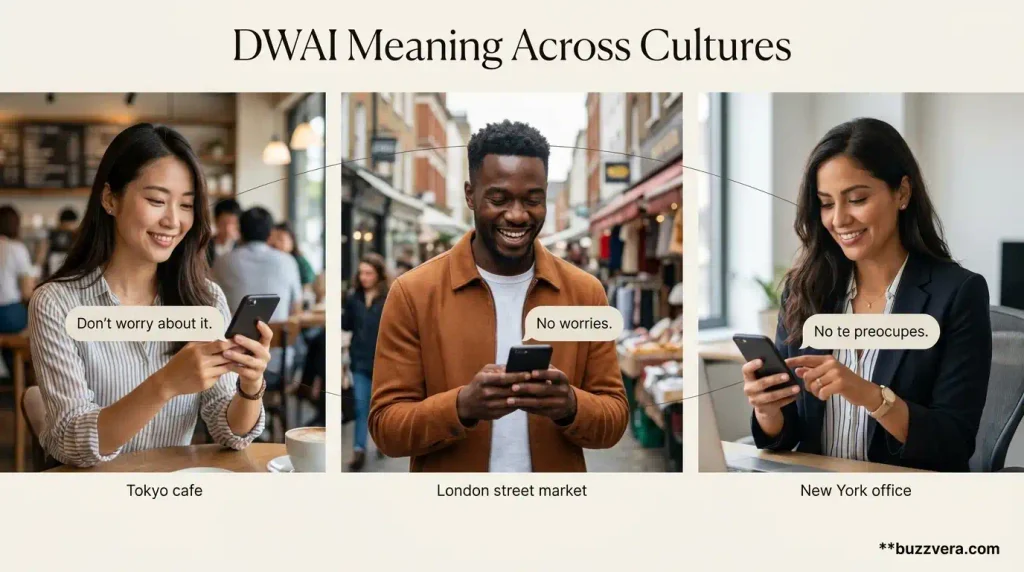
DWAI is mostly an English slang term. It follows the English phrase “don’t worry about it,” so it travels where English texting travels.
In English-Speaking Countries
You will see it in the US, UK, Canada, and Australia. The meaning is the same everywhere. But the style shifts a little.
- US: People say “don’t worry about it” and “no worries.”
- UK: Many say “no worries,” “not to worry,” or “you’re alright.”
- Australia: “No worries” is a classic, so people may pick it over DWAI.
In Other Languages
Most languages do not use DWAI. They have their own ways to say it.
- Spanish: “No te preocupes” (often shortened in chat)
- French: “T’inquiète” or “pas de souci”
- German: “Kein Problem”
- Hindi/Urdu speakers often mix English and local words: “Don’t worry yaar.”
People who text in more than one language may still type DWAI. They mix it in, just like they mix in other English slang.
Legal Meaning by Region
The legal DWAI is tied to New York in the US. Other places use other names, like DUI or DWI. So if you are outside that area, you may never meet the legal meaning. That is why many people only know the text one.
Cultural Tone
In some cultures, brushing off an apology quickly can feel kind. In others, it can feel too casual. Some people expect a longer, more formal reply. So if you text across cultures, add a friendly note. A smiley or “thank you” goes a long way.
DWAI vs. Similar Expressions
How is DWAI different from its cousins? Let’s compare side by side.
The Big Comparison
| Expression | Meaning | Tone | Risk of Misread |
| DWAI | Don’t Worry About It | Calm, caring | Low to medium |
| DWI | Deal With It (slang) or Driving While Intoxicated | Harsh or legal | High |
| NP | No Problem | Friendly | Low |
| NBD | No Big Deal | Relaxed | Low |
| NVM | Never Mind | Neutral or closed | Medium |
| IDC | I Don’t Care | Cold | High |
| IDGAF | I Don’t Give A (Bad Word) | Very rude | Very high |
Key Differences
DWAI vs. NP “NP” answers a favor. “DWAI” answers a worry or an apology. They overlap, but not always.
DWAI vs. NVM “NVM” often says, “Forget I asked.” It can feel like the person gave up. “DWAI” says, “You’re fine.”
DWAI vs. IDC These are far apart. “IDC” says you don’t care at all. “DWAI” says the other person should not stress. One is cold. One is kind.
DWAI vs. DWI Watch out. They look alike. But “DWI” can sound mean or point to a legal charge. Always double check before you send.
A Quick Example
Alex: I broke your mug. I’m so sorry.
- “dwai” = “It’s okay, I’m not upset.”
- “nvm” = “Forget it.” (could feel cold)
- “idc” = “I don’t care.” (feels harsh)
Same moment. Three very different feelings.
DWAI in Online Communities & Dating Apps
Online spaces move fast. DWAI fits right in.
On Tinder and Other Dating Apps
On dating apps, people text in short bursts. DWAI can show up when someone feels shy or sorry.
Match: Sorry for the slow reply, I’m bad at texting 😅 You: dwai! No rush.
Here it makes the other person feel at ease. That is a great thing in early chats.
A caution: On dating apps, tone is harder to read. A flat “DWAI.” from a match can feel cold. If you get one, look at the rest of the chat. Are they warm? Do they ask questions? That tells you more than the word does.
On X (Twitter) and Reddit
On public feeds, DWAI shows up in replies. People use it to calm a heated thread or to be kind.
User A: Sorry, I posted the wrong link! User B: dwai, fixed it for you.
In Gaming Communities
On Discord, Twitch, and in-game chat, DWAI keeps teams happy.
Teammate: my bad, wrong lane You: dwai, next round
It helps a team stay calm. Gamers tend to like short replies, so DWAI is a good fit.
Tips for Replying Online
- Read the room. Is it a joke, a fight, or a flirt?
- Add a friendly sign. A smiley can soften a short reply.
- Do not use it to dodge real talk. If a match shares something deep, give a full reply.
- Stay safe. If someone uses “DWAI” to push you past a red flag, trust your gut. A real “don’t worry” never means you must ignore your own comfort.
Hidden or Offensive Meanings of DWAI
Good news: DWAI has no secret rude meaning in text slang. It is a gentle phrase at its core.
But there are a few things to watch.
The Legal Meaning
As we saw, DWAI also means Driving While Ability Impaired. That is a serious topic. If you joke about it, people may not laugh. Be careful in sensitive chats.
When Tone Turns It Sour
DWAI can feel offensive when it is used to:
- Brush off a real concern. “DWAI” in answer to “I’m really hurt” can sting.
- Silence someone. It can feel like “stop talking.”
- Show anger in disguise. A short “DWAI.” after a fight may mean “I’m mad, but I won’t say it.”
Why Tone and Context Matter
Text has no face and no voice. You cannot hear a smile. You cannot see a shrug. So tiny things carry big weight:
- A period can feel cold.
- All caps can feel loud.
- An emoji can feel warm.
- Timing matters. A fast reply may feel curt. A slow one may feel upset.
Example:
Mia: I forgot your birthday. I feel awful. Jess: dwai 😊
versus
Jess: DWAI.
Same word. Two moods.
How to Be Safe
- If you are unsure, ask: “Are you okay?”
- If you want to be kind, add a few words: “dwai, really, it’s okay!”
- If someone sends a cold DWAI, don’t assume. Check in gently.
Is DWAI Suitable for Professional Communication?
Short answer: mostly no, but it depends.
When It Might Be Okay
- In a quick chat with a close coworker you know well
- In a casual team channel where slang is normal
- In a text to a friendly teammate
Example:
Teammate: Sorry, I’m a minute late to the call. You: dwai, we just started.
When to Avoid It
- Emails to clients or bosses
- Formal reports and official notes
- First messages with new contacts
- Anything legal, HR, or high stakes
In these cases, slang can seem lazy. It can also confuse people who do not know it. Remember, some may think of the legal term.
Better Professional Alternatives
| Instead of DWAI | Try This |
| dwai | “No need to worry about it.” |
| dwai | “That’s perfectly fine.” |
| dwai | “Thank you for letting me know.” |
| dwai | “No problem at all.” |
| dwai | “I appreciate your concern, but all is well.” |
Examples at Work
Casual (okay): “dwai, I can cover your shift.”
Professional (better): “No worries at all. I can cover your shift.”
Very formal (best for clients): “Thank you for the update. There is no need for concern. We will handle it.”
A Simple Rule
Ask yourself: Would I say this to my boss out loud? If the answer is no, use full words.
FAQs About DWAI Meaning in Text
1. What does DWAI stand for in text?
DWAI stands for “Don’t Worry About It.” People use it to calm someone or to say a small problem is okay.
2. Is DWAI rude?
Not on its own. It is usually kind. But a cold tone, a period, or all caps can make it feel sharp. Always read the mood.
3. Is DWAI the same as DWI?
No. DWAI is “Don’t Worry About It.” DWI can mean “Deal With It” in slang, or “Driving While Intoxicated” in law. They feel very different.
4. What is the legal meaning of DWAI?
In New York, DWAI means Driving While Ability Impaired. It is a driving charge that is less serious than a DWI. You will see it in news and legal papers, not in friendly chats.
5. How do I reply to DWAI?
Keep it simple. Say “Thanks!” or “Appreciate it!” You can also add a joke if the mood is light. If the DWAI felt cold, gently check in.
6. Can I use DWAI at work?
Only with close coworkers in casual chats. For emails and formal notes, write “No worries” or “That’s fine” in full.
7. Should I write it in caps or lowercase?
Lowercase feels softer. Caps can feel loud. A period can feel cold. Pick what fits your mood.
Conclusion
Let’s wrap it up.
DWAI means “Don’t Worry About It.” It is short, kind, and easy to use. You can type it when a friend says sorry, makes a small mistake, or feels bad.
Keep these points in mind:
- Tone matters. Lowercase and an emoji feel warm. A cold period can feel sharp.
- Context matters. In talk about driving or law, DWAI may mean “Driving While Ability Impaired.”
- Know your place. It is great for friends, games, and chats. Skip it in formal work emails.
- Reply with care. Match the mood and be kind.
Now you know the full DWAI meaning in text. Next time you see it, you will know just what to say. And if you need to use it, you can type it with confidence.
Don’t worry about it. You’ve got this.

Mafia Noor is an experienced content writer and author at BuzzVera.com, with 3 years of experience creating helpful and easy-to-understand content. Mafia specializes in texting slang, internet abbreviations, modern expressions, and text meanings, helping readers understand today’s digital language clearly and confidently.