Have you ever gotten a tiny moving picture in a text? Maybe a cat falling off a couch. Maybe a thumbs up from a movie star. That is a GIF.
GIFs are short looping clips. They show up in texts, chats, and social posts. People use them when words feel too plain. A GIF can say “I’m so happy!” faster than a whole sentence.
You see GIFs everywhere now. Friends send them in group chats. Gamers post them after a big win. Even some coworkers drop one into a work chat.
Why does it matter? Because a GIF can change the mood of a message. A funny one can make someone laugh. A wrong one can cause a mix-up. Knowing what GIFs mean helps you chat with more ease. Let’s break it all down.
Definition & Meaning of GIF
What Does GIF Stand For?
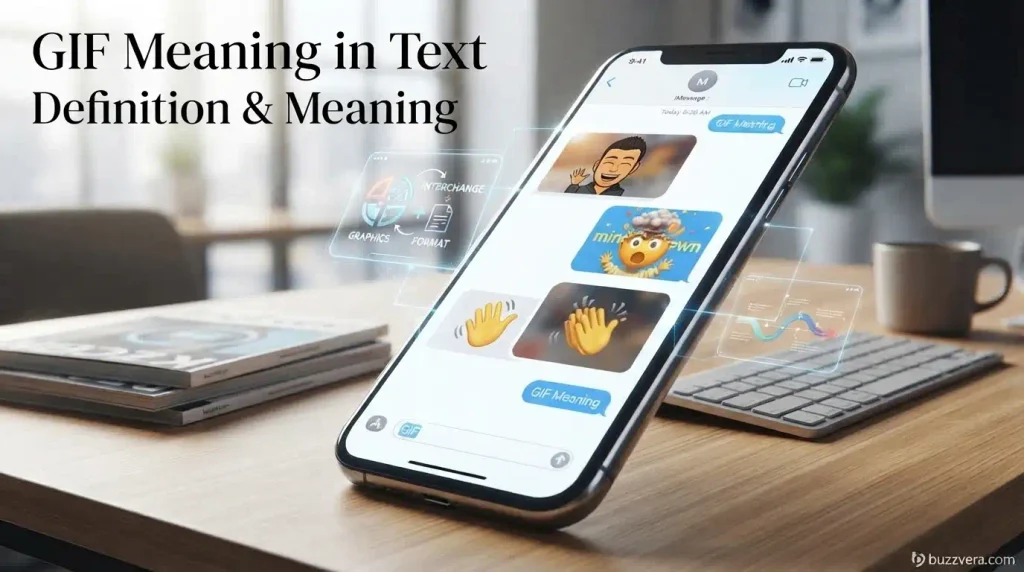
GIF stands for Graphics Interchange Format. It is a type of image file. It can hold many frames in one file. When the frames play in a loop, you see motion.
In a text message, a GIF is a short, looping, silent clip. It is often a few seconds long. It repeats again and again.
What Does a GIF Mean in a Text?
When someone sends you a GIF, they are using a picture to show a feeling or reaction. The clip does the talking. It might show:
- A person clapping
- A dog spinning in circles
- A movie scene with a famous line
- A cartoon character rolling their eyes
The GIF is like a face and a voice in one small box. It tells you how the sender feels.
Real-Life Examples
Here are a few ways people use GIFs:
Example 1: Celebrating
Mia: I got the job!!
Jake: [GIF of confetti falling]
Jake did not need words. The confetti said it all.
Example 2: Showing Tired
Sam: How was your Monday?
Lena: [GIF of a sloth hanging from a branch]
Lena is worn out. The sloth says it better than “tired” would.
Example 3: Saying Thanks
Ben: I fixed your bike tire.
Ava: [GIF of a person bowing]
Short. Sweet. Clear.
Is It “Gif” or “Jif”?
This one starts fights. The maker of the format said it is “jif”, like the peanut butter. But most people say “gif” with a hard G, like “gift.” Both are used. Pick what feels right.
Background & History of GIF

Where GIFs Came From
The GIF format was born in 1987. A software engineer named Steve Wilhite made it at CompuServe. Back then, the internet was slow. Files had to be small. GIFs were a smart way to store images without using much space.
At first, GIFs were just still images. Soon people found they could store many frames. That made simple animations possible.
The Early Web Years
In the 1990s, GIFs filled websites. You saw spinning logos. You saw dancing babies. You saw “under construction” signs. They were quirky and fun. Some were also a bit messy.
The Fall and Rise
In the 2000s, new tools like Flash took over. GIFs seemed old. But they came back in the 2010s. Social sites like Tumblr and Twitter made them popular again. They were easy to share and easy to loop.
Then phones changed everything. Keyboards added built-in GIF search bars. You could type “happy” and get hundreds of clips. Sending a GIF took one tap.
Where GIFs Live Today
Today, GIFs are part of daily talk. You find them in:
- Text apps like iMessage and WhatsApp
- Social apps like X, Instagram, and Snapchat
- Work chat tools like Slack and Teams
- Gaming chats like Discord
The word “GIF” even entered major dictionaries. It has come a long way from a 1987 file trick.
Usage in Various Contexts
GIFs change shape based on where you use them. Let’s look at each place.
In Texting
In private texts, GIFs are quick reactions. They show mood without much effort.
Chloe: Did you finish the report?
Dan: [GIF of a man sweating nervously]
Chloe: Oh no. 😂
Dan says “not yet” without saying it. It is funny and light.
On Social Media
On social apps, GIFs often sit in the comments. People use them to react to a post.
Post: “Just ran my first 5K!”
Comment: [GIF of a crowd cheering]
It gives the poster a little boost.
In Gaming
Gamers love GIFs. They use them to celebrate wins or tease friends.
Player 1: We just won the round!
Player 2: [GIF of a player doing a victory dance]
Player 3: [GIF of a sad clown]
Player 3 lost. The clown says what words cannot.
In Casual Conversations
With friends, GIFs are inside jokes in a box. You may share a clip that only your group gets.
Nina: Remember the time we got lost?
Tom: [GIF of a person staring at a map upside down]
Nina: 😭 Stop!
In Work Chats
Many teams use GIFs to lighten the mood. A small clap GIF after a good meeting is common. But we will talk more about that later.
Common Misconceptions & Clarifications of GIF

“A GIF Is a Video”
Not quite. A GIF is an image file with moving frames. It has no sound. Most short clips you see in chats are now actually small video files that act like GIFs. But we still call them GIFs.
“A GIF Always Means Something Funny”
No. GIFs can show many moods. They can be happy, sad, angry, shy, or sarcastic. Some are even serious. Tone depends on the clip.
“A GIF Replaces Real Talk”
A GIF is a nice add-on. It is not always a full answer. If a friend asks a real question, a GIF alone may feel like a dodge.
Lily: Are we still meeting at 6?
Omar: [GIF of a shrugging cat]
Lily: Is that a yes or a no? 😅
Omar should have typed a clear reply.
“Everyone Sees the Same GIF”
Sometimes the GIF looks different on different phones. Some apps show it as a still image. Some load it slowly. If your friend seems confused, that may be why.
Can a GIF Be Misread?
Yes. A GIF of someone clapping can be sincere or sarcastic. Without a face or voice, the other person may guess wrong. When in doubt, add a few words.
Similar Terms & Alternatives
GIFs are not the only way to show a feeling. Here are other tools people use.
- Emoji: Small icons like 😂 or ❤️. Quick and simple.
- Stickers: Bigger, often cartoon images. Common in WhatsApp and Line.
- Memes: Images with text, often a joke. Usually still, not moving.
- Reaction images: A still photo used to show a mood.
- Short video clips: Real videos, often with sound.
- Voice notes: Audio you record and send.
Quick Comparison Table
| Type | Moves? | Has Sound? | Best For |
| GIF | Yes | No | Fun reactions |
| Emoji | No | No | Fast feelings |
| Sticker | Sometimes | No | Cute, bold looks |
| Meme | Rarely | No | Jokes and trends |
| Video clip | Yes | Yes | Real moments |
| Voice note | No | Yes | Personal tone |
Each one has its place. GIFs sit in the middle. They are more lively than emoji, but lighter than a video.
How to Respond to This Term
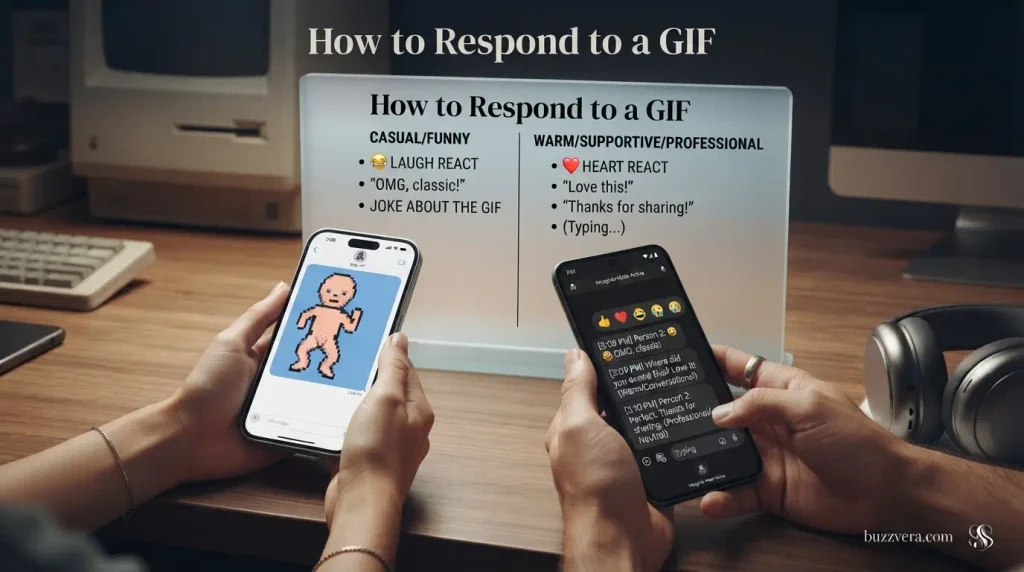
When someone sends you a GIF, how do you reply? It depends on the mood you want.
Casual Response
Match their energy. Send a GIF back or a short text.
Zoe: [GIF of a dancing banana]
You: Haha love it! 😄
Funny Response
Reply with a GIF that tops theirs.
Ryan: [GIF of a cat falling off a shelf]
You: [GIF of a dog watching and shaking its head]
Warm or Supportive Response
If the GIF shows a feeling, respond to it with care.
Ella: [GIF of a crying puppy]
You: Aw, rough day? Want to talk?
Professional Response
At work, keep it short and polite.
Coworker: [GIF of a thumbs up]
You: Thanks! Glad it worked out.
Privacy-Conscious Response
Some people don’t want to trade GIFs. That is okay. You can reply in plain words.
Friend: [GIF of a wave]
You: Hey! Good to hear from you.
You do not have to send a GIF back. A kind reply is enough.
Regional or Cultural Differences
GIFs Around the World
GIFs are used in many countries. The format is the same. But the humor changes from place to place.
Language Differences
Some places use their own words for GIFs. In many languages, people just say “GIF.” In others, they use words like “animated image.” The meaning is clear anyway.
Cultural Tastes
- In the US and UK: People love reaction GIFs from TV, movies, and sports.
- In Japan: Cute characters and anime clips are popular. Stickers are also big on the Line app.
- In Latin America: Fun, loud, and colorful GIFs are common in group chats.
- In South Asia: Movie scenes and dance clips are shared often, and many chats mix languages.
- In Korea: Cute animated stickers are widely used on KakaoTalk.
Watch for Gestures
Some GIFs show hand signs. A sign that is fine in one country may be rude in another. A thumbs up is a good example. It means “great” in many places, but it can be rude in a few.
Tip: If you chat across cultures, pick simple, friendly GIFs. Smiles, waves, and claps are safe bets.
Comparison with Similar Terms
Let’s put GIFs next to close cousins.
GIF vs. Emoji
An emoji is a tiny icon. A GIF is a moving clip. Emoji are quick and neat. GIFs are bigger and more expressive.
GIF vs. Sticker
Stickers are often drawn art. GIFs often come from real videos, movies, or shows. Stickers feel cute. GIFs feel real.
GIF vs. Meme
A meme usually has a joke or idea baked in. A GIF is more about showing a reaction. A meme can also be a GIF, but not always.
GIF vs. Video
A video can be long and can have sound. A GIF is short, silent, and loops.
| Feature | GIF | Emoji | Sticker | Meme |
| Motion | Yes | No | Sometimes | Rarely |
| Length | Short loop | Single icon | Single image | Single image |
| Source | Clips, shows, art | Keyboard | Apps | Internet culture |
| Tone | Expressive | Simple | Cute | Joking |
Key point: Use a GIF when a plain emoji feels too small.
Usage in Online Communities & Dating Apps
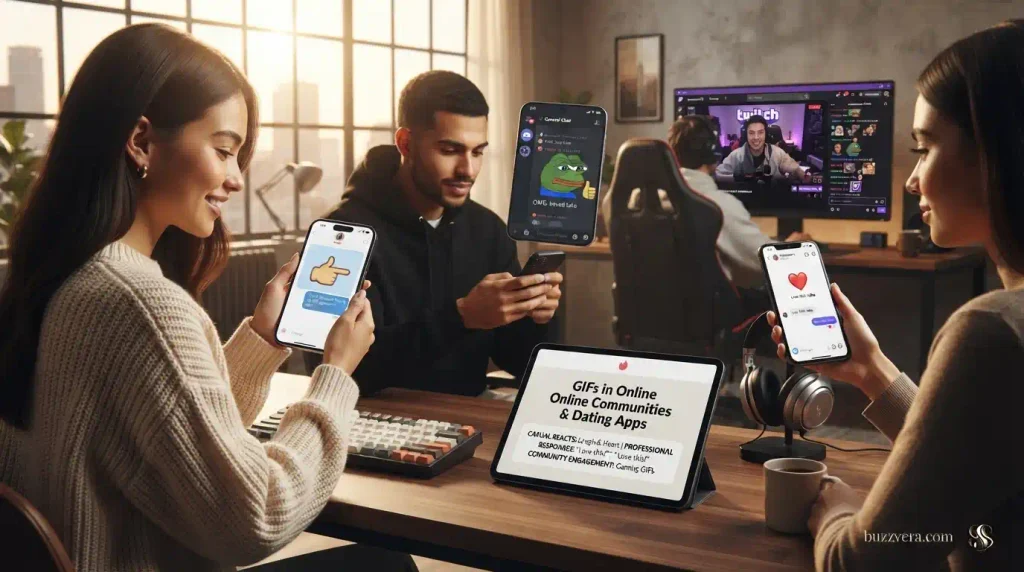
On Dating Apps
Apps like Tinder, Bumble, and Hinge let you send GIFs in chat. GIFs can break the ice. They can also show your sense of humor.
Match: Hey there 🙂
You: [GIF of a person waving with a big smile]
It is friendly and light.
Tips for dating apps:
- Keep it kind. Skip GIFs that feel rude or too bold.
- Don’t overdo it. Too many GIFs can hide your real voice.
- Add words. A short line with your GIF helps the other person know you.
- Read the mood. If they reply with plain text, you may want to do the same.
On X (Twitter) and Social Feeds
On X, GIFs are a big part of replies. People use them to react to news, sports, and shows. A good GIF can get lots of likes.
In Gaming Communities
On Discord and Twitch, GIFs fly fast. Some servers even have custom ones. They help build a group feel.
How to Respond Well
- If a GIF is funny, laugh or send one back.
- If it feels off, ask what they mean.
- If it feels rude, you can set a boundary.
Sam: [GIF making fun of a mistake]
You: Hey, that felt a bit harsh. Let’s keep it friendly.
You are allowed to say when something is not okay.
Hidden or Offensive Meanings
GIFs Can Carry Hidden Messages
A GIF itself is just a file. But the clip inside can mean many things. Some clips are sarcastic. Some are mean. Some are rude jokes.
Sarcasm
A slow clap GIF may look like praise. But it can also mean “sure, whatever.”
Kai: I made dinner!
Jo: [GIF of a slow clap]
Kai: Are you being nice or mean? 😅
Mocking or Rude Clips
Some GIFs make fun of people. They may use an eye roll, a laugh at someone, or a rude sign. In a fight, these can hurt.
Adult or Unsafe Content
Some GIFs are not fit for all ages. Many keyboards have filters, but they are not perfect. Check a GIF before you send it. Avoid anything you would not show your family or boss.
Why Tone and Context Matter
A GIF has no voice. It has no face from the sender. So the reader fills in the mood. That is why the same GIF can feel sweet from a friend and harsh from a stranger.
Rule of thumb: If you are unsure how it will land, don’t send it.
Suitability for Professional Communication
Is a GIF Okay at Work?
It depends on your workplace. Some teams love GIFs. Others prefer plain, formal talk.
When It Can Work
- Small team chats on Slack or Teams
- Celebrating a win
- Saying thanks in a light way
- Casual chats with close coworkers
When to Skip It
- Emails to clients
- Messages to senior leaders you don’t know well
- Serious topics like layoffs, complaints, or bad news
- Any chat with strict company rules
Professional Alternatives
Instead of a GIF, try:
- “Great work, team!”
- “Thanks so much. I appreciate it.”
- “Congrats on the launch!”
- A simple thumbs up or check mark emoji, if your team uses them
A Safe Approach
Watch how others in your workplace chat. If they use GIFs, you can too. If not, stay with words. When in doubt, keep it simple and polite.
FAQs
1. What does GIF stand for?
GIF stands for Graphics Interchange Format. It is an image file type that can show short looping animations.
2. How do you say GIF?
Both “gif” (hard G) and “jif” (soft J) are used. The maker said “jif,” but most people say “gif.” Either is fine.
3. How do I send a GIF in a text message?
Most phones have a GIF option in the keyboard or message app. Tap the plus or GIF icon, search a word like “happy,” pick a clip, and hit send. It takes just a few seconds.
4. Is a GIF the same as a video?
No. A GIF is a short, silent, looping image. A video can be long and can include sound. Many “GIFs” in apps are actually tiny video files that act like GIFs.
5. Can I send GIFs at work?
Sometimes. Many teams are fine with light GIFs in casual chats. But avoid them in formal emails or serious talk.
6. Why does my GIF not move?
The app may be slow to load it. Or the app may show it as a still picture. Check your internet and try again. Some phones also let you pause animations in settings.
7. What should I do if someone sends me a rude GIF?
Stay calm. You can ignore it, tell them it bothered you, or block them if it keeps happening. You do not have to put up with mean messages.
Conclusion
A GIF in a text message is a short, looping clip that shows a feeling. It began in 1987 and grew into one of the most loved ways to chat online.
GIFs can make you laugh, cheer someone on, or say thanks. They work in texts, on social apps, in games, and even at work. But they can also cause mix-ups. Tone and context matter.
Keep it kind. Pick clips that fit the mood. And when a message really matters, add a few words. That way, your GIF says what you mean.
Would you like me to put this in a file (Word or Markdown) so it’s ready to paste into your site?

Mahi Aylin is a content writer and author at BuzzVera.com, with 3 years of writing experience. She specializes in texting slang, internet abbreviations, modern expressions, and text meanings, creating simple and easy-to-understand content that helps readers confidently navigate today’s digital language.