
Have you ever received a message that simply says HYO and wondered what it means? Internet slang can be confusing, especially when a short word has more than one possible meaning. HYO meaning in text depends on the conversation, the person using it, and the online community where it appears.
Unlike popular abbreviations such as LOL, BRB, or OMG, HYO does not have one universally accepted meaning in every text conversation. In some contexts, it may be used as casual online shorthand. In Korean culture, hyo has a well-established meaning connected to filial piety, respect, and care for parents.
You may see HYO in texts, social media comments, gaming chats, forums, or cultural discussions. Therefore, understanding the surrounding conversation is important before deciding what someone means.
In this guide, we will explain the possible meanings of HYO, show natural examples, discuss cultural differences, and explain how you can respond when someone sends you this term.
What Does HYO Meaning in Text Mean?
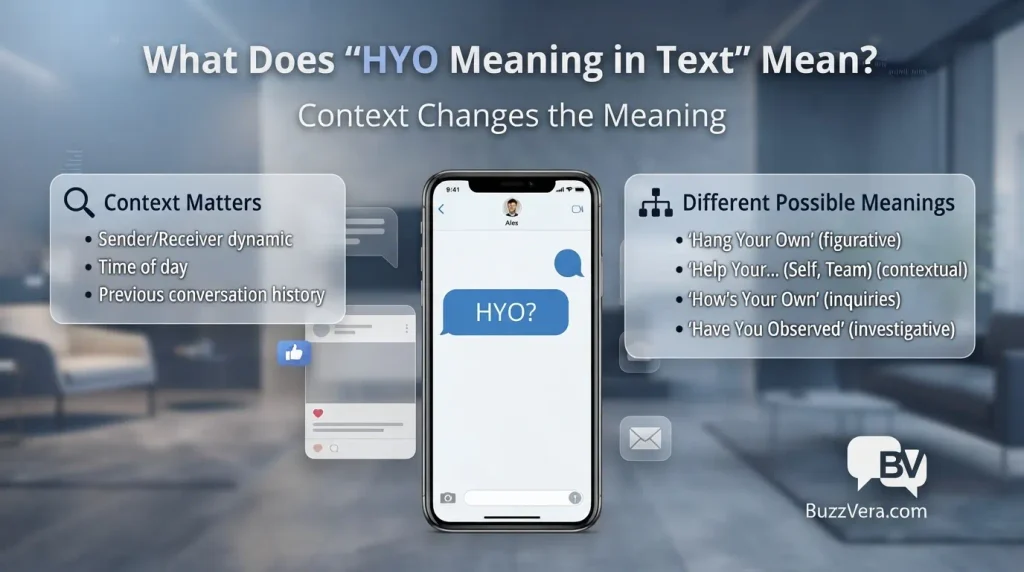
The phrase HYO meaning in text does not have one fixed definition. Its meaning can change based on context.
One important meaning comes from Korean culture. (hyo) refers to filial piety, which means showing respect, care, and responsibility toward one’s parents and family elders. It is associated with traditional Korean values and the wider East Asian influence of Confucian thought.
For example:
Person 1: She moved back home to care for her parents.
Person 2: That is a good example of hyo.
Here, HYO is a cultural term rather than ordinary texting slang.
Some online slang sources also give HYO informal meanings used in casual conversations. However, these meanings are not as standardized as common abbreviations such as LOL or BTW. Therefore, you should not assume that every person who types HYO means the same thing.
For example:
Friend: HYO?
You: I’m doing good! What about you?
In a casual chat, the sender may be using HYO as informal shorthand. However, the exact meaning should be confirmed from the surrounding conversation.
The easiest way to understand HYO is to remember this:
Context decides the meaning.
If the conversation is about Korean culture, family, or respect for parents, HYO may refer to filial piety. If it appears in casual internet conversation, it may have a community-specific slang meaning.
The Background of HYO Meaning in Text
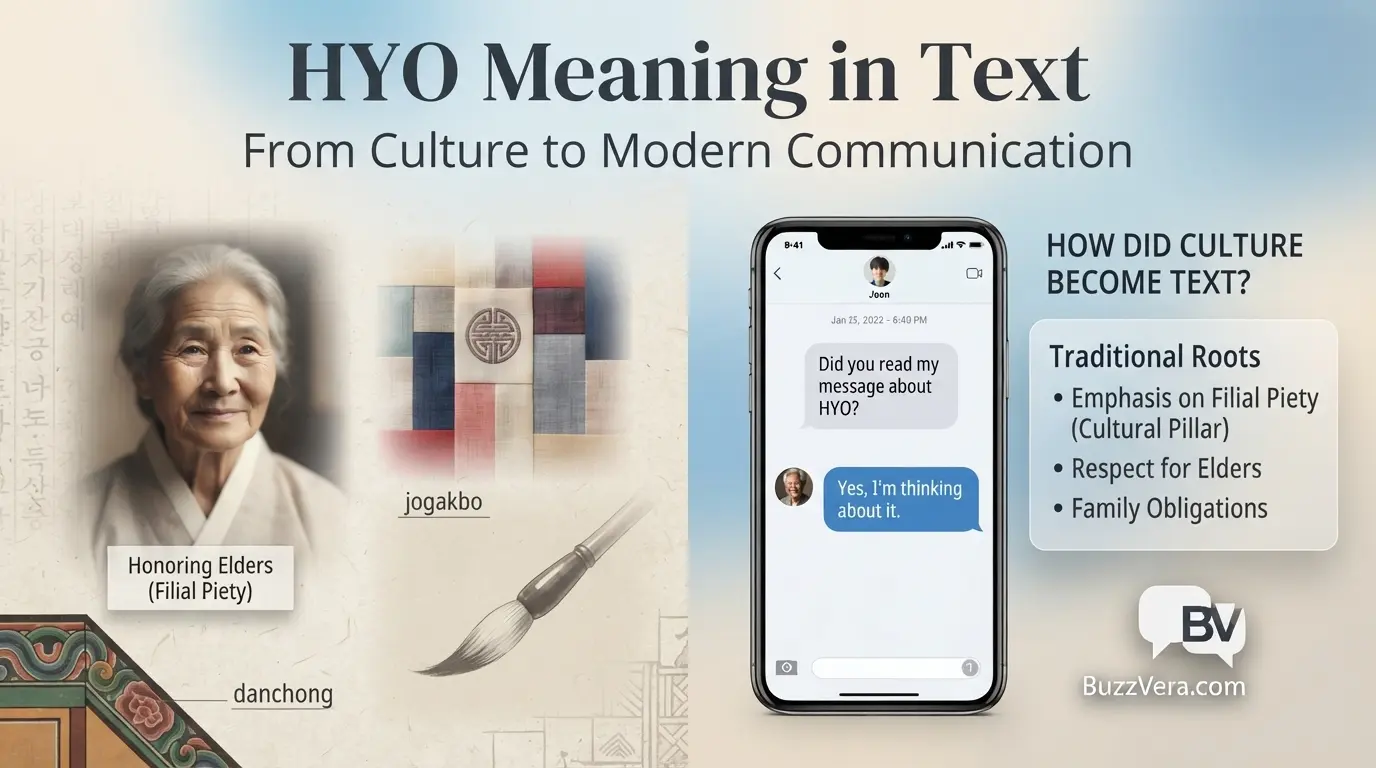
The cultural meaning behind HYO meaning in text is much older than modern social media.
The Korean word (hyo) is connected with the idea of filial piety. It emphasizes respect for parents and family elders, along with care and responsibility toward them. The concept has been influenced by Confucian traditions that have played an important role in Korean history and society.
Hyo is therefore more than a simple abbreviation. In a cultural discussion, it can describe a person’s actions toward their family.
For example, caring for an older parent, respecting family older, or supporting parents can be discussed in relation to hyo.
The modern internet has added another layer to the letters HYO. Online communities often create abbreviations to make conversations faster. However, these abbreviations do not always develop a single standard meaning.
As a result, you may find different explanations for HYO online. One website may describe an informal texting use, while another may discuss the Korean cultural term.
This is why the history of HYO can seem confusing.
Today, you are most likely to encounter HYO in one of two broad situations:
- Cultural discussions: HYO refers to Korean filial piety.
- Online conversations: HYO may be used as informal or community-specific shorthand.
Understanding the topic of the conversation can usually help you identify which meaning is intended.
How Is HYO Meaning in Text Used?
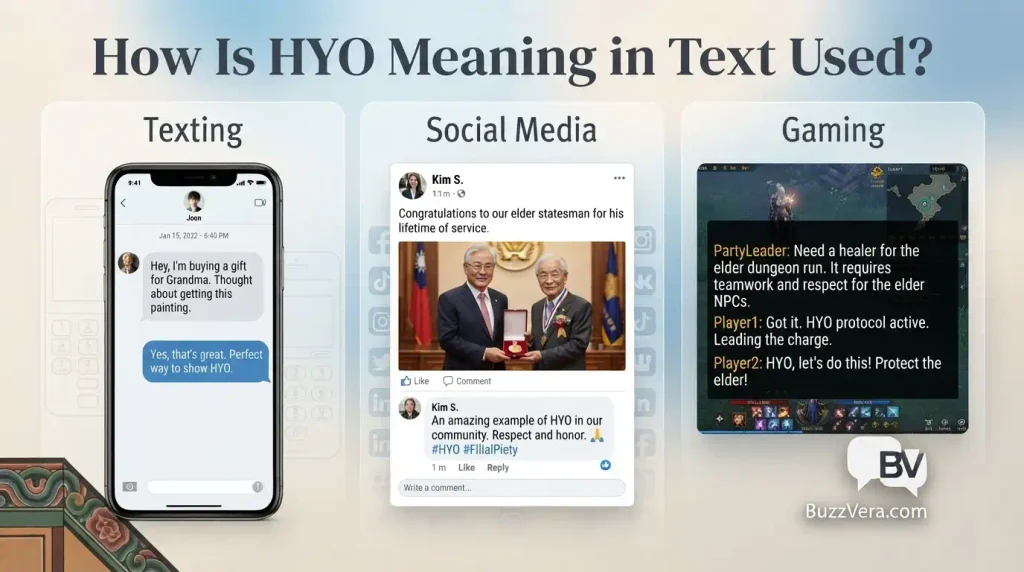
The way HYO meaning in text is used depends on the platform and conversation.
HYO in Text Messages
In casual texting, a person may use HYO as short-form internet language.
For example:
Friend: HYO?
You: I’m fine! Just relaxing at home.
If you are not familiar with the abbreviation, you can simply ask what the person means.
HYO on Social Media
Social media comments can contain slang that is specific to certain communities.
For example:
Post: I spent the weekend helping my grandparents.
Comment: That shows hyo.
In this example, HYO relates to family respect and care.
HYO in Gaming
Gaming communities use many abbreviations because players often need to communicate quickly.
For example:
Player 1: HYO? Ready?
Player 2: Yep, let’s go!
Here, the meaning depends on the gaming community and the previous conversation.
HYO in Casual Conversations
A short message such as HYO? can be unclear without context.
Before responding, look at what the person said before it.
If the conversation is about family or Korean traditions, HYO may have a cultural meaning. If you are simply chatting with friends, it may be informal slang.
Common Misconceptions About HYO Meaning in Text
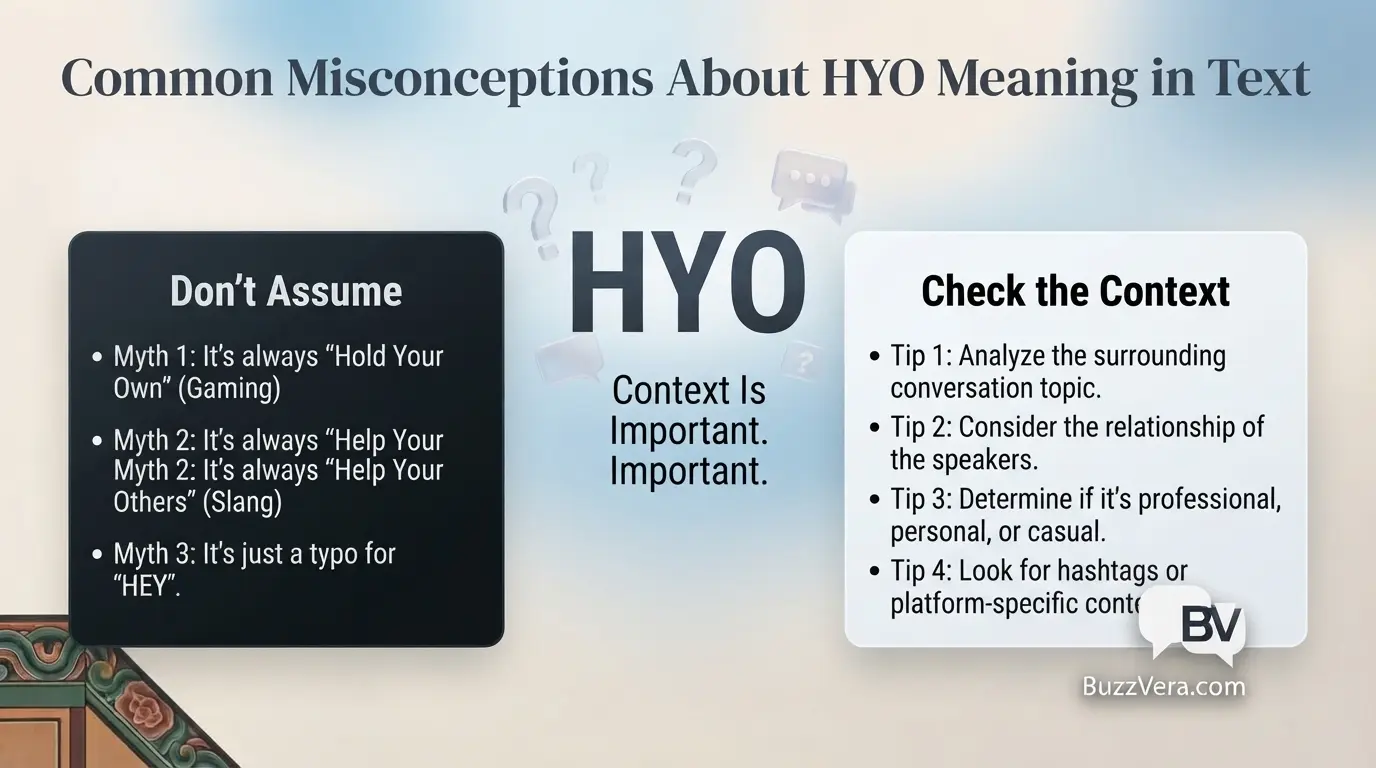
One common mistake is believing that HYO meaning in text always has one official definition.
It does not.
Internet slang changes quickly. Different groups may use the same letters in different ways. Therefore, a meaning found on one slang website may not match the meaning intended by the person who sent you HYO.
Another misconception is that HYO is always a romantic expression.
That is not necessarily true.
For example:
My parents taught me about hyo.
This sentence is clearly about family values, not romance.
Likewise, if someone sends HYO in a dating conversation, it does not automatically mean that they are flirting.
Another important point is that HYO can be an acronym or abbreviation outside texting. The three letters can represent different names or organizations in different contexts.
Therefore, always consider the subject of the conversation.
Is HYO offensive?
HYO does not have one universally recognized offensive meaning. However, user-generated slang websites sometimes list unusual or inappropriate interpretations for short abbreviations.
That does not make those interpretations standard.
If you see HYO used in a strange or uncomfortable way, consider the surrounding messages before assuming what the sender intended.
Similar Terms to HYO Meaning in Text
Several expressions can be related to the possible meanings of HYO meaning in text.
| Term | Meaning | Context |
| HYO | Can refer to filial piety or informal shorthand | Culture/texting |
| Xiao | Filial piety | Chinese culture |
| Respect | Showing regard for someone | General |
| Family duty | Responsibility toward family | General |
| HBU | How about you? | Texting |
| WYD | What are you doing? | Texting |
| HMU | Hit me up | Texting |
If someone is using HYO as a casual check-in, clearer alternatives may include:
- How are you?
- How are you doing?
- You good?
- How’s everything?
- What’s up?
These phrases are easier to understand because they do not depend on niche slang.
How to Respond to HYO Meaning in Text
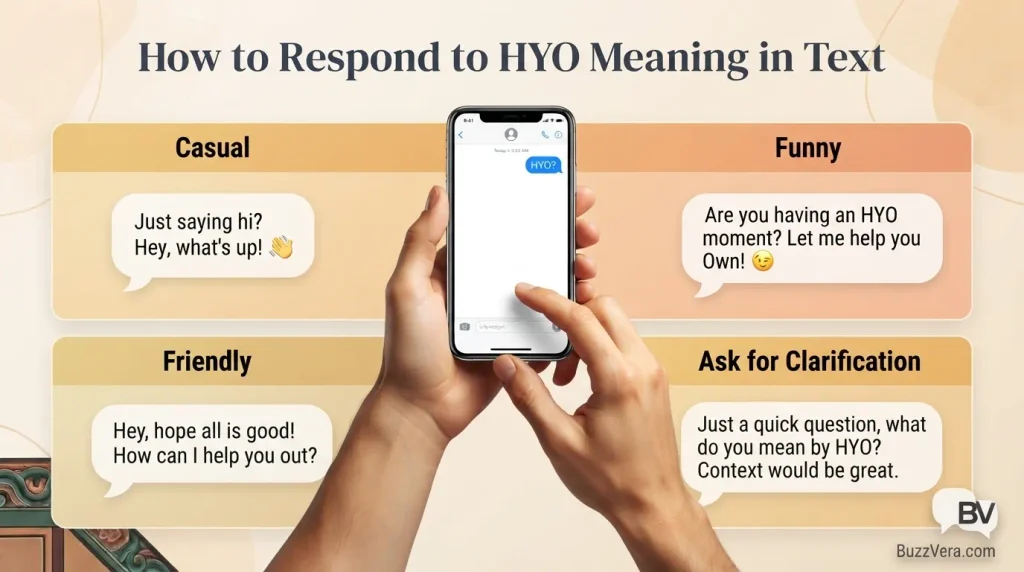
Your response to HYO meaning in text should depend on what you think the sender means.
Casual Response
If the person is casually checking on you:
Them: HYO?
You: I’m good! You?
This is short and natural.
Funny Response
With a close friend, you can make the reply playful:
Them: HYO?
You: Still alive and running on coffee 😂
Friendly Response
You can also keep it warm:
I’m doing great! Thanks for asking. How have you been?
If You Are Unsure
There is no need to guess.
Simply say:
Hey, what do you mean by HYO?
This is especially useful when the sender is someone you do not know well.
Privacy-Conscious Response
If the message feels personal, keep your answer simple:
I’m doing okay, thanks. Hope you’re doing well too.
You do not need to share private information just because someone asks how you are.
Regional and Cultural Differences in HYO Meaning in Text
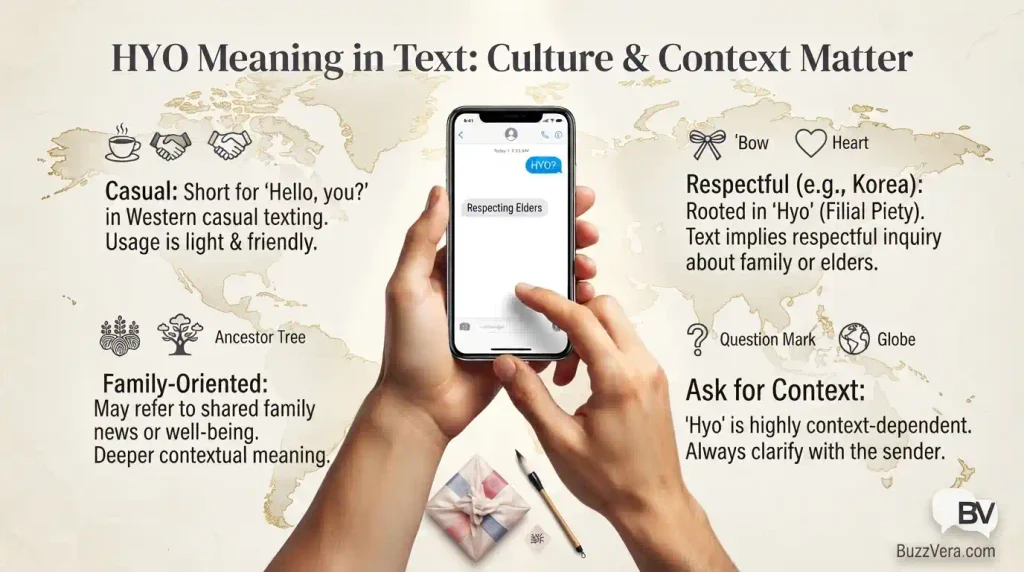
Regional and cultural differences are especially important when understanding HYO meaning in text.
In Korean culture, (hyo) refers to filial piety. It is connected with respect and responsibility toward parents and family elders.
A related idea appears in Chinese culture under the term xiao (孝). Both concepts are connected to the broader East Asian tradition of filial respect.
In English, the closest common phrase is filial piety.
The words may be different, but the basic idea is related to showing respect and care toward one’s parents.
Internet slang is different.
A short abbreviation may be common in one online group but completely unfamiliar to another. This is especially common in gaming communities, social media groups, and international chats.
For this reason, HYO should not automatically be interpreted according to one country’s slang habits.
If the conversation is multicultural, using the full phrase can prevent confusion.
HYO Meaning in Text vs. Similar Expressions
Comparing HYO with common texting expressions makes the difference easier to understand.
| Expression | Common Meaning | Typical Use |
| HYO | Context-dependent; also Korean filial piety | Culture/online chat |
| LOL | Laughing out loud | Casual texting |
| BRB | Be right back | Chatting/gaming |
| WYD | What are you doing? | Casual texting |
| HBU | How about you? | Casual texting |
| HMU | Hit me up | Social messaging |
| OMG | Oh my God | Casual reactions |
The key difference is that expressions such as LOL and BRB have widely understood meanings.
HYO is more context-dependent.
That means you should be more careful when interpreting it.
HYO Meaning in Text on Social Media, Dating Apps, and Gaming

The internet has made short expressions common across many platforms.
On social media, HYO may appear in comments or private messages. In gaming communities, it may appear in fast-moving chats where players use shortened expressions.
Dating apps can be even more confusing because people often use slang to keep conversations short.
For example:
Match: HYO?
You: I’m good! How about you?
This response works if the person is using HYO as a casual check-in.
However, if you do not understand the abbreviation, you can ask:
What does HYO mean here?
That is often the safest approach.
Do not automatically treat HYO as a romantic signal. The meaning depends on the person and the conversation.
On gaming platforms, check previous messages. The same abbreviation can have a different meaning within different communities.
Hidden or Offensive Meanings of HYO Meaning in Text
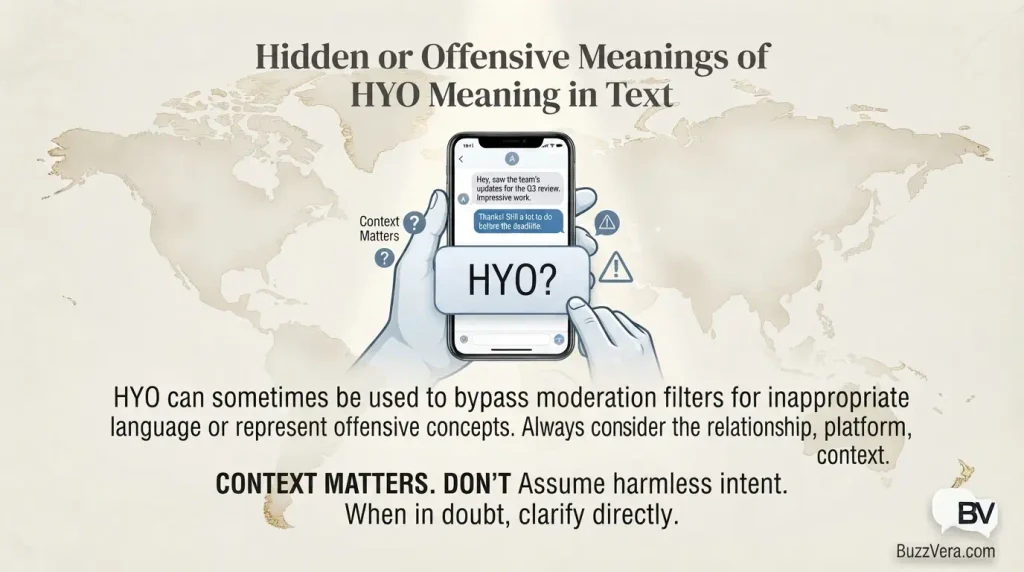
There is no single standard offensive definition of HYO meaning in text.
However, internet slang databases can contain user-created definitions that are unrelated to the commonly understood meanings of a term. Some may be crude or inappropriate.
This is one reason you should not assume that every definition you find online is equally common or reliable.
Tone also matters.
For example:
HYO 😂
could be playful among friends.
But if someone uses unfamiliar slang during an argument, the same letters may be intended differently.
When you see a potentially confusing abbreviation, consider:
- Who sent it?
- What were you discussing?
- What was said before HYO?
- Is the conversation about culture or casual slang?
- Does the sender normally use abbreviations?
These clues can help you understand the intended meaning.
Is HYO Meaning in Text Appropriate for Professional Communication?
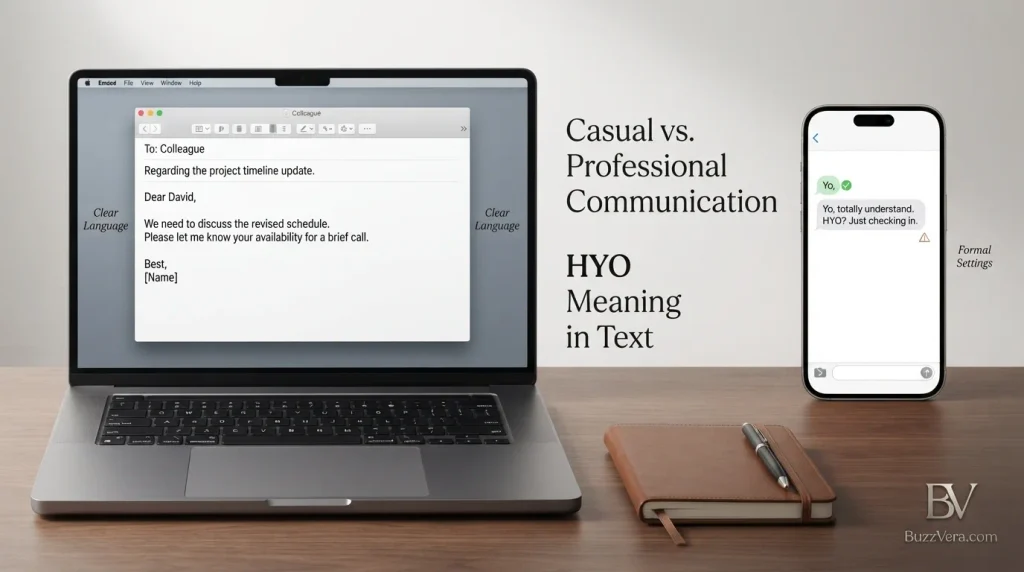
Using HYO meaning in text in professional communication is usually not recommended when the meaning is unclear.
Work emails and business messages should be easy for everyone to understand.
Instead of:
HYO, are you ready for the meeting?
write:
Hello, are you ready for the meeting?
or:
I hope you are doing well. Are you available for the meeting?
However, HYO can be appropriate in a professional or academic context when you are specifically discussing Korean culture.
For example:
The article examines hyo, or filial piety, in Korean family traditions.
Here, the meaning is clearly explained.
If your audience may not know the word, introduce it with the full meaning the first time you use it.
For casual workplace chats with close colleagues, slang may sometimes be acceptable. Still, clear language is a safer choice when the meaning could be misunderstood.
FAQs About HYO Meaning in Text
1. What does HYO mean in text?
HYO can have different meanings depending on context. In Korean culture, hyo refers to filial piety. Online communities may also use HYO as informal shorthand.
2. What does HYO mean in Korean?
In Korean, (hyo) refers to filial piety, including respect, care, and responsibility toward parents and family elders.
3. Is HYO a common texting abbreviation?
HYO is not as standardized as LOL, BRB, or OMG. Its meaning can vary between online communities.
4. Does HYO mean how are you?
Some online slang sources use HYO as informal shorthand for a casual check-in. However, this is not a universal meaning, so context should be considered.
5. Is HYO a romantic abbreviation?
Not necessarily. HYO does not automatically indicate romantic interest. Its meaning depends on the conversation.
6. Can HYO have an offensive meaning?
Some user-generated slang sources list alternative meanings, including inappropriate ones. These are not necessarily common or standard meanings.
7. How should I reply when someone says HYO?
If you believe they are asking how you are, you can say I’m good! How about you? If you are unsure, simply ask, What do you mean by HYO?
Conclusion
Understanding HYO meaning in text requires looking at the context. Unlike popular abbreviations such as LOL and BRB, HYO does not have one universally accepted meaning in every online conversation.
One important meaning is the Korean cultural concept (hyo), which refers to filial piety, respect, care, and responsibility toward parents and family. In casual online conversations, HYO may also appear as community-specific shorthand.
The best way to understand HYO is to consider the conversation, platform, relationship, and surrounding words. If the meaning is unclear, asking the sender is perfectly fine.
For professional communication, clear and complete phrases are usually better than unfamiliar slang. Once you understand the context, HYO becomes much easier to interpret and use correctly.

Mahi Aylin is a content writer and author at BuzzVera.com, with 3 years of writing experience. She specializes in texting slang, internet abbreviations, modern expressions, and text meanings, creating simple and easy-to-understand content that helps readers confidently navigate today’s digital language.