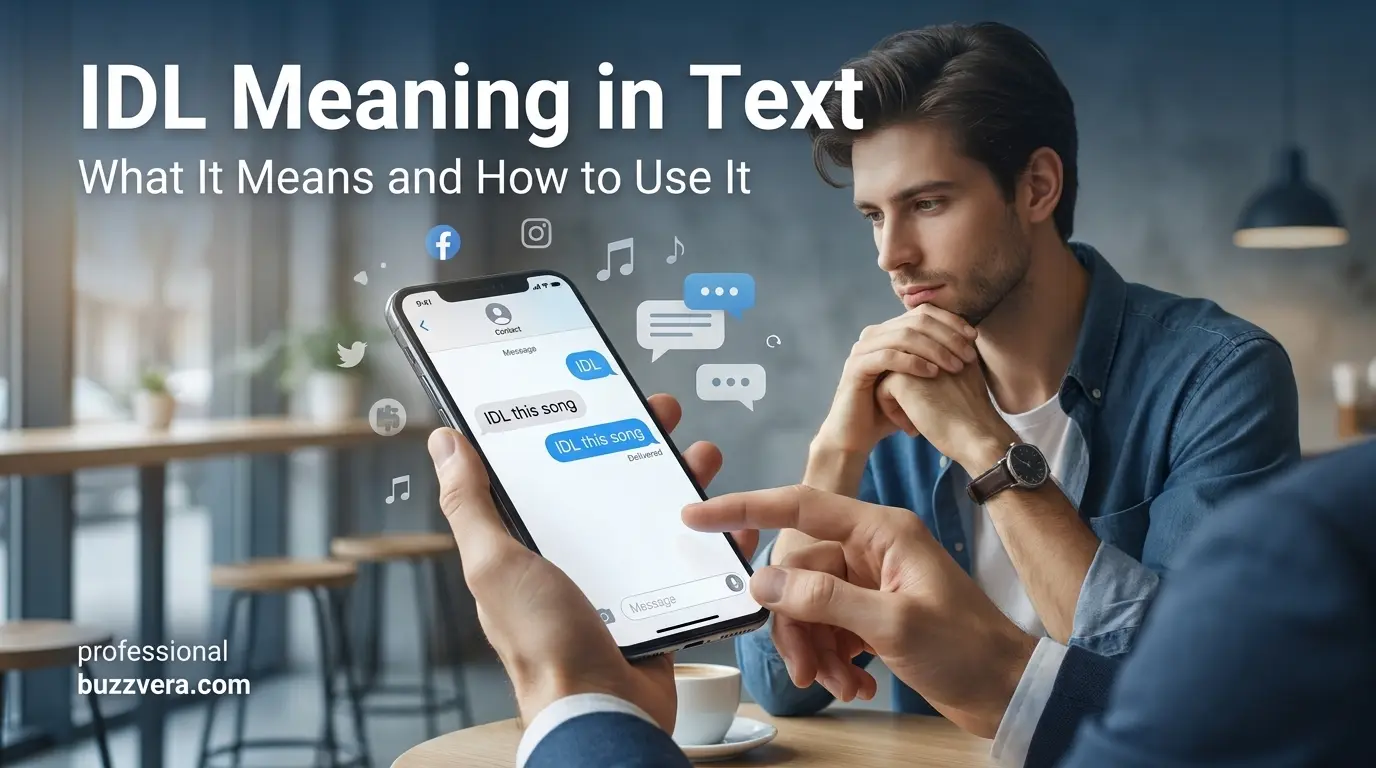
You get a message from a friend. It says, “IDL this song.” You understand the words, but the three letters may leave you confused. What does IDL mean?
In texting and casual online chat, IDL usually means “I Don’t Like.” People use it as a quick way to show dislike, disagreement, or a personal preference. It is most common in informal conversations, social media, DMs, and online communities.
For example:
Friend: “Do you like this new song?”
You: “IDL it. The beat is not for me.”
Here, IDL simply means “I don’t like it.”
Understanding IDL meaning in text is useful because short forms can sometimes look similar. Someone may confuse IDL with IDK, which means “I don’t know,” or IDC, which means “I don’t care.”
Context is important. IDL can sound friendly, funny, direct, or even rude depending on what follows it and who receives the message.
IDL Meaning in Text: Definition and Meaning

The most common meaning of IDL in text is “I Don’t Like.” It is an informal abbreviation used to express a negative preference or dislike. Slang dictionaries list IDL as an internet and texting abbreviation with this meaning.
Instead of typing:
“I don’t like this movie.”
someone may write:
“IDL this movie.”
The basic meaning stays the same, but the shorter version feels more casual.
Simple examples of IDL meaning in text
“IDL this food.”
Meaning: I don’t like this food.
“IDL that outfit.”
Meaning: I don’t like that outfit.
“IDL the new update.”
Meaning: I don’t like the new update.
“Honestly, IDL this place.”
Meaning: Honestly, I don’t like this place.
The abbreviation can describe many things. A person may use it for food, music, movies, games, ideas, places, habits, or situations.
It can also express disagreement:
Friend: “I think we should cancel the trip.”
You: “IDL that idea. We could wait another day.”
Here, IDL shows that the speaker does not approve of the idea.
However, IDL does not always mean strong hatred. Saying “IDL this song” is usually much softer than saying “I hate this song.”
The tone depends on the full sentence, relationship, punctuation, and conversation.
It is also worth remembering that IDL has other meanings outside texting. For example, in computing, IDL can refer to an Interface Definition Language, while in science it can refer to Interactive Data Language.
So, when someone asks about IDL meaning in text, the casual slang meaning is normally the one they want.
IDL Meaning in Text: Background and History
Texting language developed as people looked for faster and shorter ways to communicate. Early text messaging encouraged short words and abbreviations because typing on older mobile phones could take time.
Over the years, internet users created many forms of shorthand. Common examples include:
- IDK = I Don’t Know
- IDC = I Don’t Care
- IMO = In My Opinion
- TBH = To Be Honest
- BRB = Be Right Back
- IDL = I Don’t Like
IDL follows this same pattern. It takes the first letters of I, Don’t, and Like and turns them into a short expression.
Text slang is not always standardized. Different groups may use different abbreviations, and some abbreviations can have more than one meaning. This is why context matters when reading online language.
Today, IDL can appear in text messages, social media comments, private messages, group chats, and other casual online spaces. Slang references consistently identify “I Don’t Like” as the texting meaning.
For example:
Person A: “Are you watching the new show?”
Person B: “No, IDL reality shows.”
The abbreviation makes the response shorter without changing the basic message.
However, IDL is not a formal English expression. It is better suited to relaxed communication between people who understand texting slang.
Its history is therefore less about one specific invention and more about the natural growth of internet shorthand. As digital communication became faster, users continued creating compact ways to express common thoughts.
That makes IDL meaning in text part of a larger pattern of online language where familiar phrases are reduced to a few letters.
IDL Meaning in Text in Different Contexts

The meaning of IDL is usually easy to understand when you look at the sentence around it. The same abbreviation can appear in different online situations.
IDL meaning in text messages
Friends may use IDL when talking about everyday preferences.
Friend: “Want pizza tonight?”
You: “IDL pizza today. How about burgers?”
IDL meaning in social media
A person may use IDL in a comment or reply.
User 1: “This new trend is amazing.”
User 2: “IDL it tbh.”
Here, the person is saying they do not like the trend.
IDL meaning in gaming chats
Gamers can use IDL when talking about maps, updates, weapons, characters, or game modes.
Player 1: “Do you like the new map?”
Player 2: “IDL the new map. Too many open areas.”
IDL meaning in casual conversations
It can also appear in normal conversations between friends.
Friend: “What do you think of this restaurant?”
You: “IDL the food, but the place looks nice.”
IDL and emojis
An emoji can change the emotional tone.
“IDL this song 😂”
This may sound playful.
But:
“IDL you.”
can sound much more personal or hurtful.
That is why understanding the full context is more important than looking at the three letters alone.
Common Misconceptions About IDL Meaning in Text
There are several reasons people may misunderstand IDL meaning in text.
IDL does not mean IDK
This is one of the easiest mistakes.
IDL = I Don’t Like
IDK = I Don’t Know
Example:
“IDL this movie.”
= I don’t like this movie.
“IDK this movie.”
= I don’t know this movie.
The letters are similar, but the meanings are completely different.
IDL does not automatically mean hate
When someone says:
“IDL this song.”
they are usually expressing dislike. They are not necessarily saying they hate the song.
The difference can be important.
“I don’t like it” can be mild.
“I hate it” is much stronger.
IDL is not always rude
The abbreviation itself is not automatically offensive. Tone and context matter.
Compare:
“IDL this flavor lol 😂”
with:
“IDL you.”
The first may simply express a harmless preference. The second can feel personal and insulting.
IDL can have other meanings
Outside casual texting, IDL can stand for several technical or specialized terms. For example, abbreviation references list meanings such as Interface Definition Language, Interactive Data Language, and International Date Line.
Therefore, always consider where the abbreviation appears.
Similar Terms to IDL Meaning in Text
Several texting abbreviations look or sound similar to IDL.
| Term | Meaning | Main Use |
| IDL | I Don’t Like | Expressing dislike |
| IDK | I Don’t Know | Showing uncertainty |
| IDC | I Don’t Care | Showing lack of concern |
| IMO | In My Opinion | Giving an opinion |
| TBH | To Be Honest | Introducing an honest opinion |
| IDM | I Don’t Mind | Showing acceptance |
| IDLI | I Don’t Like It | Stronger or clearer version of IDL |
These terms should not be treated as interchangeable.
For example:
“IDL this game.”
= I don’t like this game.
“IDK this game.”
= I don’t know this game.
“IDC about this game.”
= I don’t care about this game.
The first letters may look similar, but each expression communicates a different idea.
How to Respond to IDL Meaning in Text
How you respond depends on the situation and your relationship with the person.
Casual response
If a friend says:
“IDL this restaurant.”
You could say:
“Fair enough. Let’s try somewhere else.”
Funny response
If someone says:
“IDL this song.”
You could reply:
“Wow, the song is officially offended 😂.”
Curious response
If you want to understand their opinion:
“What don’t you like about it?”
This keeps the conversation going.
Respectful response
If you disagree:
“That’s fair. I actually like it.”
You do not need to argue.
Privacy-conscious response
Sometimes IDL may be about a person or a sensitive subject.
“I get that. You don’t have to explain if you’d rather not.”
This gives the other person space.
When someone says “IDL you”
This is different because it can sound personal.
You might respond:
“Did I do something that upset you?”
This is better than immediately becoming defensive.
The key is to read the surrounding conversation before deciding what the sender means.
Regional and Cultural Differences in IDL Meaning in Text

The basic texting meaning of IDL, “I Don’t Like,” is understandable to English-speaking internet users. However, slang use can vary between communities and regions.
People who regularly communicate in English online may recognize IDL even if English is not their first language. At the same time, not everyone will know the abbreviation.
Different cultures also have different ways of expressing dislike.
One person may use:
“IDL this.”
Another may simply say:
“Not really my thing.”
Someone else may write:
“I’m not a fan.”
The meaning is similar, but the tone can be different.
Cultural expectations also matter. In some settings, directly saying that you dislike something may feel too blunt. In others, direct opinions are normal.
For this reason, IDL meaning in text should be understood together with the language, relationship, and cultural setting.
If you are talking with someone who does not often use English slang, spelling out “I don’t like it” may be clearer.
IDL Meaning in Text Compared With Similar Expressions
Here is a simple comparison:
| Expression | Meaning | Tone | Example |
| IDL | I Don’t Like | Casual | “IDL this movie.” |
| I don’t like it | Same meaning | Neutral | “I don’t like it.” |
| I’m not a fan | Mild dislike | Polite | “I’m not a fan of this style.” |
| Not my thing | Mild dislike | Casual | “That music is not my thing.” |
| I dislike it | Negative preference | Formal | “I dislike this approach.” |
| I hate it | Strong dislike | Strong | “I hate this design.” |
| IDC | I Don’t Care | Dismissive | “IDC what they choose.” |
The important difference is strength.
IDL normally communicates dislike without necessarily showing strong anger.
For example:
“IDL spicy food.”
sounds like a personal preference.
But:
“I hate spicy food.”
sounds much stronger.
Using the right expression helps you communicate your actual feeling.
IDL Meaning in Text in Online Communities and Dating Apps
In online communities, IDL can be used to give quick opinions.
Someone might comment:
“IDL this update.”
or:
“IDL the new design.”
Gaming communities may use it to discuss game features, characters, maps, or updates.
Dating apps can be more sensitive.
Imagine someone says:
“IDL people who text once a week.”
They are expressing a dating preference.
Another person might write:
“IDL small talk.”
This means they do not enjoy small talk.
On dating apps, however, short negative statements can sometimes sound harsher than intended. A better approach is often to express your preference clearly without insulting another person.
For example:
“I prefer people who enjoy regular conversation.”
sounds more positive than:
“IDL people who barely text.”
The same idea can be expressed in a more welcoming way.
On social platforms, IDL may also appear in comments, replies, and private messages. The exact meaning should still be judged from the surrounding words because abbreviations can be reused for different purposes.
Hidden or Offensive Meanings of IDL in Text
For ordinary texting, IDL usually means “I Don’t Like.” There is no widely established offensive meaning that replaces this common slang definition.
Still, the phrase can become offensive depending on what comes after it.
For example:
“IDL this color.”
is harmless.
But:
“IDL you.”
can feel insulting because the dislike is directed at a person.
There is also a related abbreviation IDLU, which some slang references define as “I Don’t Like You.”
This is different from simple IDL.
Context also matters when someone uses IDL sarcastically.
“IDL this amazing cake 🙄.”
The person may actually like the cake and be joking.
Emojis, punctuation, previous messages, and the relationship between the speakers can all affect the meaning.
Therefore, do not assume that every IDL message is hostile. Read the entire conversation before reacting.
IDL Meaning in Text and Professional Communication
When discussing IDL meaning in text, it is important to know where the abbreviation is appropriate.
IDL is generally informal. It works best in casual conversations, friendly chats, and relaxed online communication.
It is usually better to avoid it in:
- Business emails
- Job applications
- Academic writing
- Reports
- Official documents
- Client communication
- Formal workplace messages
Instead of:
“IDL this approach.”
write:
“I do not think this approach is effective.”
Or:
“I have some concerns about this approach.”
These alternatives are clearer and more professional.
In a workplace setting, clarity is often more important than saving a few characters.
There is another reason to avoid IDL at work: not every reader will know the abbreviation. Because IDL is informal and relatively uncommon compared with terms like IDK, using the full phrase can prevent confusion.
FAQs About IDL Meaning in Text
1. What does IDL mean in text?
IDL usually means “I Don’t Like” in casual texting and online communication. It is used to express dislike or a negative preference.
2. Is IDL a slang abbreviation?
Yes. When it means “I Don’t Like,” IDL is an informal texting and internet abbreviation.
3. What does IDL mean on social media?
On social media, IDL usually means “I Don’t Like.” Someone may use it in comments, DMs, replies, or posts to express an opinion.
4. Is IDL the same as IDK?
No.
IDL = I Don’t Like
IDK = I Don’t Know
They have completely different meanings.
5. Is IDL rude?
Not necessarily. Saying “IDL this movie” is usually just a personal opinion. However, “IDL you” can sound personal or hurtful.
6. Can IDL have other meanings?
Yes. IDL has several meanings outside casual texting, including technical and scientific meanings such as Interface Definition Language and Interactive Data Language.
7. Should I use IDL at work?
It is better to avoid it in formal communication. Use clear phrases such as “I don’t like this approach” or “I have concerns about this option.”
Conclusion: Understanding IDL Meaning in Text
IDL usually means “I Don’t Like” in texting and casual online conversations. It is a short way to express dislike, disagreement, or a personal preference.
You may see it in messages, social media comments, DMs, gaming chats, and other informal spaces. Its tone can range from playful to direct, so the surrounding conversation matters.
Remember the key difference:
IDL = I Don’t Like
IDK = I Don’t Know
IDC = I Don’t Care
IDL is best used with people who understand casual internet slang. For professional communication, it is safer to write the complete phrase.
Also, remember that IDL can have technical meanings outside texting. So, when you see it, always look at the context first.
In short, understanding IDL meaning in text helps you read online conversations more clearly and respond with the right tone.

Mahi Aylin is a content writer and author at BuzzVera.com, with 3 years of writing experience. She specializes in texting slang, internet abbreviations, modern expressions, and text meanings, creating simple and easy-to-understand content that helps readers confidently navigate today’s digital language.