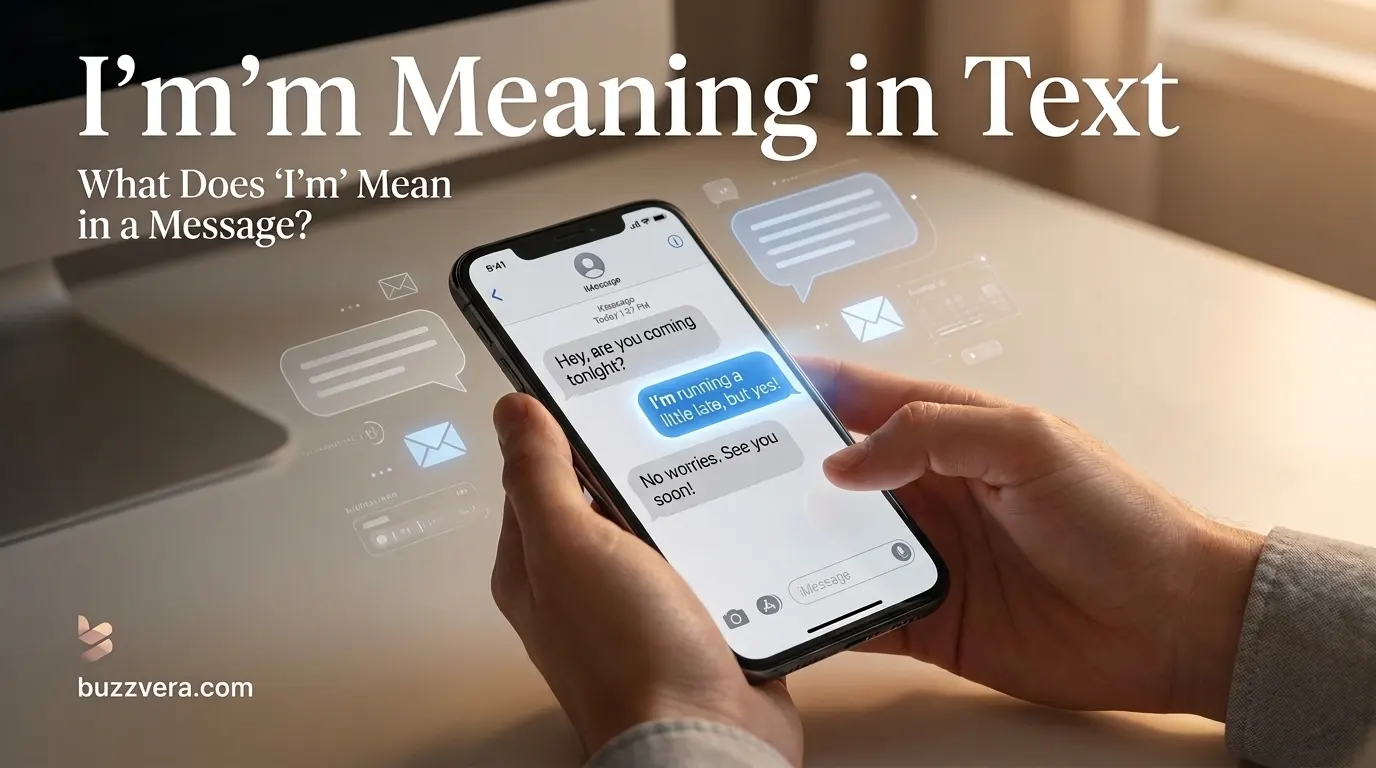
When someone sends “I’m” in a text, it can look like a very simple word. In fact, you probably use it every day without thinking about it. Still, if you are learning English or trying to understand a message, you may wonder what “I’m” means in text.
“I’m” is a short form of “I am.” It is called a contraction. People use it in everyday speech, text messages, social media posts, online chats, and casual conversations because it sounds natural and saves space.
For example, someone may text, “I’m tired,” “I’m coming,” “I’m sorry,” or “I’m happy for you.” The meaning depends on the words that come after it.
You may also see “I’m” in gaming chats, dating apps, comments, emails, and professional messages. Understanding it is useful because contractions are common in modern English.
In this guide, we will explain I’m meaning in text with simple examples, related expressions, possible misunderstandings, and ways to respond.
Definition and Meaning of I’m in Text
The basic I’m meaning in text is “I am.”
It is a contraction made by joining “I” and “am.” The apostrophe replaces the missing letter or letters.
I am → I’m
The meaning does not usually change when “I am” becomes “I’m.” The shorter form simply sounds more natural in everyday communication.
For example:
“I’m tired.”
means
“I am tired.”
“I’m ready.”
means
“I am ready.”
“I’m going home.”
means
“I am going home.”
“I’m sorry.”
means
“I am sorry.”
In texting, people often prefer “I’m” because it feels relaxed and conversational.
Common examples
Friend: Are you coming tonight?
You: I’m coming.
Friend: How are you feeling?
You: I’m okay.
Partner: Are you upset?
You: No, I’m fine.
Coworker: Are you available now?
You: I’m available after 3 PM.
The word itself does not tell you the complete meaning. The words around it provide the real message.
For example, “I’m not sure” shows uncertainty, while “I’m excited” shows happiness or anticipation.
It can also describe an action:
“I’m eating.”
“I’m working.”
“I’m studying.”
Here, “I’m” means “I am,” while the next word explains what the person is doing.
So, if you see “I’m” in a message, there is usually no hidden slang meaning. It is simply a common English contraction.
Background and History of I’m in Text

To understand the I’m meaning in text, it helps to understand where the contraction comes from.
“I’m” is not a new texting abbreviation. It has been part of English for a very long time. English speakers have often shortened words in natural speech. These shortened forms eventually became common in writing too.
The full expression is “I am.” In everyday speech, saying “I’m” is quicker and smoother.
For example, instead of saying:
“I am going to the store.”
A person naturally says:
“I’m going to the store.”
As written English became more conversational, contractions such as I’m, you’re, we’re, they’re, he’s, she’s, don’t, can’t, and won’t became widely used.
Text messaging made contractions even more common. People wanted messages to feel quick, natural, and friendly. However, “I’m” was already a standard part of English before texting and social media existed.
Today, you can find “I’m” almost everywhere.
It appears in:
- Text messages
- Social media posts
- Online comments
- Gaming chats
- Dating apps
- Personal emails
- Workplace messages
- Customer conversations
- Everyday speech
The rise of smartphones did not create the word. Instead, digital communication helped make short, conversational writing even more common.
There is also an important difference between “I’m” and texting abbreviations such as “idk” or “brb.” “I’m” is a standard English contraction, while “idk” and “brb” are informal internet abbreviations.
This means “I’m” can be used in many situations where slang might not be suitable.
Usage and I’m Meaning in Text in Different Contexts
The I’m meaning in text stays close to “I am,” but the emotion or purpose can change based on the situation.
1. I’m in everyday texting
Friends often use “I’m” to describe their feelings, plans, or actions.
Friend: Where are you?
You: I’m at home.
Friend: Are you busy?
You: I’m studying right now.
2. I’m on social media
People use “I’m” in captions, comments, and posts.
“I’m finally on vacation!”
“I’m so happy today.”
“I’m not ready for Monday.”
Here, “I’m” helps people express personal feelings or experiences.
3. I’m in gaming
Gamers use “I’m” in quick team communication.
Player 1: Where are you?
Player 2: I’m behind you.
Player 1: Are you ready?
Player 2: I’m ready.
The contraction makes the message fast and easy to understand.
4. I’m in dating conversations
On dating apps, “I’m” is often used to share personal information.
“I’m from Lahore.”
“I’m looking for something serious.”
“I’m free this weekend.”
The meaning is still simply “I am.”
5. I’m in professional communication
“I’m” can also appear in work messages.
“I’m available for the meeting at 2 PM.”
“I’m reviewing the document now.”
“I’m happy to discuss this further.”
In a formal report, however, the full form “I am” may sometimes sound more formal.
Common Misconceptions About I’m Meaning in Text
There are several misunderstandings about I’m meaning in text, especially among people who are learning English.
Misconception 1: “I’m” is texting slang
Not exactly.
“I’m” is a standard English contraction, not internet slang. It can be used in speech and writing.
Misconception 2: “I’m” has a secret meaning
Usually, it does not.
If someone writes:
“I’m tired.”
They normally mean:
“I am tired.”
The meaning comes from the rest of the sentence.
Misconception 3: “I’m” is always casual
It is more conversational than “I am,” but it is not automatically inappropriate.
For example:
“I’m writing to confirm the meeting.”
This can be perfectly acceptable in a professional email.
However, very formal academic or legal writing may favor the full form depending on the style.
Misconception 4: “I’m” means “I was”
It does not.
I’m = I am
I was = I was
For example:
“I’m tired” means the person is tired now.
“I was tired” refers to a past state.
Misconception 5: “I’m” and “im” are identical
They have the same intended meaning in many informal texts, but correct English spelling is “I’m” with an apostrophe.
Writing “im” is common in quick messages, but it is not standard punctuation.
Similar Terms and Alternatives to I’m Meaning in Text
The I’m meaning in text is closely connected to several other expressions.
| Expression | Meaning | Example |
| I’m | I am | I’m happy. |
| I am | Full form of I’m | I am happy. |
| Im | Informal missing-apostrophe form | Im tired. |
| I feel | Describes an emotion or opinion | I feel happy. |
| I’m being | Describes current behavior | I’m being honest. |
| I’ve | I have | I’ve finished. |
| I’ll | I will | I’ll call you. |
| I’d | I would / I had | I’d like to help. |
These forms should not be confused with one another.
For example:
I’m ready. = I am ready.
I’ve finished. = I have finished.
I’ll help. = I will help.
I’d help. = I would help.
The apostrophe helps show that letters have been removed from the longer expression.
How to Respond to I’m in Text
Knowing the I’m meaning in text is easy, but the best response depends on what comes after “I’m.”
If someone says:
“I’m tired.”
You could say:
“Get some rest.”
If someone says:
“I’m excited!”
You might answer:
“That’s great! What happened?”
Casual response
Them: I’m home.
You: Nice! How was your day?
Funny response
Them: I’m hungry.
You: That sounds like an emergency. 😂
Caring response
Them: I’m not feeling good.
You: I’m sorry. Do you want to talk about it?
Professional response
Them: I’m available after 3 PM.
You: Perfect. Let’s schedule the meeting for 3:30 PM.
Privacy-conscious response
Sometimes someone may use “I’m” before asking personal questions.
Them: I’m trying to get to know you. Where exactly do you live?
If you do not want to share personal information, you can say:
“I prefer not to share my exact location.”
You do not have to answer every personal question just because someone starts the message with “I’m.”
Regional and Cultural Differences in I’m Meaning in Text
The basic I’m meaning in text is widely understood in English-speaking communities around the world.
People in the United States, United Kingdom, Canada, Australia, New Zealand, Pakistan, India, and many other places use “I’m” in English communication.
The contraction itself does not have a major regional meaning change.
However, the way people use it can vary.
For example, casual English in one country may use more contractions than formal English in another. Some people may write:
“I’m gonna call you.”
Others may prefer:
“I’m going to call you.”
Both begin with “I’m,” but the rest of the sentence changes the level of formality.
In some cultures where English is a second language, people may prefer “I am” because they learned the full grammatical form first.
In digital communication, however, “I’m” is widely understood.
When translating it into another language, the exact form may change because different languages have different grammar rules and contractions.
Therefore, the core meaning remains:
I’m = I am
The surrounding language and cultural setting determine how natural or formal the sentence sounds.
Comparison With Similar Expressions: I’m Meaning in Text
The I’m meaning in text becomes clearer when compared with similar contractions.
| Term | Full form | Main use |
| I’m | I am | Current state, feeling, identity, or action |
| I’ve | I have | Possession or completed action |
| I’ll | I will | Future action |
| I’d | I would / I had | Conditional or past perfect |
| You’re | You are | Describing the other person |
| We’re | We are | Describing a group |
| They’re | They are | Describing other people |
| He’s | He is / He has | Describing a male person |
| She’s | She is / She has | Describing a female person |
Consider these examples:
I’m working.
I am working.
I’ve worked.
I have worked.
I’ll work.
I will work.
I’d work.
I would work.
The small apostrophe can represent missing letters, but the meaning of each contraction is different.
I’m Meaning in Text on Online Communities and Dating Apps

The I’m meaning in text is very common on online platforms.
On dating apps such as Tinder, people often use “I’m” when introducing themselves.
For example:
“I’m a teacher.”
“I’m from Karachi.”
“I’m looking for a serious relationship.”
“I’m new to this app.”
On social platforms such as X, people may use it to express opinions or reactions.
“I’m honestly surprised.”
“I’m not sure about this.”
In gaming communities, “I’m” often appears in fast messages:
“I’m low on health.”
“I’m coming.”
“I’m behind the team.”
The best way to respond is to read the complete sentence instead of focusing only on “I’m.”
On dating apps, it is also wise to avoid sharing sensitive personal information too quickly. A message such as “I’m looking for you” may be playful, romantic, or uncomfortable depending on the conversation.
Context matters more than the contraction itself.
Hidden or Offensive Meanings of I’m in Text
For most users, the I’m meaning in text has no hidden or offensive meaning.
“I’m” is an ordinary English contraction.
Still, any word can appear inside a sentence that has a rude, sexual, insulting, threatening, or otherwise inappropriate meaning. That meaning comes from the complete sentence, not from “I’m” itself.
For example:
“I’m angry.”
This is not offensive by itself.
But if someone says:
“I’m going to hurt you.”
the entire statement is threatening.
The word “I’m” is not the problem.
Tone also matters. Someone may write:
“I’m just saying.”
Depending on the conversation, this can sound defensive, dismissive, or completely neutral.
Likewise:
“I’m done.”
could mean:
- I have finished my work.
- I am leaving.
- I do not want to continue the conversation.
- I am emotionally frustrated.
Therefore, you should not assume a hidden meaning from “I’m” alone.
Look at the complete message, previous messages, punctuation, emojis, and relationship between the people.
Suitability for Professional Communication and I’m Meaning in Text
The I’m meaning in text is generally acceptable in professional communication.
For example:
“I’m available for the meeting.”
“I’m reviewing the report.”
“I’m happy to help.”
“I’m writing to confirm our appointment.”
These sentences are grammatically correct and natural.
However, very formal writing may sometimes use “I am” instead.
For example:
More conversational:
“I’m pleased to confirm your appointment.”
More formal:
“I am pleased to confirm your appointment.”
Neither is automatically wrong.
The choice depends on the situation, organization, audience, and writing style.
For a friendly workplace email, “I’m” usually sounds natural.
For academic writing, legal documents, official statements, or highly formal communication, following the required style guide is more important.
If you are unsure, use the full form “I am.” It is always clear and grammatically correct.
FAQs About I’m Meaning in Text
1. What does I’m mean in text?
I’m means “I am.” It is a common English contraction used in texts, conversations, emails, social media, and other forms of communication.
2. Is I’m texting slang?
No. “I’m” is standard English, not internet slang. It is simply the contracted form of “I am.”
3. What does I’m mean in a message?
It usually means “I am.” The exact meaning depends on the words that follow it.
For example, “I’m tired” means “I am tired.”
4. Is “im” without an apostrophe correct?
In standard written English, the correct form is “I’m.” People often type “im” in quick texts, but the apostrophe should be used in proper writing.
5. Is I’m appropriate in professional emails?
Yes. “I’m” is grammatically correct and can be used in many professional emails. However, “I am” may sound slightly more formal.
6. Does I’m have a hidden meaning?
Usually, no. “I’m” simply means “I am.” Any special, rude, romantic, or offensive meaning comes from the complete sentence and its context.
7. What is the difference between I’m and I am?
There is usually no difference in basic meaning. “I’m” is the shorter, contracted form, while “I am” is the full form.
Conclusion: Understanding I’m Meaning in Text
Understanding I’m meaning in text is simple once you know that “I’m” means “I am.” It is a standard English contraction, not a secret texting code.
You can see it in everyday conversations, social media posts, gaming chats, dating apps, emails, and professional messages. Its meaning usually depends on the words that come after it.
For example, “I’m tired” means “I am tired,” while “I’m ready” means “I am ready.”
The contraction is widely understood across English-speaking communities. It is also acceptable in many professional situations, although the full form “I am” can sound more formal.
Most importantly, do not look for a hidden meaning in “I’m” by itself. Read the complete message and consider the context. That will usually tell you exactly what the sender means.

Mahi Aylin is a content writer and author at BuzzVera.com, with 3 years of writing experience. She specializes in texting slang, internet abbreviations, modern expressions, and text meanings, creating simple and easy-to-understand content that helps readers confidently navigate today’s digital language.