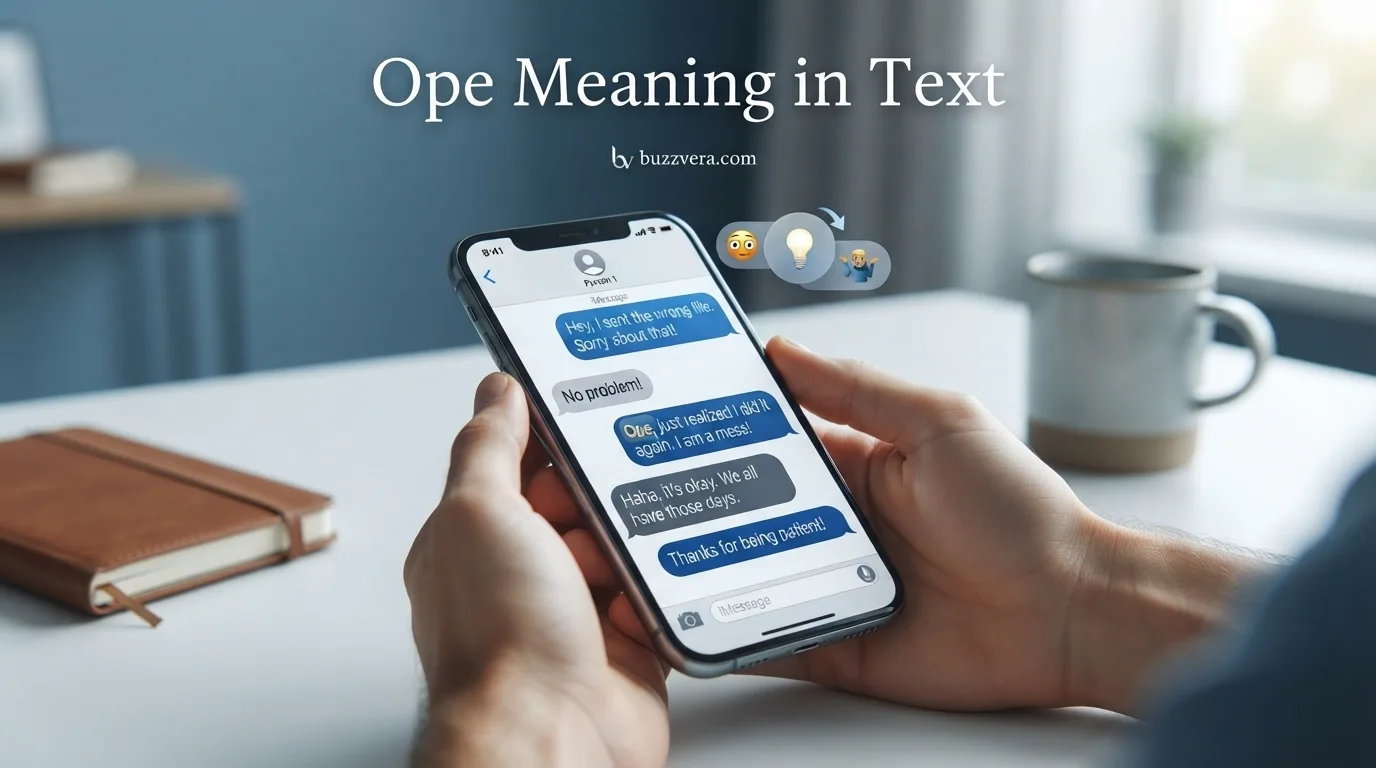
Have you ever seen someone type ope in a text and wondered what they meant? You are not alone. Ope is a short, casual expression that people use when they notice something suddenly, make a small mistake, or need to react to an awkward moment.
For example, someone may say Ope, sorry! after bumping into another person. A friend might text Ope, I forgot to send that! after realizing they missed something. In online chats, the word can also show surprise, embarrassment, or a quick change in attention.
The ope meaning in text depends a lot on the situation and tone. It is usually light, harmless, and informal. You may see it in text messages, social media comments, memes, gaming chats, and casual conversations.
Understanding this small slang word can help you read online conversations more naturally. Instead of treating ope as a serious abbreviation, think of it as a quick reaction to something unexpected.
Ope Meaning in Text: Definition & Meaning
The most common ope meaning in text is a short reaction used when someone notices something unexpected, makes a small mistake, or encounters an awkward situation.
Unlike many texting abbreviations, ope does not usually stand for a longer phrase. It is an interjection, much like:
- Oops
- Oh!
- Oh, sorry
- Excuse me
- Whoa
- I just noticed that
The exact meaning changes with context.
For example:
Person 1: Did you take my charger?
Person 2: Ope, yeah. It was in my bag. Sorry!
Here, ope shows that the person suddenly realized what happened.
Another example:
Friend 1: You just sent that message to the wrong group.
Friend 2: Ope 😭
Here, ope expresses embarrassment and surprise.
It can also be used when someone physically moves around another person:
Person 1: Ope, sorry! Let me get past you.
In this case, it works almost like excuse me.
The word can also appear before an unexpected discovery:
Person 1: Ope, I just found your missing book.
In casual online conversations, ope often makes a message sound more natural and playful. It can soften a small mistake instead of making the situation sound serious.
For instance:
Ope, I forgot your birthday!
sounds more casual than:
I forgot your birthday.
However, ope is not always interchangeable with oops. Oops usually focuses on a mistake, while ope can describe a wider range of small reactions, including noticing something, moving around someone, or experiencing an awkward moment.
So, when someone uses ope in a text, look at the surrounding conversation. Their tone and situation usually reveal the intended meaning.
Ope Meaning in Text: Background & History

The history of ope is not completely clear. It is generally understood as a spoken interjection rather than an abbreviation created specifically for texting.
The expression became especially associated with casual speech in the Midwestern United States. People from the region have often been stereotypically portrayed as saying ope when they suddenly notice something, bump into someone, or need to move around another person.
For example:
Ope, let me sneak past you.
The expression existed in spoken language before social media made it highly visible. As internet culture grew, people began writing the sound exactly as they heard it.
That helped turn ope into a recognizable internet expression.
Its written form became common in:
- Text messages
- Social media
- Memes
- Reddit discussions
- Group chats
- Gaming communities
- Comment sections
The exact origin of the sound is difficult to establish. Some people connect it to expressions such as oops or oh, while others simply view it as a natural vocal reaction to sudden situations. There is no universally accepted explanation proving one single origin.
Over time, ope also became a cultural joke. Online posts sometimes use it to represent a stereotypical Midwestern reaction.
For example:
Ope, just gonna squeeze right past ya.
This kind of phrase is often used humorously to imitate Midwestern speech.
The internet has also expanded the word beyond its original regional association. Someone who has never lived in the Midwest may still use ope because they encountered it through memes, TikTok, social media, or friends.
Today, ope is best understood as a casual reaction word rather than a strict abbreviation.
Ope Meaning in Text: Usage in Various Contexts

The ope meaning in text can change slightly depending on where it appears. The main idea is usually a quick reaction to something unexpected.
Ope in Text Messages
Friends often use ope when they make a small mistake.
Friend 1: You forgot to attach the photo.
Friend 2: Ope, one second!
It can also show sudden realization:
Friend 1: Your meeting starts in five minutes.
Friend 2: Ope! I need to go.
Ope on Social Media
On social media, ope is often playful.
User 1: I accidentally liked a post from 2018.
User 2: Ope 😂
It can make an embarrassing situation sound funny rather than serious.
Ope in Gaming
Gamers may use ope when something unexpected happens.
Player 1: Ope, enemy behind you!
Or:
Player 2: Ope, I fell off the map.
The word adds a quick emotional reaction without needing a long explanation.
Ope in Casual Conversation
Someone might say:
Ope, didn’t see you there.
It can function as a quick response when two people unexpectedly meet.
Ope in Social Situations
It may also be used when someone accidentally interrupts or notices an awkward situation.
Person 1: Ope, sorry. I didn’t mean to interrupt.
Overall, the word is flexible. Surprise, realization, embarrassment, apology, and awkwardness are some of its most common emotional tones.
Ope Meaning in Text: Common Misconceptions & Clarifications

There are several common misunderstandings about ope.
Is Ope an Acronym?
Usually, no.
Ope is generally an interjection, not an acronym. It does not normally mean a specific phrase such as Only People Everywhere or another long expression.
Does Ope Mean Oops?
Sometimes the feeling is similar, but the words are not identical.
Oops usually points to a mistake.
Ope can signal a mistake, but it can also express surprise, realization, or an attempt to get around someone.
Compare:
Oops, I dropped my phone.
with:
Ope, didn’t see you there.
Both show a reaction, but the situations differ.
Is Ope Rude?
Usually, no.
The word itself is generally harmless and informal. However, tone matters. If someone uses it sarcastically during a serious conversation, it may sound dismissive.
Is Ope Only Used by Americans?
No. It is strongly associated with American English and especially Midwestern speech, but internet culture has spread it much further.
Does Ope Have a Hidden Bad Meaning?
In ordinary texting, ope does not normally have an offensive meaning. Still, slang can vary between communities, so context should always be considered.
Ope Meaning in Text: Similar Terms & Alternatives
Several expressions can perform a similar role.
| Term | Common meaning | Typical use |
| Ope | Sudden reaction or realization | Casual texting |
| Oops | Small mistake | Accidental actions |
| Oh | Surprise or realization | General conversation |
| Oh no | Concern or surprise | Unexpected problems |
| Whoa | Strong surprise | Unexpected events |
| Excuse me | Polite interruption or passing | Social situations |
| My bad | Informal apology | Casual mistakes |
| Sorry | Apology | Mistakes or interruptions |
For example:
Ope, sorry!
could sometimes become:
Oops, sorry!
or:
Excuse me!
However, the emotional tone may change.
Ope often sounds more spontaneous and playful, while excuse me is more directly polite.
Ope Meaning in Text: How to Respond to This Term

Your response should depend on why the other person used ope.
Casual Response
If a friend says:
Friend: Ope, I forgot to text you back.
You can say:
Haha, no worries!
Funny Response
Friend: Ope, I sent that to the wrong person.
You:
Ope indeed 😂
This keeps the conversation playful.
Friendly Response
Friend: Ope, sorry for interrupting.
You:
You’re good!
Professional Response
If someone uses ope at work in an informal chat, you do not need to copy the slang.
Coworker: Ope, I missed that attachment.
You could reply:
No problem. Please send it when you have a chance.
Privacy-Conscious Response
If ope appears in a conversation involving something personal, focus on the actual message rather than the slang.
For example:
Person: Ope, I just saw your private post.
You can respond:
Thanks for letting me know. I’d prefer to keep that private.
The main point is that ope itself usually does not require a special response. Respond to the situation behind the word.
Ope Meaning in Text: Regional or Cultural Differences

The use of ope has a strong connection with American English, particularly the cultural stereotype of the Midwestern United States.
In that setting, people may use it in everyday speech:
Ope, let me get around you.
Ope, sorry about that.
As internet culture grew, the word spread beyond the region.
People from other parts of the United States may use it because they hear friends say it or see it online. It can also appear among international internet users who learn American slang through social media.
Different languages have their own expressions that perform similar functions.
For example, depending on the language and situation, people may use an equivalent of:
- Oops
- Oh!
- Oh, sorry!
- Excuse me
- Oh no!
However, these expressions are not exact translations of ope.
The cultural feeling behind the word can also differ. In American internet culture, ope can carry a humorous or deliberately Midwestern tone.
Someone may write:
Ope, just gonna slide past you.
even when they are not actually from the Midwest.
Therefore, the cultural meaning of ope is partly connected to internet humor and regional identity.
Ope Meaning in Text: Comparison with Similar Terms
Understanding similar expressions makes the ope meaning in text easier to recognize.
| Expression | Main purpose | Tone | Example |
| Ope | Quick reaction | Casual | Ope, didn’t see you there. |
| Oops | Mistake | Casual | Oops, wrong chat. |
| Oh | Surprise or realization | Neutral | Oh, I understand. |
| Whoa | Strong surprise | Casual | Whoa, that’s huge! |
| My bad | Informal apology | Casual | My bad, I forgot. |
| Excuse me | Polite interruption | Polite | Excuse me, can I pass? |
| Sorry | Apology | Neutral/polite | Sorry, I interrupted. |
The biggest difference is that ope is more of a spontaneous reaction.
For example:
Ope, there you are!
shows sudden recognition.
Meanwhile:
Sorry, there you are.
does not carry the same natural reaction.
This is why slang users often choose ope when they want their message to sound relaxed and conversational.
Ope Meaning in Text: Online Communities & Dating Apps

The ope meaning in text can also appear in online communities, gaming spaces, and dating conversations.
On social platforms, people may use ope after an unexpected event.
Ope, I just found your old post.
In gaming communities:
Ope, I walked straight into the trap.
The expression can make an embarrassing gaming mistake feel humorous.
Ope on Dating Apps
On dating apps such as Tinder, someone might use ope when they realize something unexpectedly.
Person 1: Wait, you’re into hiking too?
Person 2: Ope, looks like we already have something in common.
Or:
Person 1: I just realized we matched last month too.
Person 2: Ope 😂
The word usually creates a light and relaxed tone.
Still, users should focus on the actual conversation rather than assuming that ope has a hidden romantic meaning. The word itself does not automatically indicate flirting or attraction.
How to Respond Online
If someone sends:
Ope, I didn’t mean to send that.
A simple:
Haha, you’re fine.
is enough.
If the situation is serious, answer the serious part rather than focusing on the slang.
Ope Meaning in Text: Hidden or Offensive Meanings

In standard online use, ope does not have a widely recognized offensive or vulgar meaning.
It is normally a harmless interjection.
However, context can change how any word sounds.
For example:
Ope, whatever.
could sound dismissive if the speaker is clearly annoyed.
Likewise:
Ope, look who finally showed up.
could be playful between friends or sarcastic in another situation.
This is why tone matters more than the word itself.
The surrounding emojis can also change the feeling:
- Ope 😂 → humorous
- Ope 😭 → embarrassed or overwhelmed
- Ope 😅 → awkward or apologetic
- Ope! → sudden surprise
- Ope, sorry! → accidental interruption
People should also avoid assuming that every unfamiliar slang word has a secret meaning. Online dictionaries, memes, and communities sometimes create unusual definitions, but the most common meaning should be determined from context.
Ope Meaning in Text: Suitability for Professional Communication
The ope meaning in text is generally associated with casual communication. Because of this, it is usually better to avoid it in highly formal professional writing.
For example, this is casual:
Ope, I forgot the attachment!
A more professional version would be:
Apologies, I forgot to include the attachment.
Another example:
Casual:
Ope, I’ll send it now.
Professional:
I’ll send it shortly.
In a workplace chat with close coworkers, ope may be acceptable if the communication style is relaxed. However, it is less suitable for:
- Formal emails
- Business proposals
- Reports
- Official letters
- Job applications
- Client communication
- Academic writing
Professional alternatives include:
- Sorry
- Apologies
- Excuse me
- I just noticed
- I apologize for the mistake
- Let me correct that
- I’ll take care of it
The goal in professional communication is clarity. Casual slang can sometimes make a message sound less polished.
FAQs About Ope Meaning in Text
1. What does ope mean in text?
Ope is a casual interjection used for sudden surprise, realization, awkwardness, or a small mistake. It is similar to oops in some situations.
2. Is ope an abbreviation?
No. In most cases, ope is not an abbreviation. It is a spoken-style reaction that people also write in text.
3. Is ope the same as oops?
Not exactly. Oops usually refers to a mistake, while ope can express a broader quick reaction.
4. Why do people say ope?
People use it when something unexpected happens. It can make a reaction sound natural, casual, and sometimes humorous.
5. Is ope a Midwest word?
It is strongly associated with the Midwestern United States, especially through popular internet stereotypes and memes. However, its use has spread far beyond the region.
6. Can I use ope at work?
You can use it in a relaxed workplace chat if the culture allows casual slang. However, it is better to choose more professional wording in formal emails and documents.
7. Does ope have a bad meaning?
Usually, no. Ope is generally harmless. Its tone can change depending on the situation, but it does not normally carry an offensive meaning.
Conclusion: Ope Meaning in Text
The ope meaning in text is usually a quick and casual reaction to something unexpected. It can express surprise, realization, embarrassment, a small mistake, or a polite attempt to move around someone.
Although the word is strongly linked with Midwestern American speech, social media and internet culture have helped spread it to a much wider audience. Today, you may see it in text messages, memes, gaming chats, social media posts, and casual conversations.
The key is context. Ope can sometimes feel similar to oops, but it has a wider range of uses. It is normally informal and harmless, making it a natural choice for relaxed conversations.
For professional communication, however, clearer phrases such as sorry, apologies, excuse me, or I just noticed are usually more suitable.
So, when you see ope in a message, think of it as a quick, natural reaction not a complicated acronym.

Mahi Aylin is a content writer and author at BuzzVera.com, with 3 years of writing experience. She specializes in texting slang, internet abbreviations, modern expressions, and text meanings, creating simple and easy-to-understand content that helps readers confidently navigate today’s digital language.