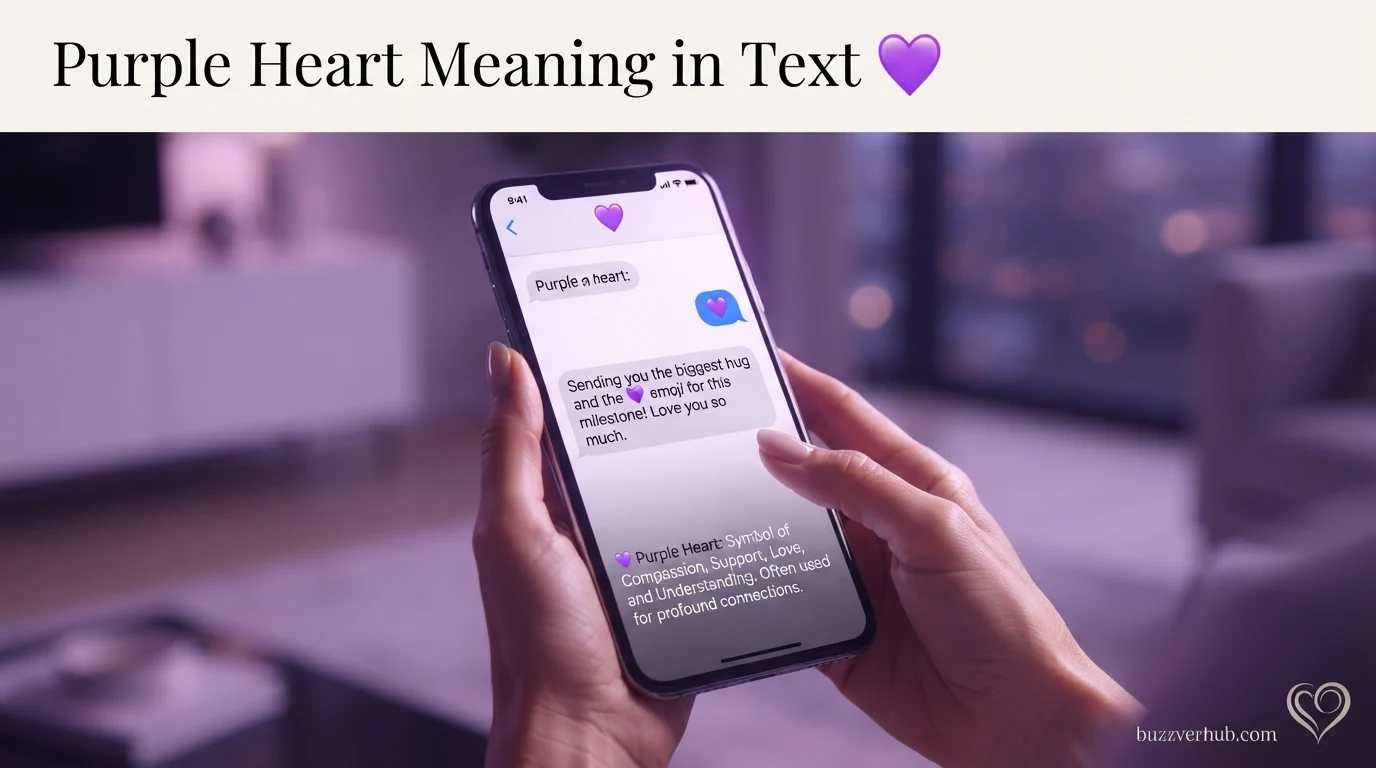
You get a text. It has no words. Just one little 💜.
What does it mean? Is it love? Is it friendship? Is it something else?
The purple heart is one of the most popular emojis today. People send it in texts. They add it to posts. They drop it in game chats and under photos. It looks small. But it carries a lot of feeling.
The trick is that the same emoji can mean different things to different people. A friend might send it to say thank you. A fan might send it to show love for a singer. A crush might send it to say I like you.
In this guide, you will learn what 💜 really means. You will see where it came from. You will see how to use it, how to reply, and when to skip it. By the end, you will know exactly what that purple heart is saying.
Definition & Meaning
The purple heart emoji 💜 is a heart shape in the color purple. In texting, it most often means love, care, and support.
But it is a softer love than the red heart ❤️. Think of it as a warm hug in emoji form.
Here are the most common meanings:
- Friendly love. I care about you.
- Support. I am here for you.
- Gratitude. Thank you so much.
- Fandom love. I am a huge fan.
- Gentle affection. I like you, but I am keeping it light.
- Kindness and comfort. Hang in there.
The color matters. Purple often feels calm, creative, and special. It is less intense than red. That is why many people use it when they want to show love without sounding too serious.
Real-life examples
Example 1: A friend says thanks
Maya: I brought you coffee! Jen: You are the best 💜
Here, 💜 means thank you and I love you as a friend.
Example 2: A comfort text
Sam: Bad day at work. Ugh. Dee: Sorry, friend. Call me later 💜
Here, 💜 means I am here for you.
Example 3: A fan post
Fan: That concert was unreal!! Best night ever 💜💜💜
Here, 💜 shows love for a band or artist.
Key point: In most chats, the purple heart is kind, warm, and safe.
Background & History
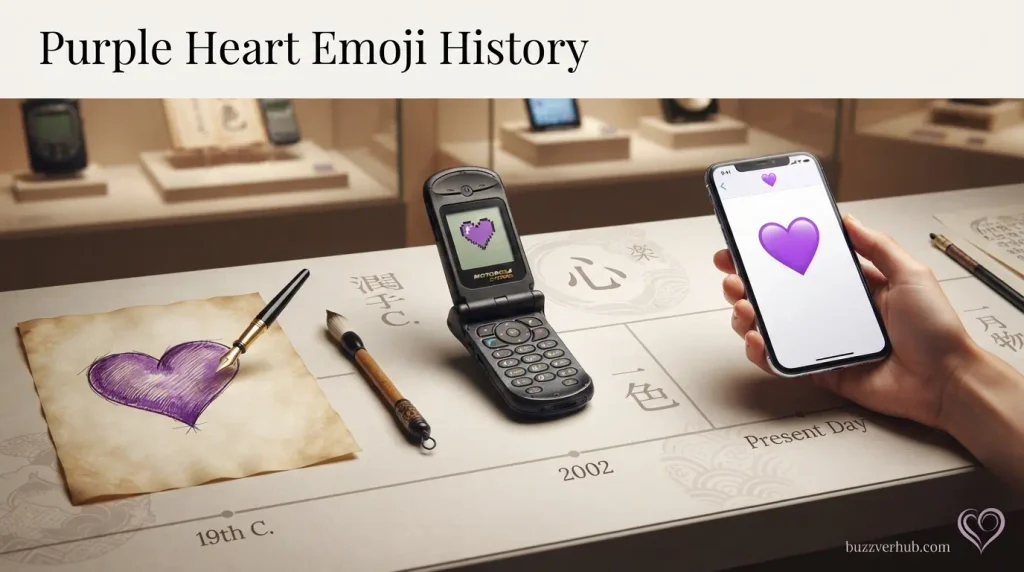
The heart shape has stood for love for hundreds of years. Over time, it moved from paper cards to phone screens.
Where the emoji came from
Emoji started in Japan in the late 1990s. Early phones had only a few hearts. Most were red.
Later, the Unicode group made a global list of emoji. The purple heart was added in 2010 with Unicode 6.0. It then became part of the standard emoji set on phones around 2015. Before this, many people could only send red hearts.
Once colored hearts arrived, people had more ways to speak. Blue, green, yellow, and purple hearts all got their own feelings.
How the meaning grew
At first, 💜 was just a different heart. But it soon picked up special meanings:
- K-pop fans: The group BTS made purple a fan symbol. Their member V created the phrase borahae. It means I purple you. Fans use 💜 to say they love the group and each other.
- Awareness causes: Purple is linked to some health and safety causes, like Alzheimer’s awareness and domestic violence awareness. People sometimes use 💜 to show support.
- Sports and brands: Some teams and brands use purple. Fans send 💜 to show team pride.
- Identity: Purple also shows up in some pride colors, so some people use it to show support or belonging.
Where it is used today
Today, 💜 is everywhere. You will see it in texts, comments, bios, game chats, and dating apps. It has become a go-to symbol for gentle love and support.
Usage in Various Contexts
The purple heart changes a little depending on where you see it. Here is how people use it in different places.
In texting
Between friends and family, 💜 says I care. It often ends a message in a kind way.
Mom: Dinner at 6. Wear a jacket. Leo: Ok Mom 💜
On social media
On Instagram, TikTok, and X (Twitter), 💜 shows up in comments and captions. People use it to cheer on a post.
Comment: Your art is so pretty 💜 Reply: Thank you!! That means a lot 💜
In gaming
Gamers use 💜 to say good game or thanks for the help. It is a friendly sign.
Player 1: Thanks for the revive! Player 2: Anytime 💜 GG
In casual chat
In everyday talk, 💜 can soften a message. It makes words sound nicer.
Ana: Can we move lunch to Friday? Sorry 💜 Kim: No problem!
In fandom spaces
Among fans, 💜 is a bond. It says we love the same thing.
Fan A: Did you hear the new album? Fan B: I cried. Purple forever 💜
In support moments
When someone shares bad news, 💜 is a quiet way to say I see you.
Rae: My test did not go well. Tom: You tried your best. Proud of you 💜
Key point: The place changes the vibe, but the core feeling stays the same: care and warmth.
Common Misconceptions & Clarifications
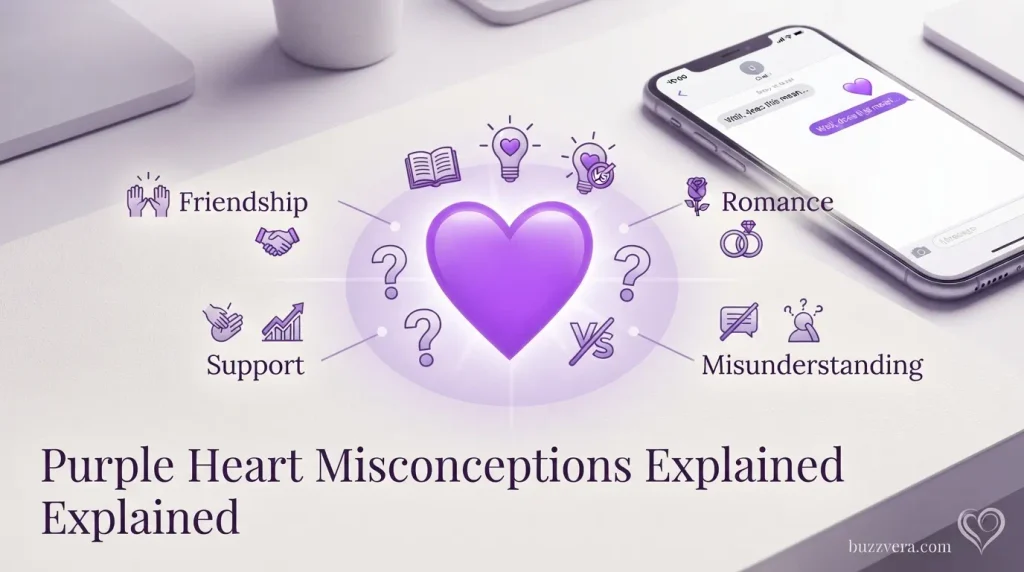
Some people read too much into the purple heart. Let’s clear up the big mix-ups.
Misconception 1: It means romantic love.
Not always. The red heart ❤️ is the main romantic one. The purple heart is often platonic. That means it is for friends, family, and fans.
But sometimes it is romantic. If someone you are dating sends it, it can mean I really like you. Look at the full picture. Who sent it? What else did they say?
Misconception 2: It means the person is upset.
No. Purple is not a sad color in emoji language. Some people link blue hearts 💙 with sadness. Purple is more calm and caring.
Misconception 3: It has a secret rude meaning.
Mostly, it does not. Unlike some emojis, 💜 has no widely known rude meaning. It is a safe pick.
Misconception 4: It is the same as the Purple Heart medal.
The Purple Heart medal is a US military award for people wounded or killed in service. It is a real honor. The emoji is a different thing. In most texts, 💜 is not about the medal. But in a military setting, context might point to it.
Misconception 5: Everyone uses it the same way.
They do not. Some people send 💜 all the time. Others use it only for special people. Learn how your friend uses it before you decide what it means.
How to read it right
Ask yourself three things:
- Who sent it?
- What was the message about?
- How do they usually text?
The answers will tell you the true meaning.
Similar Terms & Alternatives
Many hearts and symbols have a close feeling to 💜. Here are the best ones.
| Emoji / Phrase | Typical Meaning | Feels Like |
| ❤️ Red heart | Romantic or deep love | Strong, classic |
| 🩷 Pink heart | Sweet, cute love | Soft, sweet |
| 💙 Blue heart | Trust, calm, loyalty | Steady, cool |
| 💚 Green heart | Friendship, growth, nature | Fresh, friendly |
| 🤍 White heart | Pure, peaceful love | Clean, gentle |
| 🖤 Black heart | Dark humor, edgy love | Moody |
| 🧡 Orange heart | Warmth, friendship | Cheerful |
| 💛 Yellow heart | Happy, bright friendship | Sunny |
| 💞 Revolving hearts | Deep affection | Big feelings |
| 🫶 Heart hands | Love and thanks | Warm, kind |
Words that mean the same
If you do not want to use an emoji, try these:
- Love you!
- Thinking of you.
- You are the best.
- Sending hugs.
- Proud of you.
- Thank you so much.
Key point: 💜 sits right in the middle. It is warmer than a smile, softer than a red heart.
How to Respond to This Term

Got a 💜? Here is how to answer. Pick the style that fits you.
Casual reply
Keep it simple and friendly.
Friend: Good luck today 💜 You: Thank you!! 💜
You can also just send one back. Easy.
Funny reply
Add some play.
Friend: Love you 💜 You: Love you more. I’m adding a cookie to this 🍪
Or:
Friend: You are the best 💜 You: I know. My mom says so too 😄
Warm reply
Show real feeling.
Friend: I’m so proud of you 💜 You: That means the world to me. Thank you for always being there.
Professional reply
If a coworker sends 💜, keep it light and polite.
Coworker: Great job on the report 💜 You: Thank you! I appreciate the kind words. Happy to help anytime.
Privacy-conscious reply
Not sure what the sender means? Not ready to share feelings? Stay kind but calm.
Contact: Thinking of you 💜 You: Thanks, that’s kind. Hope your week is going well.
Or ask gently:
You: That’s sweet! What made you think of me?
What to avoid
- Do not over-read it.
- Do not panic if it feels too close.
- Do not ignore it if it is a kind gesture.
Key point: A simple thank you works almost every time.
Regional or Cultural Differences
Hearts are known around the world. But colors can shift in meaning from place to place.
English-speaking countries
In the US, UK, Canada, and Australia, 💜 means friendly love, support, and fandom. It is seen as sweet and safe.
South Korea
Purple has a special place thanks to BTS and borahae. Fans across Korea and the world use 💜 as a loving fan code. It is both a color and a community.
Japan
Japan has a long history with emoji. Colored hearts are popular. Purple is often seen as elegant and special. It can also suggest a mix of cool and warm feelings.
Latin America
Hearts are used in warm and open ways. 💜 is often used for affection, friendship, and sometimes romance. In some places, purple is tied to religious seasons like Lent, so it can feel serious in that setting. In others, it may link to women’s rights marches, where purple is a strong color.
Parts of Europe
Purple has links to royalty and history. The emoji can feel stylish. In some places, it is also linked to feminist movements.
Southeast Asia and beyond
Purple can carry deeper meanings in some places. In a few cultures, purple is tied to mourning or respect. The heart emoji is usually still seen as kind. But it is smart to know your audience.
Slang variations
- Purple you — a fan phrase for I love you.
- Purple heart energy — kind, calm, supportive vibes.
- Send purple — send support.
Key point: The emoji is friendly almost everywhere, but the extra meanings change by place and group.
Comparison with Similar Terms
How is 💜 different from other hearts? Let’s compare them side by side.
| Emoji | Best For | Level of Intensity | Romantic? |
| 💜 Purple | Support, fandom, soft affection | Medium-low | Sometimes |
| ❤️ Red | Love, romance, deep care | High | Often |
| 💙 Blue | Trust, calm, loyalty | Medium | Rarely |
| 💚 Green | Friendship, growth | Low-medium | Rarely |
| 🩷 Pink | Cute, sweet affection | Medium | Sometimes |
| 🖤 Black | Dark humor, edgy style | Varies | Sometimes |
| 💛 Yellow | Happy friendship | Low | Rarely |
Key differences in plain words
- 💜 vs ❤️: Red is bold. Purple is gentle. Red often says I love you. Purple often says I care about you.
- 💜 vs 💙: Blue is about trust and calm. Purple is warmer and more emotional.
- 💜 vs 🩷: Pink is sweet and cute. Purple is deeper and more caring.
- 💜 vs 💚: Green is for friends. Purple is for friends too, but with more heart.
- 💜 vs 🖤: Black can be dark or funny. Purple is kind and soft.
Quick example
Alex: Sent you a ❤️. Bri: Whoa, that’s big! Alex: Fine, here’s a 💜. Better? Bri: Much less scary 😂
Key point: If you want to show love without sounding too serious, 💜 is a great pick.
Usage in Online Communities & Dating Apps
The purple heart is a star in online spaces. Here is how it shows up.
On dating apps (Tinder, Hinge, Bumble)
On dating apps, 💜 usually means I like you, but I’m easy-going. It is friendly and a little flirty. It is not as heavy as ❤️.
Match: Your dog is so cute 💜 You: Thanks! His name is Max. He’s the real star.
A 💜 in a bio can also mean the person is kind, creative, or into fandoms.
On X (Twitter) and Instagram
Here, 💜 is used for support, fandom, and kind replies. Fans of artists often add it to their names. It shows who they love.
Reply: Congrats on the new job 💜 Original poster: Thank you so much!
On TikTok
People drop 💜 in comments to cheer for creators. It is also used in stan culture, where fans show big love.
In gaming communities (Discord, Twitch, Xbox, PlayStation)
Twitch uses purple as its brand color. So 💜 is a common sign of support for streamers. Viewers spam it in chat during big moments.
Viewer: That clutch was outrageous 💜💜💜 Streamer: Thank you all!
Tips for responding
- On dating apps: Match their energy. A 💜 back is sweet and safe.
- With a stranger: Stay polite. Do not assume romance.
- In fan spaces: Join the fun. 💜 is a group hug.
- If unsure: Ask a friendly question.
Key point: Online, 💜 builds warmth and belonging fast.
Hidden or Offensive Meanings
Good news: the purple heart has very few hidden or rude meanings. It is one of the safer emojis.
Possible alternate meanings
- Flirting. Sometimes 💜 is a soft flirt. A person may use it when they like someone but do not want to say it outright.
- Group signals. In some online groups, purple is a code for belonging. This is usually harmless.
- Causes. Purple can stand for awareness of certain health and safety causes. This is positive.
- Military link. In some settings, it may point to the Purple Heart medal. That is respectful, not rude.
Could it be offensive?
Rarely. But tone and context matter. Here are some times it might feel wrong:
- During a serious loss. If someone shares terrible news, a lone 💜 can feel too small. Add words.
- From a stranger. A 💜 from someone you do not know can feel odd or pushy.
- From a boss or teacher. It may feel too personal in some places.
- In a fight. Sending 💜 in an angry chat can feel fake or sarcastic.
Sarcasm
Like any emoji, 💜 can be used with a joke or an eye roll.
Friend: Thanks for ditching me 💜 You: Ouch. I’m sorry!
Here, the 💜 is sarcastic. The words around it show the real mood.
Why tone matters
An emoji is a tiny clue. The words, timing, and person tell the full story. When in doubt, ask. A quick What do you mean? clears up most confusion.
Key point: The purple heart is kind by default. Only context can turn it sour.
Suitability for Professional Communication
Can you use 💜 at work? The answer is: it depends.
When it is okay
- Friendly workplaces. If your team uses emojis, 💜 is fine.
- Internal chats like Slack or Teams. A 💜 can thank a coworker.
- Non-profits and creative fields. These spaces often like warm tones.
- After you know the person well.
Manager: Great work this week, team 💜 Team member: Thanks! Happy to be here.
When to skip it
- Emails to clients or new contacts.
- Formal letters or reports.
- Messages to senior leaders you don’t know well.
- Legal, finance, or strict corporate settings.
- Any time you are unsure.
Why caution helps
At work, you want to sound clear and respectful. A heart can make some people feel unsure. They may read it as too friendly or too personal.
Professional alternatives
Instead of 💜, try:
| Instead of… | Try saying… |
| 💜 | Thank you so much. |
| 💜 | I really appreciate your help. |
| 💜 | Great work on this. |
| 💜 | Warm regards. |
| 💜 | Thanks for your support. |
| 💜 | 👍 or 🙏 (if emojis are okay) |
Simple rule
Follow the room. If your team uses emojis, you can too. If not, stay with words.
Key point: Words are always safe. Emojis are safe only when the culture allows them.
FAQs
1. What does the purple heart emoji mean in text?
It mostly means love, care, support, and thanks. It is a soft, friendly kind of love. It is often used between friends, family, and fans.
2. Is the purple heart romantic?
Sometimes, but not always. The red heart is the main romantic one. A purple heart can be romantic if the sender is a crush or partner. Check the context.
3. What does 💜 mean from a girl or guy I like?
It usually means they like you and feel warm toward you. It is a soft sign of interest. But it may also be plain friendship. Pay attention to their other words and actions.
4. Why do BTS fans use the purple heart?
Purple became the fan color for BTS. The phrase borahae means I purple you. Fans use 💜 to show love for the group and for each other.
5. Is the purple heart emoji the same as the Purple Heart medal?
No. The medal is a US military honor. The emoji is just a heart in purple. They are not linked, but context may bring the medal to mind.
6. Can I use 💜 at work?
Yes, if your workplace is casual and uses emojis. If it is formal, use words instead.
7. What should I reply when someone sends me 💜?
Send a 💜 back, or say Thank you! That works in almost every case. Match the tone of the sender.
Conclusion
The purple heart 💜 is a small emoji with a big heart. It means love, care, support, and thanks. It is gentler than a red heart. It is perfect for friends, family, fans, and sweet moments.
Remember these key points:
- It is mostly friendly and safe.
- It can be romantic, but check the context.
- Fans, gamers, and creators love it.
- It rarely has a rude meaning.
- At work, follow your team’s style.
- A simple thank you or a 💜 back is a great reply.
Next time you see that little purple heart, you will know what it says. It says: I care. And that is a message worth sending. 💜

Mafia Noor is an experienced content writer and author at BuzzVera.com, with 3 years of experience creating helpful and easy-to-understand content. Mafia specializes in texting slang, internet abbreviations, modern expressions, and text meanings, helping readers understand today’s digital language clearly and confidently.