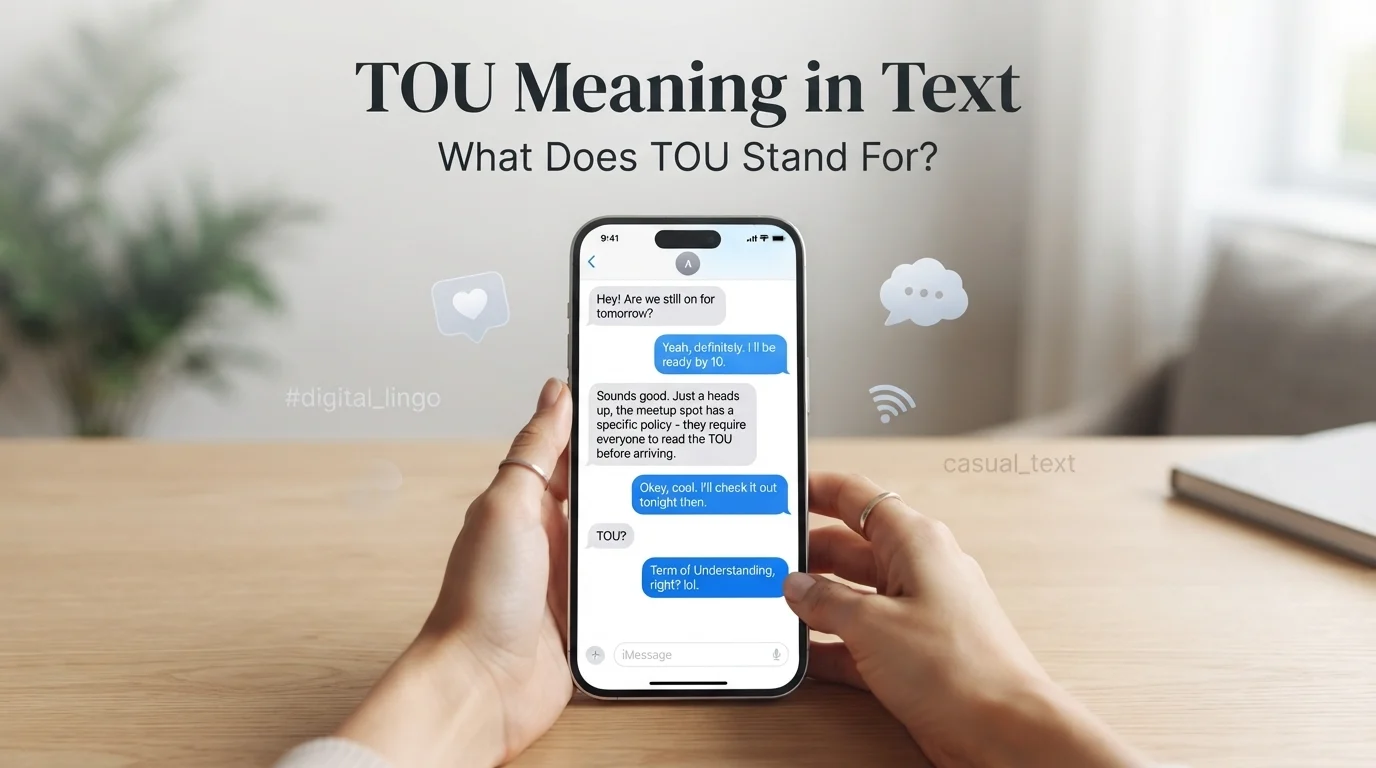
Have you ever received a message containing TOU and wondered what it means? Internet slang can be confusing, especially when people use short forms in texts, social media comments, and online chats. One small abbreviation may have more than one meaning, depending on the conversation.
In casual texting, TOU commonly stands for Thinking of You. People may use it to show care, affection, or support. However, TOU can also mean Terms of Use or Time of Use in websites, apps, technology, and business discussions.
Understanding the TOU meaning in text helps you read messages correctly and avoid confusion. If you are chatting with a friend, talking to someone you like, playing an online game, or reading website instructions, the surrounding words can help you understand the intended meaning.
In this guide, we will explore the meanings, uses, examples, alternatives, and common misunderstandings related to TOU.
What Does TOU Mean in Text?

The most common informal meaning of TOU in text is Thinking of You. It is a short expression used to tell someone that they are on your mind.
People may send TOU to a friend, family member, partner, or someone they care about. It can express kindness, friendship, affection, or emotional support. The exact feeling depends on the relationship between the people and the rest of the message.
Here, TOU means Thinking of You. The sender is showing concern and support.
Another example is:
Person 1: I watched a movie today that reminded me of you.
Person 2: Aww, that’s so sweet!
it made me smile. Just wanted you to know I’m thinking of you (TOU). 😊
The abbreviation can also appear at the end of a conversation:
Good night! TOU ❤️
In this case, the sender may be expressing affection or simply letting the other person know they are thinking about them.
Other Meanings of TOU
Although Thinking of You is a recognized texting meaning, TOU is not limited to casual conversations.
| TOU Meaning | Where It Is Used | Explanation |
| Thinking of You | Texting and online chats | Expressing care or affection |
| Terms of Use | Websites and apps | Rules that explain how a service may be used |
| Time of Use | Energy, technology, and business | Refers to a particular period when something is used |
| Time-of-Use Pricing | Electricity services | Pricing that changes according to the time of consumption |
The abbreviation may also appear as a typo when someone intends to type you. Therefore, the conversation is important when deciding what TOU means.
Texting references commonly list Thinking of You as an informal meaning, while abbreviation databases also record technical meanings such as Terms of Use and Time of Use. (slang.net)
Background and History of TOU

The exact origin of TOU as a texting abbreviation is not clearly documented. Unlike well-known expressions such as LOL, BRB, and OMG, there is limited reliable historical evidence showing when TOU first became popular.
However, the use of short forms in digital communication has a long history. People began using abbreviations in text messages and online chats to save time, reduce typing, and communicate quickly. As mobile phones, instant messaging, and social media became more common, informal abbreviations spread across different online communities.
The phrase Thinking of You has existed in everyday communication for many years. People have used it in letters, greeting cards, phone calls, and personal messages to express care. TOU is a shortened form that can communicate a similar idea in a quick digital message.
For example, instead of writing:
I just wanted to let you know that I am thinking of you today.
Someone might write:
TOU ❤️
However, TOU is not universally understood. Some people may recognize it immediately, while others may think it is a spelling mistake or an abbreviation for something technical.
The term also has an established role outside texting. Terms of Use is widely used on websites and apps to describe the rules that users agree to follow. Similarly, Time of Use is used in energy systems, business reports, and technology.
Today, the meaning of TOU depends largely on the platform and the surrounding conversation. In a personal chat, it may suggest Thinking of You. On a website, it may refer to Terms of Use. In an electricity discussion, it may refer to Time of Use. (Abbreviations)
How Is TOU Used in Different Contexts?

The TOU meaning in text can change according to the situation. Here are some common contexts where you may encounter it.
1. TOU in Text Messages
Friends and family members may use TOU as a short way to express care.
Example:
A: Hey, are you feeling better today?
B: A little better, thanks.
A: Glad to hear that. TOU!
Here, TOU means Thinking of You.
Another example:
Good luck with your interview today. TOU!
The sender is offering encouragement and showing that they care.
2. TOU on Social Media
People may use TOU in comments, private messages, or posts. It may appear when someone wants to support another person.
Example:
User 1: Missing my old friends today.
User 2: TOU! Hope we can meet soon.
In this conversation, TOU expresses friendly affection.
However, TOU is not a universal social media abbreviation. Many users may not recognize it, so writing the full phrase can sometimes be clearer.
3. TOU in Gaming Communities
Gaming conversations often use short forms because players communicate quickly during matches. However, TOU is not a widely established gaming term with one universal meaning.
If someone writes:
Player 1: I haven’t played with you in ages.
Player 2: TOU, bro! Let’s play tonight.
The sender may mean Thinking of You, although the meaning should be confirmed from context.
In gaming, TOU could also refer to a technical phrase or a game-specific term. Therefore, do not automatically assume it means Thinking of You.
4. TOU in Professional Conversations
In a workplace, TOU may refer to Terms of Use or Time of Use.
Example:
Employee: Where can I find the rules for this software?
Manager: Please review the TOU before using the platform.
Here, TOU means Terms of Use.
Another example:
Manager: The electricity report includes TOU data.
Employee: Does that refer to Time of Use?
In this situation, the abbreviation is technical rather than emotional.
Common Misconceptions About TOU
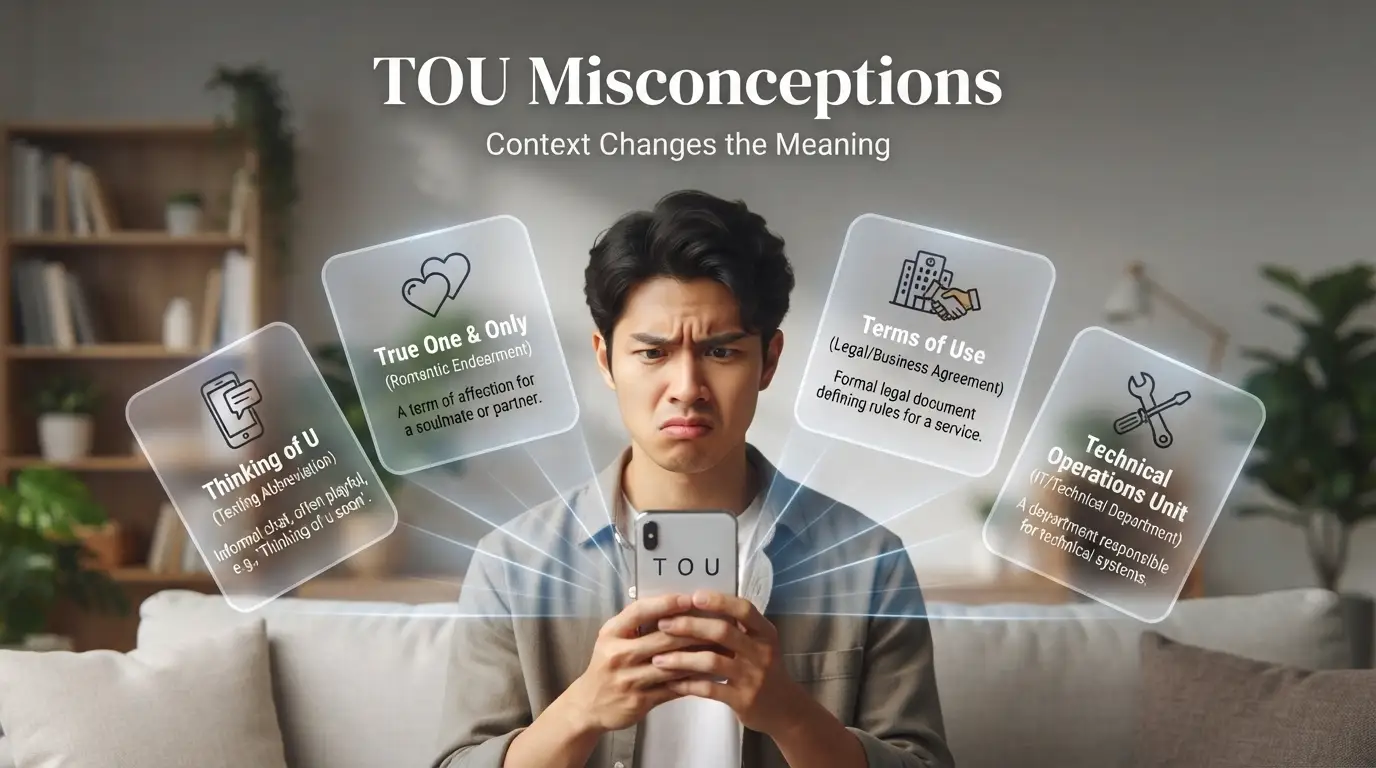
Because TOU has multiple meanings, people can easily misunderstand it. Here are some common misconceptions.
Misconception 1: TOU Always Means Thinking of You
This is not correct. TOU may mean Thinking of You in a personal chat, but it can also refer to Terms of Use or Time of Use.
Example:
Please read the TOU before creating an account.
This clearly refers to website rules, not a personal message.
Misconception 2: TOU Is Always a Romantic Expression
TOU can express affection, but it does not automatically indicate romantic interest.
A friend may write:
TOU! Hope your exam goes well.
A family member may also use the abbreviation. The meaning depends on the relationship and the message.
Misconception 3: TOU Is a Common Typing Shortcut for You
Some people may type tou accidentally when they mean you. This can happen because of fast typing or a keyboard mistake.
For example:
Can tou send me the file?
The writer may simply have made a typo.
There is no reliable rule that says every use of tou is a typo. It may be an abbreviation, a technical term, or a spelling mistake.
Misconception 4: TOU Is an Offensive Word
TOU is not generally recognized as an offensive or vulgar word in texting. When it means Thinking of You, it usually has a friendly or caring tone.
Still, the abbreviation can cause confusion if the receiver does not know what it means. Clear communication is especially important in professional or unfamiliar conversations.
Similar Terms and Alternatives to TOU
If you want to express care or affection, several other phrases may be easier to understand than TOU.
| Term or Phrase | Meaning | Common Use |
| TOU | Thinking of You | Short personal messages |
| ILY | I Love You | Romantic or close relationships |
| IMY | I Miss You | Expressing that someone is missed |
| TTYL | Talk To You Later | Ending a conversation |
| Take Care | A friendly expression of concern | Texts and everyday conversations |
| Thinking of You | A full phrase showing care | Personal messages and cards |
| Hope You’re Well | A polite check-in | Personal or professional messages |
| Sending Love | Expressing affection and support | Friends, family, and partners |
TOU vs. IMY
TOU means Thinking of You, while IMY means I Miss You.
For example:
TOU! Hope your day is going well.
This shows that someone is on your mind.
IMY. I wish you were here.
This directly expresses that you miss someone.
TOU vs. ILY
ILY means I Love You. It is usually stronger and more direct than Thinking of You.
For example:
TOU ❤️
This may express affection or care.
ILY ❤️
This directly communicates love.
The two expressions should not automatically be treated as having the same emotional meaning.
How to Respond When Someone Says TOU
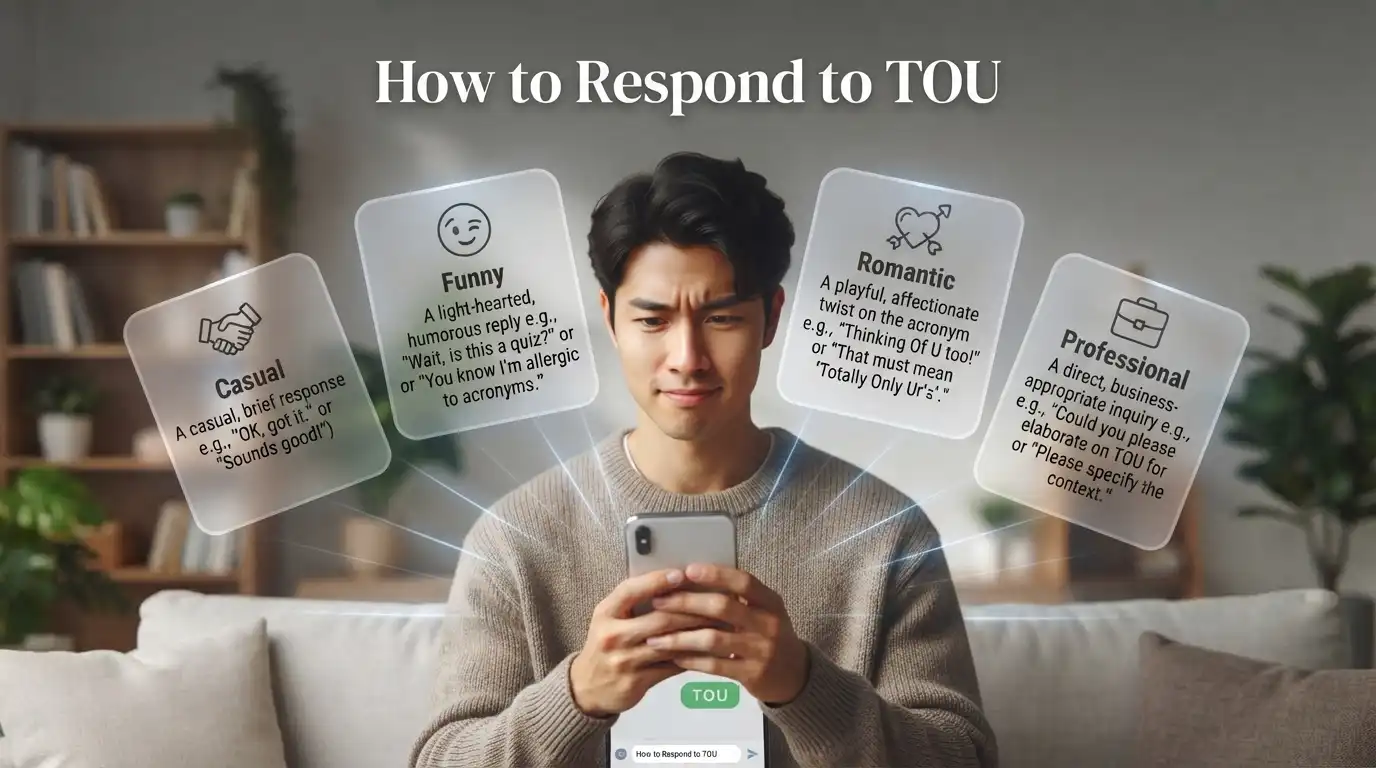
Your response can depend on what you think the sender means and how close you are to that person.
1. Casual Response
If a friend sends TOU, you can reply in a friendly way.
Example:
Friend: TOU! Hope you’re doing well.
You: Aww, thanks! Thinking of you too.
Other casual replies include:
- That’s sweet of you!
- Thanks for checking in!
- Thinking of you too 😊
- Hope your day is going well!
2. Funny Response
If you have a playful relationship with the sender, you can respond with humor.
Example:
Friend: TOU 😂
You: Wow, I’m famous enough to be on your mind!
Or:
Friend: TOU!
You: Same brain, same thoughts!
Make sure the joke fits your relationship. Humor may not be suitable if the sender is discussing a serious problem.
3. Romantic Response
If someone you like sends TOU, you can respond warmly.
Example:
Person 1: TOU ❤️
Person 2: That’s so sweet. Thinking of you too ❤️
Other replies include:
- You’ve been on my mind too.
- Aww, I was just thinking about you.
- That made me smile.
- Sending you a big hug.
4. Professional Response
If TOU appears in a work message, first determine If it means Terms of Use or Time of Use.
Example:
Colleague: Please check the TOU before using the software.
You: Sure, I’ll review the Terms of Use.
If the meaning is unclear, you can ask:
Could you clarify what TOU refers to here?
5. Privacy-Conscious Response
If the sender is someone you do not know well, you can reply politely without sharing personal details.
Example:
Stranger: TOU.
You: Thanks. Hope you’re having a good day.
If the message feels confusing or uncomfortable, you can simply ask:
What do you mean by TOU?
Regional and Cultural Differences in TOU Usage
The TOU meaning in text may vary across languages, regions, and online communities.
In English-language texting, TOU may be understood as Thinking of You, although it is not a universally recognized abbreviation. Some people may be more familiar with other expressions, such as Thinking of you, Miss you, or Take care.
In multilingual conversations, the letters may have a different meaning. For example, tou can appear as part of words in other languages, and it may not function as an English abbreviation at all.
The same abbreviation can also have different meanings in different industries. A person working with electricity may understand TOU as Time of Use, while someone reading website policies may understand it as Terms of Use.
Cultural communication styles also matter. Some people prefer direct and complete phrases, while others enjoy short internet expressions. An abbreviation that feels warm to one person may seem confusing to another.
For this reason, it is helpful to consider:
- The language of the conversation.
- The relationship between the people.
- The platform where the abbreviation appears.
- The topic being discussed.
- If the conversation is personal or professional.
When the meaning is uncertain, asking for clarification is usually the simplest solution.
TOU Compared With Similar Expressions
Several abbreviations may appear similar to TOU, but they do not communicate exactly the same message.
| Expression | Full Meaning | Main Difference |
| TOU | Thinking of You | Shows that someone is on your mind |
| IMY | I Miss You | Expresses that someone is missed |
| ILY | I Love You | Directly expresses love |
| TY | Thank You | Shows gratitude |
| HBU | How About You? | Asks another person a question |
| TTYL | Talk To You Later | Signals that a conversation will continue later |
| TC | Take Care | Offers a friendly wish for someone’s well-being |
| FYI | For Your Information | Shares information |
Example Comparison
TOU:
TOU! Hope everything is going well.
IMY:
IMY. I wish we could hang out today.
ILY:
ILY. You mean so much to me.
TC:
I have to go now. TC!
These expressions have different purposes. Choosing the right one can make your message clearer.
TOU in Online Communities and Dating Apps

People use abbreviations on social media, messaging apps, gaming platforms, and dating services. However, TOU is not a standard or universally recognized expression on every platform.
TOU on Dating Apps
If someone sends TOU on a dating app, they may mean Thinking of You. It could be friendly, affectionate, or mildly flirtatious, depending on the conversation.
Example:
Person 1: I had a great time talking to you yesterday.
Person 2: Same here. TOU 😊
A warm response could be:
That’s sweet! I enjoyed talking to you too.
However, do not assume that TOU automatically means romantic interest. The sender may simply be expressing friendliness.
TOU on Social Media
A user may write TOU in a comment or direct message to show support.
Example:
User 1: Feeling a little sad today.
User 2: TOU. Hope you feel better soon.
The meaning is likely caring, but the abbreviation may not be familiar to everyone.
TOU in Gaming Communities
Gaming communities often use fast, informal language. If someone uses TOU, the meaning may depend on the specific group or game.
When the context is unclear, you can ask:
Does TOU mean Thinking of You here?
This avoids guessing.
Tips for Responding Online
- Consider the conversation before interpreting the abbreviation.
- Do not assume TOU is romantic.
- Ask for clarification if the message is unclear.
- Avoid using unfamiliar abbreviations in serious conversations.
- Respect personal boundaries when chatting with strangers.
Hidden or Offensive Meanings of TOU
There is no widely established offensive meaning of TOU in ordinary texting. When used as Thinking of You, it generally communicates kindness or affection.
However, abbreviations can be misunderstood. A person may interpret TOU as a typo, a technical term, or a phrase specific to an online group.
For example:
Please accept the TOU before continuing.
This refers to Terms of Use, not an emotional message.
Similarly:
Our TOU rates are higher during peak hours.
This likely refers to Time of Use pricing.
The tone of a message also matters. A short abbreviation may feel warm when sent by a close friend but confusing when sent by a stranger.
If someone uses TOU in a way that seems unusual, ask what they mean rather than assuming the message has a hidden meaning.
Is TOU Suitable for Professional Communication?

The suitability of TOU depends on its meaning.
TOU Meaning Thinking of You
When TOU means Thinking of You, it is generally informal. It may be appropriate in a friendly conversation with a close colleague, but it is not the clearest choice for formal emails or official messages.
Instead, you could write:
- I hope you are doing well.
- I wanted to check in.
- I hope everything is going smoothly.
- Wishing you a good day.
- I hope you feel better soon.
For example, instead of writing:
TOU. Hope your meeting goes well.
You could write:
I hope your meeting goes well today.
The second version is clearer for professional communication.
TOU Meaning Terms of Use
When TOU means Terms of Use, it is appropriate in technical, legal, and business contexts.
Example:
Users must review the TOU before accessing the platform.
In this case, the abbreviation is relevant and professional.
TOU Meaning Time of Use
Time of Use is also suitable in technical and business discussions.
Example:
The report includes Time of Use electricity rates.
The important point is to use the abbreviation only when the audience understands it.
Frequently Asked Questions About TOU Meaning in Text
1. What does TOU mean in text messages?
TOU commonly means Thinking of You. It is used to express care, affection, or support. However, the meaning can change depending on the conversation.
2. Is TOU a romantic abbreviation?
It can be romantic, but it is not always romantic. Friends, relatives, and partners may all use TOU. The relationship and message tone help explain its meaning.
3. What does TOU mean on social media?
On social media, TOU may mean Thinking of You when used in a personal conversation. However, it can also be a typo or a different abbreviation.
4. Is TOU a bad word?
No. TOU is not generally recognized as a vulgar or offensive word. Its common informal meaning is Thinking of You.
5. What does TOU mean in business?
In business or technology, TOU may mean Terms of Use or Time of Use. The correct meaning depends on the topic.
6. How should I respond to TOU?
If TOU means Thinking of You, you can reply, Thinking of you too! If you are unsure, ask, What do you mean by TOU?
7. Is TOU the same as IMY?
No. TOU means Thinking of You, while IMY means I Miss You. They are related but express different feelings.
Conclusion
Understanding the TOU meaning in text can help you communicate more clearly online. In personal messages, TOU commonly means Thinking of You and may express care, friendship, or affection. However, it can also mean Terms of Use or Time of Use in technical and professional contexts.
The most important step is to consider the surrounding words, the platform, and the relationship between the people involved. If the meaning is unclear, asking for clarification is always a good choice.
If you are texting a friend, replying to someone on social media, or reading website instructions, knowing the possible meanings of TOU can help you avoid confusion and understand digital conversations more easily.

Mahi Aylin is a content writer and author at BuzzVera.com, with 3 years of writing experience. She specializes in texting slang, internet abbreviations, modern expressions, and text meanings, creating simple and easy-to-understand content that helps readers confidently navigate today’s digital language.