You see “TTS” in a chat. You pause. What does it mean?
Don’t worry. It happens to everyone. Texting is full of short codes. New ones show up all the time.
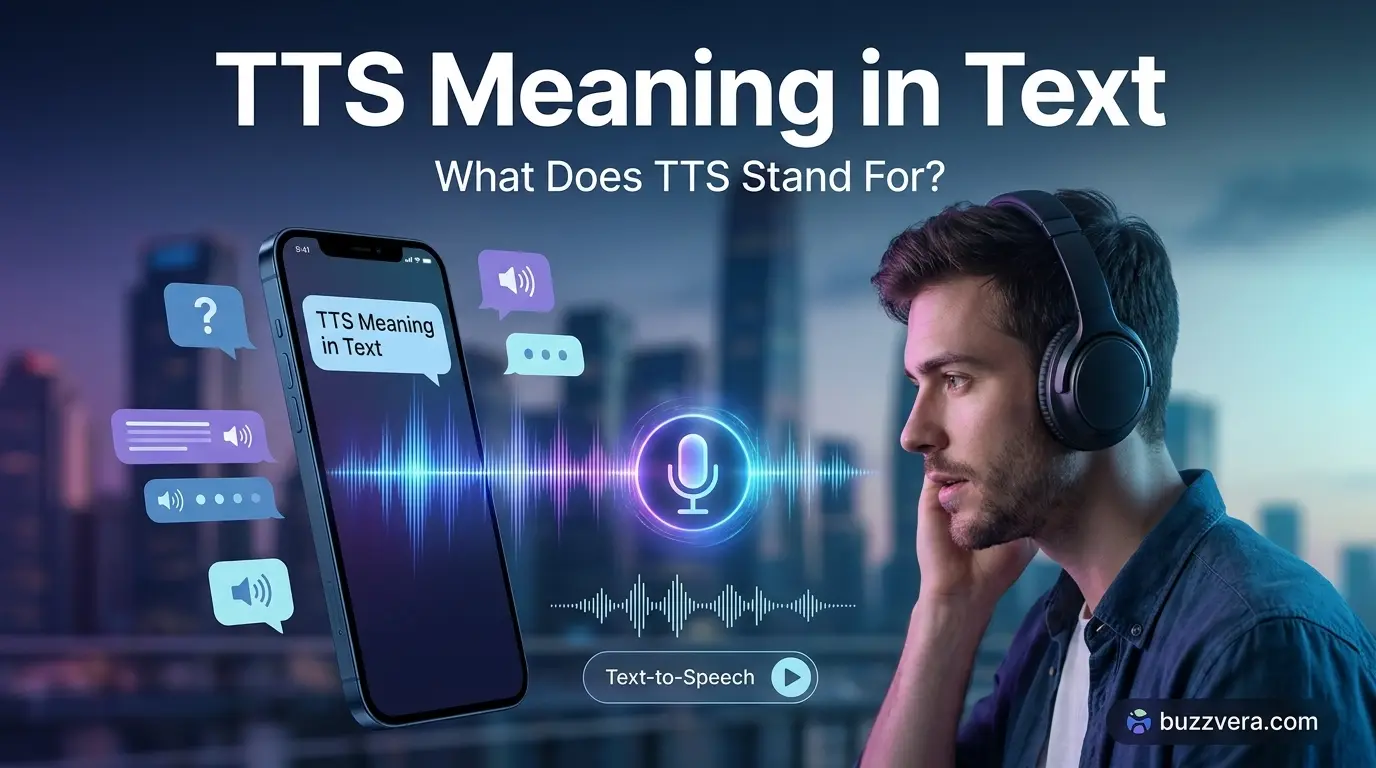
TTS usually means “text-to-speech.” It is a tool that reads written words out loud. A computer voice speaks the text for you.
You will see it in many places. People use it in group chats. Gamers use it on Discord. Streamers use it on Twitch. Creators use it on TikTok. Even work chats mention it now and then.
Why does it matter? Because the same three letters can confuse you. If you guess wrong, you may reply in a strange way. A quick lesson fixes that.
In this post, you will learn the meaning, the story, and the best ways to reply. Let’s start.
Definition: The TTS Meaning in Text Explained
TTS stands for “text-to-speech.”
Text-to-speech is a feature. It turns written words into spoken words. You type a message. A computer voice reads it aloud.
Think of it like a robot reader. You give it words. It gives you sound.
Here is how it works in simple steps:
- You write or paste text.
- The software reads the text.
- It picks sounds that match the words.
- You hear a voice speak.
That is all. No magic. Just clever software.
Where you see it:
- Phones and tablets (often found in accessibility settings)
- Computers and web browsers
- Video apps like TikTok
- Game chats like Discord
- Live streams where viewers send messages that get read aloud
Why do people use it?
- Some people cannot see well. TTS helps them read.
- Some people like to listen while they do other things.
- Some people think the robot voice is funny.
- Streamers use it so donations get read out loud.
Let’s look at real examples in text form.
Example 1: Asking about a phone feature
Mia: My phone reads my texts out loud. How?
Jay: Turn on TTS in settings.
Mia: TTS? Oh, text-to-speech!
Example 2: In a stream chat
Viewer: Can you turn TTS on for donations?
Streamer: Yes! Send a message and my bot will read it.
Example 3: On a video
Leo: Did you make this with TTS?
Ana: Yep. I typed the words and used the robot voice.
Notice a pattern. In each case, TTS means a voice reads the words. That is the main meaning. Hold on to it.
Background & History: Where the TTS Meaning in Text Came From
The idea of a talking machine is old. People wanted machines to speak long before phones existed.
Early days. In 1939, a machine called the Voder was shown at the World’s Fair. A trained operator played it like an instrument. It made speech-like sounds. People were amazed.
The computer age. In the 1980s, computers got better at speech. One famous system was DECtalk. It had a flat, robotic tone. Many people heard it back then. Some people with speech needs used it to talk. Home computers also got simple voices.
The Windows era. In the early 2000s, built-in voices came with many computers. These voices sounded stiff. They paused in odd places. But they worked. And they gave us a new kind of joke. People loved to make the robot say silly things.
Phones and smart assistants. Then came phones with voice helpers. The voices grew smoother. They sounded more human. TTS moved from a niche tool to an everyday tool.
Social media. Then apps changed everything. On TikTok, a creator can type text and add a voice. The voice reads it. This became a huge trend. Short videos with a robot narrator spread fast. Soon “TTS” was a common word in comments and captions.
Streaming and gaming. On Twitch and similar sites, viewers can pay to send a message. A TTS voice reads it live. That made TTS a fun part of live shows.
Today. The term is now everywhere. You hear it in schools, offices, and group chats. The voices keep getting better. Some sound almost like real people.
So the TTS meaning in text grew from a tech term into everyday slang. It started in labs. It now lives in your pocket.
Using the TTS Meaning in Text in Different Situations
The meaning stays the same. The setting changes. Here is how TTS shows up in different places.
In Texting
Friends use it to talk about phone features.
Sam: Can’t read this right now. I’m driving.
Kai: Turn on TTS. It will read it for you.
Sam: Smart. Thanks!
On Social Media
Creators use it in captions and comments.
Comment: Is this TTS or a real voice?
Creator: TTS. I hate recording myself.
People also write “TTS voice” or “the TTS guy” when they joke about the robot voice.
In Gaming
Gamers use TTS in voice chat tools.
Max: I can’t talk. My mic is broken.
Zoe: Use the TTS command. Type and it will speak.
Max: Oh nice. Testing now.
In Streaming
Viewers send messages that a voice reads out loud.
Viewer: I sent a TTS donation. Did you hear it?
Streamer: Yes! That was so funny.
In Casual Chats
People ask for help or share tips.
Dan: My grandma has weak eyes.
Eva: Show her TTS on her tablet. It will read the screen.
At School or Work
TTS helps people study or work faster.
Lina: I use TTS to hear my notes.
Omar: Cool. I proofread with it too. I catch more mistakes.
As you can see, the TTS meaning in text is steady. Always think “a voice that reads text.” Then check the setting. It will fit.
Common Misconceptions About the TTS Meaning in Text
Short codes cause mix-ups. TTS is no exception. Let’s clear up a few.
Misconception 1: TTS is always rude
It is not. Most of the time, TTS is neutral. It is a tool, like a calculator. Nobody is being mean.
Misconception 2: TTS means a person is talking
It does not. TTS is a computer voice. It is not a human. Sometimes it sounds human. But it is still software.
Misconception 3: TTS is only for people with disabilities
Not true. Many people use TTS. Some use it for need. Others use it for fun or ease. It helps students, drivers, and busy workers.
Misconception 4: TTS and speech-to-text are the same
They are opposites.
- TTS (text-to-speech): Text goes in. Voice comes out.
- STT (speech-to-text): Voice goes in. Text comes out.
Here is a quick dialogue.
Ben: I use TTS to dictate my texts.
Ivy: Dictate? That’s speech-to-text, not TTS.
Ben: Oh! I mixed them up.
Misconception 5: There is only one meaning
Mostly, yes. But slang can shift. Some people may use “TTS” as a short form for something else in a private chat. For example, a group might make up its own meaning as an inside joke. These cases are rare and depend on the group. If the context does not fit text-to-speech, just ask.
Rae: Ok TTS later?
Tom: Do you mean text-to-speech or something else?
Rae: Ha, I meant “talk to you soon.” Sorry!
That is not a common use. But it shows why asking is smart.
The key point: In nearly all cases, TTS means text-to-speech. Keep that as your first guess.
Similar Terms: Alternatives to the TTS Meaning in Text
Other terms sit close to TTS. Some mean the same thing. Some mean the opposite. Here is a quick guide.
| Term | Meaning | How it differs from TTS |
| TTS | Text-to-speech | Reads written words aloud |
| STT | Speech-to-text | Turns your voice into written words |
| Read aloud | A feature that speaks the text on screen | Same idea, plain words |
| Screen reader | Software that reads everything on screen | Reads menus and buttons too, not just text |
| Voiceover | A voice that narrates a video | Can be a real person or a robot |
| Dictation | Speaking so your phone types it | Works like STT |
| Narrator voice | A tool or voice that reads text | Often used for the TTS voice in videos |
Quick notes on each:
Read aloud. This is the plain way to say TTS. Many apps use these words on a button.
Screen reader. This is a bigger tool. It reads everything on the screen. It helps people who are blind or have low vision. TTS is the part that makes the sound.
Voiceover. This is a spoken track on a video. A person can record it. Or a TTS voice can do it.
Dictation. You talk. Your phone types. It is the reverse of TTS.
Alternatives people say:
- “The robot voice”
- “The computer voice”
- “The AI voice”
- “Auto voice”
Example:
Nia: Who is that talking in the video?
Cal: It’s the robot voice. Basically TTS.
Nia: Ah. It sounded so real!
If you want a simple swap for TTS, say “text-to-speech” or “read aloud.” Both are clear. Both work anywhere.
How to Respond to the TTS Meaning in Text
How do you reply when someone says “TTS”? It depends on the mood and the person. Here are four styles.
Casual Replies
Use these with friends.
- “Oh, text-to-speech? Got it.”
- “Yeah, I use TTS all the time.”
- “Wait, is that a TTS voice? Sounds funny.”
Example:
Zed: I made that clip with TTS.
You: Haha, love it. Which voice did you pick?
Funny Replies
Use these when the chat is playful.
- “Did the robot write this too?”
- “TTS voice for the win.”
- “Make the robot say my name.”
Example:
Pia: Should I use TTS for my speech?
You: Yes. The robot will not get nervous.
Professional Replies
Use these at work or school.
- “Thanks. I will turn on text-to-speech.”
- “Good idea. I will use the read aloud tool.”
- “Could you share how to enable TTS on this app?”
Example:
Manager: Please use TTS to proof the report.
You: Will do. I will listen and fix any errors.
Privacy-Conscious Replies
Sometimes TTS reads messages out loud. That may reveal private info. Be careful when others are near.
- “I will turn off TTS. I’m in a public place.”
- “Please don’t read my messages aloud here.”
- “Let’s switch to text only for now.”
Example:
Lee: Your phone is reading your texts out loud!
You: Oops. Turning TTS off now.
Tip: If you are not sure what someone means, ask. A short question saves time. “Do you mean text-to-speech?” is perfect.
Regional and Cultural Differences in the TTS Meaning in Text
TTS is a tech term. Tech terms travel fast. But different places use different words.
English-Speaking Countries
In the US, UK, Canada, and Australia, “TTS” is widely understood. People use it for the tech tool. On social media, it also names the robot voice.
Other Languages
Many languages borrow the English letters. You may see “TTS” in menus on phones set to other languages. Some languages use their own words.
- Spanish: “texto a voz” or “texto a voz” in settings
- French: “synthèse vocale”
- German: “Sprachausgabe” or “Text-zu-Sprache”
- Portuguese: “texto para fala”
- Hindi and Urdu speakers often use the English term “TTS” or “text to speech” while chatting in their own language
In bilingual chats, people mix. They may write a sentence in their own language and drop in “TTS.” This is common.
Regional Slang
Slang changes by group and by age.
- Younger users often tie TTS to TikTok and short videos.
- Gamers tie it to Discord and live chats.
- Older users tie it to accessibility tools on phones.
Example:
Ali: Mujhe TTS chahiye apne phone mein.
Sara: Settings mein accessibility kholo. Wahan milega.
(In English: “I need TTS on my phone.” “Open accessibility in settings. You will find it there.”)
Cultural Notes
Some cultures value the human voice more in speech. In those chats, a robot voice may feel odd. Others love the novelty. It is a matter of taste.
Bottom line: The letters TTS are known around the world. The way people feel about it depends on culture, age, and platform.
TTS Meaning in Text vs. Similar Terms: A Quick Comparison
Let’s put TTS next to a few close terms. This will help you pick the right one.
| Feature | TTS | STT | Screen Reader | Voiceover |
| Full name | Text-to-speech | Speech-to-text | Screen reader | Voiceover |
| Input | Written text | Your voice | Anything on screen | A script |
| Output | Spoken voice | Written text | Spoken voice | Spoken narration |
| Main use | Reading text aloud | Dictating messages | Helping low-vision users | Narrating videos |
| Who uses it | Everyone | Everyone | Mostly blind or low-vision users | Creators and filmmakers |
| Voice type | Computer | Not applicable | Computer | Human or computer |
Key differences in plain words:
- TTS vs. STT. TTS speaks. STT listens. They are mirror images.
- TTS vs. screen reader. TTS reads text. A screen reader reads the whole screen and helps you move around. A screen reader often uses TTS inside it.
- TTS vs. voiceover. A voiceover is a spoken track. It can use TTS. But it can also be a real person.
Example:
Tia: Should I use TTS or voiceover for my video?
Rob: Do you want a robot or a real person?
Tia: Real person. I’ll record a voiceover.
Pick the term that fits your need. If you want a voice to read your words, say TTS.
TTS Meaning in Text on Online Communities and Dating Apps
Where do people say TTS online? Let’s look at a few places.
Gaming Communities
Gamers love TTS. In voice apps like Discord, a TTS command can read your typed message in a voice channel. This helps players who cannot speak. Maybe their mic is broken. Maybe they are shy. Maybe they are in a quiet room.
Example:
Kit: Can’t talk. Roommate is asleep.
Dre: Use TTS then. We’ll hear you.
Streaming Platforms
On live streams, viewers send TTS donations. A voice reads the message to everyone. It is a fun way to join the show. It can also be messy. Some viewers send silly or rude messages. Many streamers set filters.
Social Media
On TikTok, Instagram, and Twitter (now X), TTS is a content tool. Creators add a robot voice to their clips. Commenters talk about it.
Comment: Why does every video use the same TTS voice?
Reply: Because it’s easy and everyone knows it.
Dating Apps
On Tinder, Bumble, or Hinge, TTS is not common slang. It rarely comes up. If someone mentions it, they probably mean the tool. They may be talking about tech, accessibility, or a video they made.
Example:
Match: I make videos with TTS voices. It’s my side job.
You: That’s cool. What kind of videos?
Do not guess a hidden meaning on a dating app. Just ask.
Tips for Replying Online
- Read the setting. Is it a game, a stream, or a chat?
- Keep it light. TTS is usually playful.
- Stay safe. Don’t share private info in a TTS message. Others may hear it.
- Ask if unsure. “You mean text-to-speech?” is easy and polite.
Hidden or Offensive Meanings Behind the TTS Meaning in Text
Is TTS ever rude? Not by itself. The three letters are clean. But some things around TTS can cause trouble.
The Tool Can Be Misused
People can type mean or rude words and let TTS read them aloud. In a stream or voice chat, that can hurt or annoy others. The tool is not the problem. The user is.
Example:
Mod: Someone sent a rude TTS message.
Streamer: Ban the user and turn on filters.
Mocking Voices
Some people use TTS voices to make fun of others. They type a person’s words and have the robot read them in a silly way. This can feel like mockery. Think before you do it.
Hidden Meanings
Some small groups may use “TTS” as a private code. For example, an inside joke in a friend group. These are rare. They are not part of general slang. If a message seems odd, ask what they mean. Never assume something bad.
Why Tone and Context Matter
Words travel without a face or a voice. A text can seem cold or sharp. TTS adds another layer. A robot voice has no feeling. It may make a kind message sound flat. It may make a joke sound harsh.
Here are tips:
- Add friendly words. A smiley or “haha” helps.
- Keep it short. Long TTS messages can annoy people.
- Check the room. Is it a good time for a robot voice?
- Respect others. If someone asks you to stop, stop.
Example:
Ann: Please stop using TTS in the call. It’s too loud.
Ben: Sorry. I’ll type instead.
Good manners go a long way.
Is the TTS Meaning in Text Suitable for Professional Communication?
Short answer: sometimes, yes. But with care.
When It Works
TTS as a tool is fine in many jobs. Many workers use it to proofread. Others use it for accessibility. Schools and offices often encourage it.
Using the term “TTS” is okay in tech, design, and education settings. Your team likely knows it. If you work with accessibility, it is a normal word.
When to Be Careful
In formal emails, spell it out first. Not everyone knows the short form. A client or an older coworker may not.
Good:
“I will use text-to-speech (TTS) to review the document.”
Less clear:
“I’ll TTS the doc.”
Professional Alternatives
Here are other ways to say it:
- “Text-to-speech”
- “Read-aloud feature”
- “Audio playback of the text”
- “Voice reader tool”
- “Listen to the document”
Examples in Professional Chats
Boss: Did you check the report?
You: Yes. I used text-to-speech to catch errors.
Boss: Great idea.
Coworker: Does our app have TTS?
You: Yes. It’s under accessibility settings.
A Few Tips
- Spell it out once. Then use “TTS” after.
- Know your reader. Use plain words for mixed groups.
- Respect privacy. Do not play TTS aloud in an open office.
- Support accessibility. Offer TTS where it helps your team.
TTS is a fine tool at work. Just keep your words clear.
FAQs About the TTS Meaning in Text
1. What does TTS mean in text?
TTS means “text-to-speech.” It is a tool that reads written words out loud with a computer voice.
2. Is TTS the same as speech-to-text?
No. They are opposites. TTS turns text into voice. Speech-to-text turns voice into text.
3. Where do people use TTS?
People use it on phones, computers, TikTok, Discord, and live streams. It also helps with study, driving, and accessibility.
4. Is TTS rude or offensive?
No. The term itself is neutral. Problems only come from how people use it. For example, a user might send a rude message through a TTS voice.
5. How do I turn on TTS on my phone?
Look in your phone’s settings. Search for “accessibility,” “read aloud,” or “text-to-speech.” Steps differ by phone and app, so check the menu on your device.
6. Can I use TTS in a work email?
You can, but spell it out the first time. Write “text-to-speech (TTS).” After that, the short form is fine.
7. What should I do if I am not sure what TTS means in a message?
Ask. A quick “Do you mean text-to-speech?” clears it up. Most of the time, that is the right answer.
Conclusion: Quick Recap of the TTS Meaning in Text
Let’s wrap up.
TTS stands for “text-to-speech.” It is a tool that reads text aloud with a computer voice. It started as an old science idea. Today, it lives in phones, games, streams, and short videos.
You learned how to spot the meaning in different places. You learned how it differs from speech-to-text, screen readers, and voiceovers. You also saw how to reply in casual, funny, professional, and private ways.
Remember these key points:
- TTS = text-to-speech in almost every case.
- It is neutral, not rude.
- Context matters. Check the setting.
- When unsure, ask.
- Spell it out in formal messages.
Next time you see “TTS” in a chat, you will know just what to say. Now you are in the loop.

Mahi Aylin is a content writer and author at BuzzVera.com, with 3 years of writing experience. She specializes in texting slang, internet abbreviations, modern expressions, and text meanings, creating simple and easy-to-understand content that helps readers confidently navigate today’s digital language.