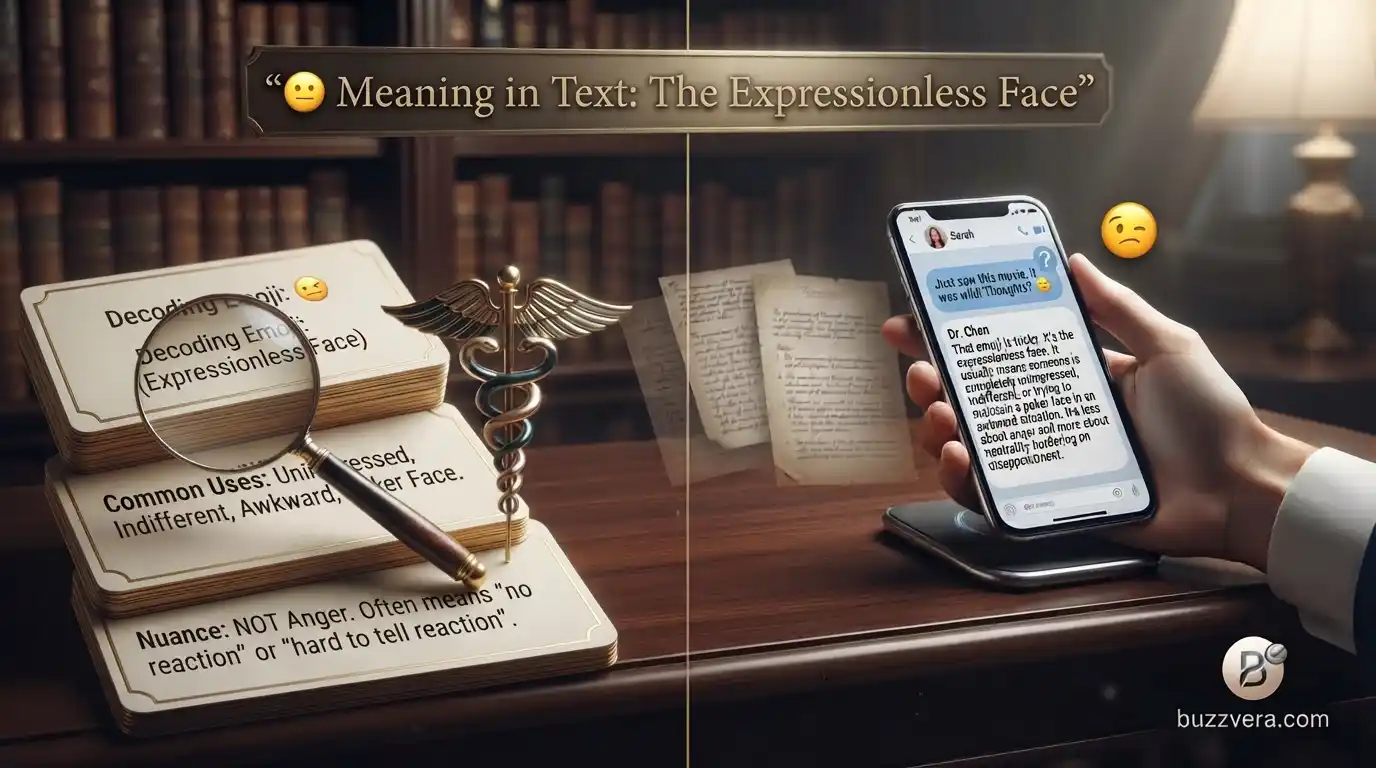
You get a text. No words. Just 😑.
What does it mean? Is the person mad? Bored? Tired? Or just done with you?
The 😑 emoji is called the Expressionless Face. It shows a face with flat eyes and a flat mouth. It looks like someone who feels nothing. But in texting, it often says a lot.
People use it in group chats, on TikTok, on Instagram, and in games. Some use it at work in casual chats too. It can be funny. It can be rude. It can be sad.
Why does it matter? Because one small emoji can change the whole mood of a chat. If you read it wrong, you might start a fight. Or you might miss a joke.
In this guide, you will learn what 😑 means, where it came from, and how to answer it. Let’s break it down.
Definition & Meaning

What does 😑 mean?
The 😑 emoji means “I have no reaction.” Or more often, “I am not impressed.”
Look at the face. The eyes are two flat lines. The mouth is one flat line. Nothing moves. Nothing smiles. Nothing frowns.
That blank look can mean many things. Here are the most common ones:
- Annoyed. “You said that again?”
- Bored. “This is so slow.”
- Unimpressed. “That’s it? That’s your big news?”
- Deadpan. “I am not laughing, but I find this funny.”
- Awkward. “I do not know what to say.”
- Tired. “I am too tired to care.”
Short version
😑 = “Really? I’m not amazed.”
Real-life examples
Example 1: Annoyed
Mia: I forgot your book again. Leo: 😑
Leo is not yelling. He is just showing he is done.
Example 2: Bored
Sam: The meeting is 2 hours long. Ava: 😑
Ava feels tired before it even starts.
Example 3: Deadpan joke
Jay: I ran for 5 minutes. I am an athlete now. Kim: 😑 Sure.
Kim is teasing. She does not mean it in a mean way.
Example 4: Awkward
Tom: So… do you like my ex? Ben: 😑
Ben has no good answer. So he sends a blank face.
Key point
The emoji itself shows no feeling. That is the point. The feeling comes from what was said before it.
Background & History
Where did it come from?
The 😑 emoji is part of Unicode. Unicode is the system that lets phones and computers share the same symbols. The official name is “Expressionless Face.” It has the code U+1F611.
It joined the Unicode list in the early 2010s. It became part of the standard emoji set on phones in the years after. Apple, Google, Samsung, and others all made their own version.
Before emoji, there were emoticons
Long before emoji, people typed faces with letters and symbols. They looked like this:
- -_-
- 😐
- —
The face -_- was very popular. It meant the same thing: “I am annoyed” or “I am not amused.” Many people used it in chat rooms and on early social sites.
When emoji came along, 😑 became the picture version of -_-.
How the meaning changed
At first, 😑 was a plain “no expression” face. It was just a neutral look.
Then people started to use it with attitude. Over time, it became a way to show:
- Quiet anger
- Sarcasm
- Dry humor
- “I can’t believe you just said that”
Today, 😑 is a favorite for deadpan humor. Deadpan means you say something funny with a straight face. The emoji lets you do that in text.
Where it is used today
You will see 😑:
- In group chats with friends
- In comment sections on TikTok and Instagram
- On X (Twitter) as a reaction
- In gaming chats when a teammate fails
- On Snapchat when a friend sends a bad joke
It is one of the most used “mood” emoji for young people.
Usage in Various Contexts
The same emoji can mean different things in different places. Let’s look at each one.
In texting
In private texts, 😑 is often a quick reaction. It says, “I read that. I have thoughts. I will not share them.”
Dad: Dinner is at 6. Don’t be late. Teen: 😑 ok
The teen is a bit annoyed. Not angry. Just tired of the rule.
On social media
On posts, 😑 is a comment. It says, “This is silly.”
Post: “I woke up at 5 AM to be productive. I have done nothing.” Comment: 😑 relatable
Here it feels funny and kind.
In gaming
In games, 😑 shows disbelief. Often it is a reaction to a bad play.
Player 1: I jumped off the cliff by mistake. Player 2: 😑 Player 3: We had one job.
It is playful. It teases the player but does not hurt.
In casual conversation
When friends talk, 😑 can show mock anger. It is a joke.
Zoe: I ate the last slice of pizza. Nina: 😑 I hate you. Zoe: 😂
Nina is not serious. The emoji makes the joke work.
In serious moments
Sometimes 😑 shows real hurt. It happens when someone is too upset to type words.
Rae: I can’t come to your party. Something came up. Chloe: 😑
If this is the third time Rae canceled, Chloe may be truly upset. The blank face says, “I am done being let down.”
Key point
Always check the words before the emoji. The chat tells you the real mood.
Common Misconceptions & Clarifications
Many people think they know what 😑 means. But there are a few common mistakes.
Misconception 1: “It means the person feels nothing.”
Not true. The face is blank, but the message is not. People often send 😑 because they feel something strong. They just do not want to say it out loud.
Misconception 2: “It always means anger.”
Not always. Sometimes it means:
- “I’m bored.”
- “I’m tired.”
- “That was a joke, and I liked it.”
Anger is only one option.
Misconception 3: “It is the same as 😐.”
They look close, but they are not the same.
- 😐 (Neutral Face) has small dot eyes. It feels more calm or unsure.
- 😑 (Expressionless Face) has flat line eyes. It feels more annoyed or fed up.
Think of 😐 as “meh.” Think of 😑 as “seriously?”
Misconception 4: “It is always rude.”
Not really. Between close friends, 😑 can be warm and funny. It is a way of teasing.
But with someone you do not know well, it can feel cold. The same emoji can be a joke in one chat and an insult in another.
Misconception 5: “It means I’m sleepy.”
Sometimes, yes. But the sleepy emoji is 😴. The face 😑 can show tiredness, but it is more about attitude.
How to read it right
Ask yourself three things:
- Who sent it?
- What did I say before it?
- How do we usually talk?
If you still don’t know, just ask: “Are you okay?”
Similar Terms & Alternatives
People have many ways to show “I’m not impressed.” Here are the closest ones.
Similar emoji
- 😐 Neutral Face Calm, unsure, or “meh.”
- 😒 Unamused Face Clear dislike. The eyes look to the side.
- 🙄 Face with Rolling Eyes Strong annoyance or sarcasm.
- 😶 Face Without Mouth Speechless or silent.
- 😤 Face with Steam Frustrated and ready to argue.
- 🫤 Face with Diagonal Mouth Unsure or let down.
Similar text faces
- -_- The classic “I’m annoyed” face.
- 😐 A flat, neutral mouth.
- … Three dots to show silence or doubt.
Similar words and phrases
- “Okay.”
- “Sure.”
- “Cool.”
- “Wow.”
- “Really?”
- “Whatever.”
Comparison table
| Emoji / Term | Mood | Strength | Best Use |
| 😑 | Annoyed, deadpan | Medium | Dry jokes, mild irritation |
| 😐 | Neutral, unsure | Low | “Meh” moments |
| 😒 | Unamused | Medium-High | Clear dislike |
| 🙄 | Sarcastic | High | Eye-roll moments |
| 😶 | Speechless | Low | Awkward silence |
| -_- | Annoyed | Medium | Old-school chat |
Key point
If you want a soft reaction, use 😐. If you want a dry, tired reaction, use 😑. If you want a sharp reaction, use 🙄.
How to Respond to This Term
When someone sends you 😑, you have choices. The best reply depends on the mood.
Casual replies
Keep it light. Match the vibe.
Friend: 😑 You: What? I said nothing wrong! 😂
Friend: 😑 You: Okay okay, I’ll stop.
Funny replies
Answer the blank face with a joke.
Friend: 😑 You: Don’t give me that look. I can feel it through the phone.
Friend: 😑 You: Is that your “I’m so proud of you” face?
Caring replies
If you think the person is truly upset, be kind.
Friend: 😑 You: Hey, are you okay? Did I upset you?
Friend: 😑 You: I’m sorry if that came out wrong. Want to talk?
Professional replies
If a coworker or boss sends 😑, stay calm and clear.
Coworker: 😑 You: Is there an issue with the plan? I’m happy to fix it.
Boss: 😑 You: Let me know what needs to change, and I’ll update it today.
Privacy-conscious replies
If you don’t want to explain yourself, keep it short.
Friend: 😑 You: I’d rather not get into it right now.
Friend: 😑 You: Let’s talk later.
Best rule
Do not guess. Ask. A short question can stop a big fight.
Regional or Cultural Differences
Emoji look the same everywhere. But the way people read them can change.
English-speaking countries
In the US, UK, Canada, and Australia, 😑 means annoyed or deadpan. It is common in casual chats. Young people use it most.
Japan and East Asia
Japan has a long history with emoticons, often called kaomoji. Flat faces like (-_-) are very common there. They show annoyance, shyness, or tiredness. The 😑 emoji fits well with this style. It often feels less rude and more soft or awkward.
Latin America and Spain
In Spanish-speaking chats, 😑 can show “no tengo palabras” (I have no words). It is used for shock, boredom, or mild disapproval. It is often paired with laughing emoji to keep the mood friendly.
South Asia
In countries like India and Pakistan, 😑 is common in group chats and family chats. It often shows “stop it” or “I’m tired of this.” In family chats, it can be a funny way to show a parent or sibling that a joke was not good.
Middle East
Many people use 😑 for dry humor or “enough already.” Like everywhere, it depends on how close you are to the person.
Regional slang that goes with it
- “Bruh 😑” (US) “Come on, really?”
- “Mate, no 😑” (UK) “Please stop.”
- “Yaar 😑” (South Asia) “Friend, really?”
- “Ay no 😑” (Spanish) “Oh, come on.”
Key point
The face is global. The tone is local. When you chat across cultures, add a few words to make your meaning clear.
Comparison with Similar Terms
Let’s look closer at how 😑 differs from its cousins.
😑 vs 😐
- 😑: Flat eyes. Feels annoyed or fed up.
- 😐: Dot eyes. Feels calm or unsure.
Friend: I got a B on the test. You: 😐 (Neutral. “Okay.”)
Friend: I got a B. Again. I didn’t study. You: 😑 (“Of course you didn’t.”)
😑 vs 🙄
- 😑: Quiet. Dry. Tired.
- 🙄: Loud. Sharp. Sarcastic.
The eye-roll shows more attitude. The flat face shows more silence.
😑 vs 😒
- 😑: Blank stare.
- 😒: Side-eye with a small frown. It shows clear dislike.
Use 😒 if you really don’t like something. Use 😑 if you’re just not impressed.
😑 vs 😶
- 😑: Has a flat mouth. The person has a reaction, but hides it.
- 😶: No mouth at all. The person has nothing to say.
Quick table
| Emoji | Eyes | Mouth | Feeling |
| 😑 | Flat lines | Flat line | Dry, annoyed |
| 😐 | Dots | Flat line | Calm, unsure |
| 😒 | Side glance | Small frown | Dislike |
| 🙄 | Rolled up | Flat | Sarcasm |
| 😶 | Dots | None | Speechless |
Key point
Small details change big meanings. Look at the eyes and mouth before you pick one.
Usage in Online Communities & Dating Apps
Twitter / X
On X, people use 😑 as a reaction to bad takes. It is quick and clear.
Tweet: “Pineapple on pizza is the best food ever.” Reply: 😑
Everyone knows what the reply means.
TikTok and Instagram
In comments, 😑 often shows “cringe” or “not funny.” It can also show deadpan humor under a funny video.
Gaming communities
On Discord, Twitch, and in-game chat, 😑 shows “you failed again.” It is usually playful. But in a heated match, it can feel rude.
Player: I’ll carry the team! (loses in 2 minutes) Teammate: 😑
Reddit and forums
Redditors use 😑 to show mild disbelief. It is often added to a sarcastic reply.
Dating apps (Tinder, Bumble, Hinge)
Here, 😑 can be tricky.
It can be playful:
Match: I’m a morning person. I wake up at 5 AM. You: 😑 Why? Match: 😂 I know, I know.
It can be a red flag:
Match: I think we should meet this weekend. You: 😑
The second one may look cold or rude. The other person may feel rejected.
Tips for dating apps
- Add words. “😑 Really?” is clearer than 😑 alone.
- Add a laugh. “😑😂” shows you’re joking.
- Don’t use it early if you don’t know the person well.
- Don’t use it for serious topics. It can feel like you don’t care.
How to respond if you get one
- If the mood is playful: “Haha, tough crowd.”
- If the mood is cold: “Did I say something wrong?”
- If you’re unsure: “What’s that face for? 😂”
Hidden or Offensive Meanings
Does 😑 have a dirty meaning?
No. Unlike some emoji, 😑 has no hidden adult meaning. It is not a code for anything rude.
But it can still feel offensive
The danger is not in the emoji. It is in the message behind it.
A blank face can say:
- “I don’t care about you.”
- “You are boring.”
- “You are being silly.”
- “I am ignoring you.”
That can hurt, even if you did not mean it.
The “silent treatment” effect
Sending 😑 alone, with no words, can feel like the silent treatment. The other person is left to guess what you feel. That can cause stress.
Partner: I’m sorry I forgot our date. You: 😑
The partner now feels bad and confused. A short sentence would be kinder.
Why tone and context matter
Tone is how a message sounds. In text, we have no voice. So the emoji has to do the work.
Here is the same emoji in three tones:
- Joking tone: “You snore like a bear 😑😂” → Funny.
- Annoyed tone: “You’re late again 😑” → Mildly upset.
- Cold tone: “Fine. 😑” → Hurt or angry.
Tips to avoid trouble
- Add a few words to explain your feeling.
- Pair it with a laugh if you’re joking.
- Skip it when someone shares sad or serious news.
- Think about the person. Would they read it as fun or rude?
Key point
😑 isn’t a bad emoji. But a blank face can feel cold. Use it with care.
Suitability for Professional Communication
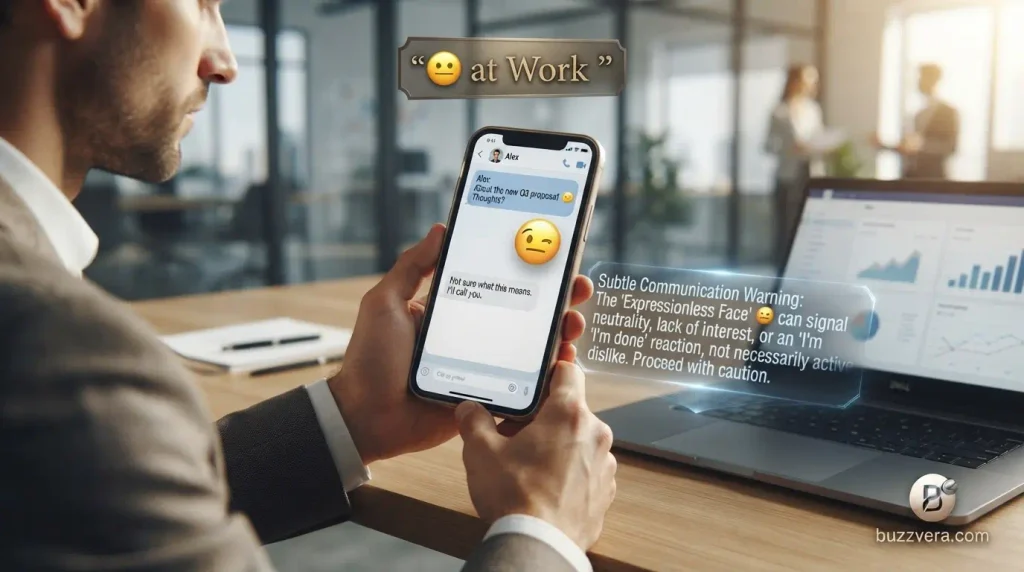
Is it okay at work?
Mostly, no.
At work, clear words are best. A blank face can look like:
- You are bored.
- You do not respect the person.
- You are mad but won’t say it.
That can hurt your image.
When it might be okay
Some work places are casual. If your team jokes in chat, a 😑 under a funny message may be fine. For example:
Teammate: The printer is broken again. You: 😑 Of course it is.
That is light and friendly. But it only works if everyone talks like this.
When to avoid it
- In emails
- With clients
- With your boss, unless you know them well
- In serious or sad moments
- In any message that might be saved or shared
Professional alternatives
Instead of 😑, try:
| Instead of… | Try this |
| 😑 (annoyed) | “I see. Let’s look at other options.” |
| 😑 (bored) | “Can we make this shorter?” |
| 😑 (unimpressed) | “I’d like to see more detail.” |
| 😑 (awkward) | “Let me think about that.” |
| 😑 (tired) | “I need a bit more time on this.” |
Safe emoji for work
If you want to use an emoji, pick clear ones:
- 👍 Agreed
- 🙂 Friendly
- 🙏 Thanks
- ✅ Done
Key point
Use words, not blank faces, at work. Clear writing earns respect.
FAQs
1. What does 😑 mean in a text?
It means the sender is annoyed, bored, or not impressed. It can also be a deadpan joke. Check the words before it to know for sure.
2. Is 😑 rude?
It can be. With close friends, it is usually a joke. With people you do not know, it can seem cold. Add words or a laugh to keep it kind.
3. What is the difference between 😑 and 😐?
😐 has dot eyes and feels calm or unsure. 😑 has flat eyes and feels annoyed or tired. Think of 😐 as “meh” and 😑 as “seriously?”
4. Does 😑 mean someone is angry?
Sometimes, but not always. It often shows mild annoyance, not deep anger. For real anger, people tend to use 😡 or 😤.
5. Can I use 😑 on a dating app?
You can, but be careful. It can be playful if you add humor. It can also look cold. Use it only after you know the person a bit.
6. How should I reply if someone sends only 😑?
Ask a simple question: “Are you okay?” or “What’s that face for?” If it is a joke, reply with a joke. If you think they are upset, be kind.
7. Is 😑 okay for work chats?
Usually not. Use clear words instead. If your team is very casual, a light use may be fine, but it is safer to skip it.
Conclusion
The 😑 emoji looks blank. But it says a lot.
Here are the key points to remember:
- 😑 means “not impressed.” It can show annoyance, boredom, tiredness, or dry humor.
- Context is everything. Always read the words before the emoji.
- It is not the same as 😐, 😒, or 🙄. Each one has its own mood.
- It can feel cold. Add words or a laugh to keep things kind.
- It has no hidden dirty meaning. But tone can still cause hurt.
- Skip it at work. Clear words are safer.
- When in doubt, ask. A short question can save a lot of stress.
Now you know how to read a flat face. Next time 😑 pops up in your chat, you will know exactly what to do.

Mafia Noor is an experienced content writer and author at BuzzVera.com, with 3 years of experience creating helpful and easy-to-understand content. Mafia specializes in texting slang, internet abbreviations, modern expressions, and text meanings, helping readers understand today’s digital language clearly and confidently.