Now you are stuck. Is it a joke? Is it a hint? Is someone hiding something?
Don’t worry. The 🥸 meaning in text is easy once you see the pattern. This emoji is called the disguised face. It looks like a fake-glasses party mask. People use it to say, “I’m in disguise,” “I’m pretending,” or “Nobody will know it’s me.”
You will see it in group chats, on TikTok, on Instagram, and in games. Friends use it for jokes. Couples use it for flirty fun. Coworkers sometimes use it to poke fun at a long day.
Why does this matter? Because emojis carry tone. One tiny face can turn a plain line into a joke, a tease, or a secret. If you read it wrong, you may reply the wrong way.
In this guide, you will learn what 🥸 means, where it came from, and how to answer it. You will also learn when to leave it out. Let’s decode it.
What Is the 🥸 Meaning in Text? Definition and Basics
The 🥸 emoji is the disguised face. It shows a smiling face wearing round glasses, a fake nose, and a bushy mustache. Think of the old party glasses that kids wear at Halloween.
The core meaning: “I’m in disguise.” Or: “I’m pretending to be someone else.”
But in real texts, it does more than that. Here are the most common meanings:
- Undercover or sneaky. The sender is acting like a spy.
- Joking or playful. The sender is being silly.
- Pretending to be an adult. This one is very popular. It means “I feel like I’m faking being a grown-up.”
- Hiding from someone. The sender does not want to be seen.
- Faking confidence. The sender is bluffing and hopes nobody notices.
The meaning depends on the words around it. The emoji alone is a hint. The sentence gives the clue.
Real-Life Examples
Example 1: Pretending to be a grown-up
Maya: I just paid my taxes by myself 🥸 Jon: Look at you, being an adult! Maya: I have no idea what I’m doing 😂
Example 2: Going undercover
Sam: I’m going to the party but I can’t be seen by my ex. Lee: So what’s the plan? Sam: Hat, glasses, new walk 🥸
Example 3: Joking about secrets
Ava: Who ate the last cookie? Noah: Not me 🥸 Ava: You have crumbs on your shirt.
In every case, the 🥸 adds a wink. It says, “I’m playing here.” It is almost never angry or sad. It is a light, funny emoji.
Quick tip: If you see 🥸 after a bold claim, the sender may not fully mean it. They may be teasing, or faking it.
Background and History: Where the 🥸 Meaning in Text Began
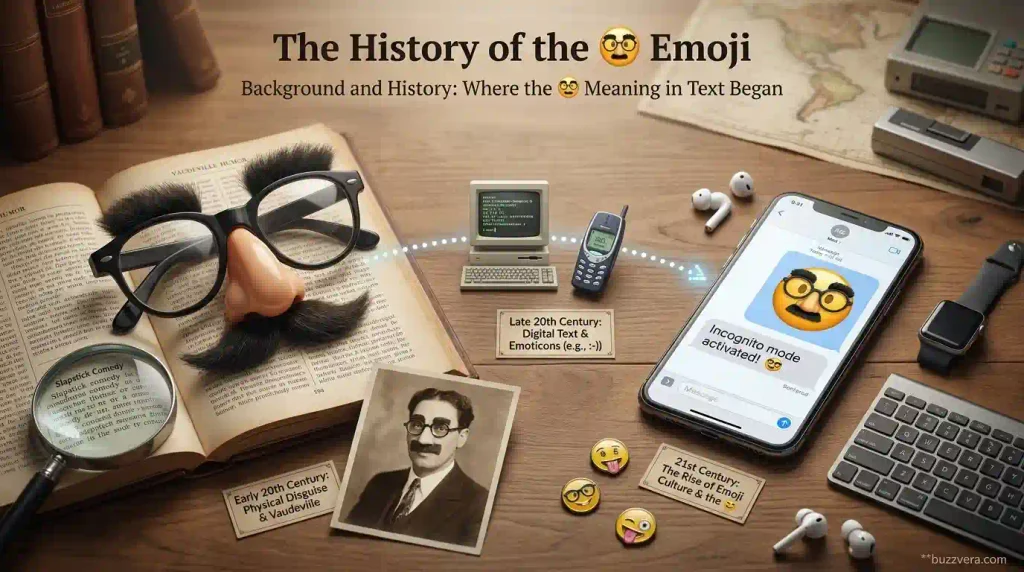
The 🥸 emoji is fairly new. It was approved in 2020 as part of Unicode and Emoji 13.0. Phones got it in updates soon after. So it has only been around for a few years.
Before 🥸, people had no emoji for “I’m in disguise.” They used other faces. The sunglasses face 😎 meant “cool.” The shushing face 🤫 meant “keep a secret.” The sneaky face 😏 meant “smug.” None of them showed a full disguise.
The new emoji filled that gap. Its look comes from the “Groucho glasses.” These are the novelty glasses with a nose and mustache. They are named after the comedian Groucho Marx. Many people know the style even if they don’t know the name.
How the Meaning Changed Over Time
At first, people used 🥸 in the plain way. It meant “I’m in disguise.” Then something fun happened. Users started to bend the meaning.
- Early use (2020–2021): Spy jokes, Halloween, and April Fools’ Day.
- Growing use: People began using it for “fake adult” humor. A person would post about bills, jobs, or home repairs and add 🥸.
- Today: It also signals imposter feelings. The sender plays a role and hopes nobody checks.
Social media pushed this along. On TikTok and Instagram, captions like “Me pretending I know what I’m doing at work 🥸” spread fast. The joke was easy to copy. Soon the emoji had its own mood.
Where You See It Today
- Group chats and friend texts
- Instagram and TikTok captions
- X (Twitter) replies
- Gaming chats, especially stealth games
- Work chats that are casual
The emoji has not changed shape. But the feeling around it has grown. It started as a costume. Now it is a small way to say, “I’m not sure I belong here, but I’m trying.”
🥸 Meaning in Text Across Different Contexts
The same emoji can feel different in each place. Here is how people use it.
In Texting
In a private text, 🥸 is usually playful. It teases a friend or hides a joke.
Zoe: Did you tell her it was me? Mia: Who, me? 🥸 Zoe: You’re the worst.
Here, 🥸 means, “I did it, and I’m acting innocent.”
On Social Media
On Instagram or TikTok, 🥸 often goes on a caption. It tells people the post is a joke about faking it.
Caption: Told my boss I understand the spreadsheet 🥸
Everyone gets it. The poster has no clue, and the emoji admits it.
In Gaming
Gamers use 🥸 for stealth and tricks. It fits games with hiding, spies, or fake roles.
Player 1: Where is the enemy team? Player 2: I’m in their base. They think I’m one of them 🥸 Player 1: Legend.
In Casual Chats With Friends
It also works as a mock-serious face. You act proud and sneaky at the same time.
Ben: I’m the new office safety manager. Cal: You? 🥸 Ben: Don’t ruin this for me.
At Work
In relaxed work chats, 🥸 can show good humor about being new or unsure.
Priya: First time running the meeting 🥸 Dan: You’ll do great. Just look confident.
Notice the pattern. In all of these, the emoji softens the message. It adds a smile to a statement that might sound odd or bold alone.
Common Misconceptions About the 🥸 Meaning in Text
Some people read this emoji wrong. Let’s clear up the big mix-ups.
Misconception 1: “It means the person is lying to me.”
Not always. Most of the time, 🥸 is a joke. A friend who sends it after “I didn’t eat your fries” is playing, not plotting. Real lying is rarely signaled with an emoji.
Misconception 2: “It’s the same as the sunglasses face 😎.”
No. The sunglasses face says “I’m cool.” The disguised face says “I’m pretending.” One is about style. The other is about acting.
Misconception 3: “It is a rude or mean emoji.”
Rarely. The face has a silly look. It is not built to insult. But tone matters. If someone sends 🥸 after you share a real success, it could feel like they doubt you. Read the words around it.
Misconception 4: “It only means a Halloween costume.”
Not anymore. Halloween is one use. The “fake adult” joke is now just as common.
Misconception 5: “It means the person is old.”
Some people see the mustache and think “dad” or “grandpa.” Now and then, it is used that way as a joke. But that is not its main meaning.
Can It Be Misread?
Yes. Here are a few ways:
- A joke may feel like a doubt. “You? In charge? 🥸” can sting if the person is nervous.
- A hint may feel like a secret. In a flirty chat, the other person may not know what you are hiding.
- Different groups use it differently. Younger users lean toward “fake adult.” Others lean toward “spy.”
Simple rule: If you are not sure, ask. A quick “Wait, is that a joke?” saves trouble.
Similar Terms and Alternatives to the 🥸 Meaning in Text
Other emojis and phrases can say close to the same thing. Here is a list.
Emojis That Feel Close
- 😎 Smiling face with sunglasses: Cool and confident.
- 🤫 Shushing face: Keep it quiet.
- 😏 Smirking face: Smug or flirty.
- 🕵️ Detective: Spy or investigating.
- 🫥 Dotted line face: Feeling invisible.
- 🤡 Clown face: Feeling foolish or acting silly.
- 🎭 Performing arts: Playing a role.
Words and Phrases
- “Pretending to be an adult”
- “Undercover”
- “Fake it till you make it”
- “Incognito”
- “Acting like I belong here”
- “Imposter mode”
Comparison Table
| Emoji / Phrase | Main Feeling | Best Used When |
| 🥸 | Pretending, disguised | Joking about faking it |
| 😎 | Cool, confident | Showing off or being proud |
| 🤫 | Secret | Asking someone to stay quiet |
| 😏 | Smug, flirty | Teasing or hinting |
| 🕵️ | Spying | Playing detective |
| 🤡 | Foolish | Making fun of yourself |
| 🫥 | Invisible | Feeling unseen |
Key takeaway: Pick 🥸 when the joke is about pretending. Pick another emoji when the feeling is about secrets, style, or silliness.
How to Respond to the 🥸 Meaning in Text
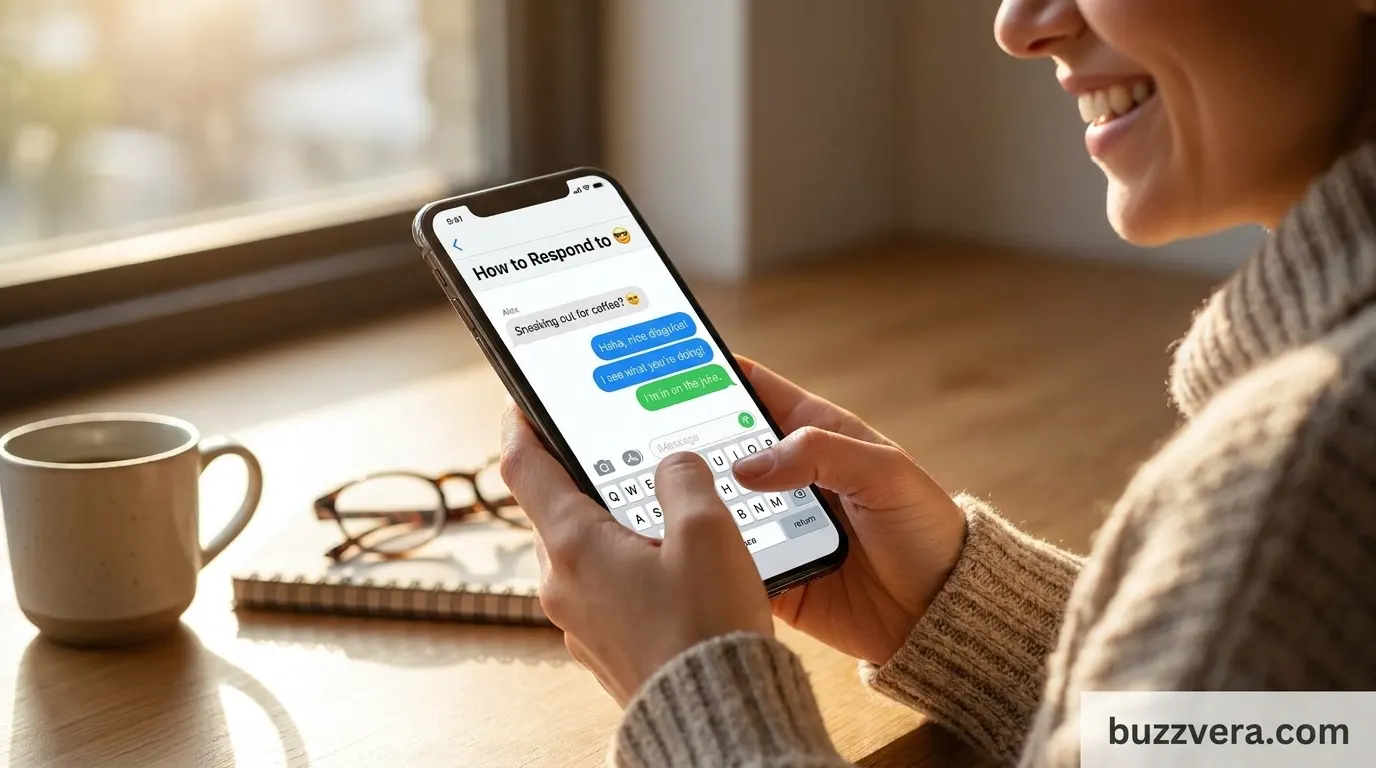
Not sure what to say? Here are replies for different moods. Match the tone you want.
Casual Replies
Keep it light and easy.
Friend: Doing my own taxes 🥸 You: Haha, same energy. Good luck!
Friend: Going undercover tonight 🥸 You: Take me with you.
Funny Replies
Play along with the joke.
Friend: Nobody knows it’s me 🥸 You: I knew it was you in two seconds.
Friend: Pretending I understand crypto 🥸 You: Pretending right next to you 🥸
Sending a 🥸 back is a fun move. It says, “I’m in on the joke.”
Professional Replies
If a coworker uses 🥸, keep it kind and short.
Coworker: First time leading the call 🥸 You: You’ll do great. Let me know if you need help.
Coworker: Faking confidence today 🥸 You: It works. You look confident from here.
Privacy-Conscious Replies
Sometimes 🥸 is a hint that someone wants to hide something. If you want to stay careful, do not push.
Friend: I can’t say where I’m going 🥸 You: No problem. Text me when you’re safe.
Friend: Guess who I saw 🥸 You: I’d rather not guess. Tell me later in person.
When You Aren’t Sure
Ask in a friendly way.
- “Wait, is this a joke? 😄”
- “Are you pretending or serious?”
- “I can’t tell if you’re teasing me.”
Pro tip: Mirror the sender. If they are silly, be silly. If they are calm, reply calm.
Regional and Cultural Differences in the 🥸 Meaning in Text
Emojis travel across the world. But people read them with their own culture. Here is how 🥸 may differ.
Widely Understood
The shape of the emoji is easy to read in most places. Glasses, nose, and mustache mean “disguise” in many cultures. People who have seen party glasses will get it.
The “Groucho Glasses” Link
In the United States and the UK, the novelty glasses are a well-known joke item. So the emoji lands fast. People tie it to comedy, costumes, and silly spy scenes.
Mustache Meanings Can Change
A mustache means different things around the world. In some places, it suggests age, rank, or pride. In others, it is just a funny prop. So the “dad joke” feel can be stronger in some groups than others.
Language Names
Each language has its own words for the emoji. In English it is the “disguised face.” In Spanish, people may say “cara disfrazada.” The idea is the same. The wording changes.
Slang That Goes With It
People often pair 🥸 with local phrases. Here are a few English versions:
- “Fake it till you make it” (common in the U.S.)
- “Winging it” (common in the U.S. and the UK)
- “Playing grown-up” (common online)
A Note on Certainty
Emoji meanings shift fast. Different age groups, friend circles, and apps may use 🥸 in their own way. So treat these notes as general trends, not strict rules. When in doubt, the context of the chat wins.
Global Humor
The best part: the “fake adult” joke feels universal. Almost everyone knows the feeling of faking it at work or at home. That is why the emoji spread so well.
🥸 Meaning in Text vs. Similar Expressions
Let’s put it side by side with close cousins. This helps you pick the right one.
Quick Differences
- 🥸 vs. 😎: 🥸 pretends. 😎 shows off real cool.
- 🥸 vs. 🤫: 🥸 hides who you are. 🤫 hides what you know.
- 🥸 vs. 😏: 🥸 is a playful costume. 😏 is a smug look.
- 🥸 vs. 🤡: 🥸 is a bluff. 🤡 is feeling silly or fooled.
- 🥸 vs. 🕵️: 🥸 is the disguise. 🕵️ is the spy at work.
Detailed Comparison Table
| Expression | What It Says | Tone | Example |
| 🥸 | “I’m in disguise / faking it” | Playful, self-teasing | “Doing my own taxes 🥸” |
| 😎 | “I’m cool” | Proud, relaxed | “Got the job 😎” |
| 🤫 | “Keep it secret” | Quiet, serious or funny | “Surprise party plans 🤫” |
| 😏 | “I know something” | Smug, flirty | “Guess who got a text 😏” |
| 🤡 | “I’m being foolish” | Self-mocking | “I forgot my own birthday 🤡” |
| 🕵️ | “I’m investigating” | Curious, spy-like | “Checking who ate it 🕵️” |
| “Winging it” | “No plan” | Honest | “Just winging it today.” |
How to Choose
Ask yourself two questions:
- Am I pretending? Use 🥸.
- Am I hiding a fact? Use 🤫.
If you want to look cool, go with 😎. If you want to tease, go with 😏. The 🥸 is your best pick for “I’m faking this and we both know it.”
🥸 Meaning in Text in Online Communities and Dating Apps
Different spaces have different habits. Here is how 🥸 shows up.
On Dating Apps (Tinder, Bumble, Hinge)
On dating apps, 🥸 can be cute and flirty. It shows humor, which many people like.
Match: What do you do for work? You: I’m a “professional adult” 🥸 Match: Same! Mine is mostly fake.
It can also be a playful bio line. For example: “Pretending to cook dinner 🥸.”
Watch out for one thing. On dating apps, people worry about fake profiles and catfishing. A 🥸 in a chat can feel like a wink at that fear. If you use it, keep the tone clear and kind. A joke like “I promise I’m not in disguise 🥸” is fine. Just make sure the person laughs with you.
On X (Twitter)
On X, 🥸 is a reaction to jokes about work, money, age, and being unsure. Short posts like “Me in meetings 🥸” are common. Replies often echo it.
On Instagram and TikTok
Creators add 🥸 to captions and comments. It says, “I’m winging this.” People in the comments often reply with the same emoji. That makes a fun shared joke.
In Gaming Communities
In stealth, spy, or role-play games, 🥸 is a code of fun. It can mean “I’m hiding,” “I’m tricking them,” or “I’m in character.”
In Group Chats and Forums
Friends use it as a running gag. One person says something silly, and others answer with 🥸.
Tips for Responding
- Match the vibe. If it’s a joke, joke back.
- Don’t over-explain. A short reply works best.
- Avoid pushing. If someone hints at a secret, don’t force them.
- Keep it safe on dating apps. If a chat feels odd, ask questions about real things. Do not share private details early.
Hidden or Offensive Meanings Behind the 🥸 Meaning in Text
Is there a dark side to this emoji? Mostly no. But there are a few edges to know about.
Possible Alternative Meanings
- Deception. In a serious chat, 🥸 may hint that someone is hiding the truth. This is rare, but it can happen.
- Mocking. Someone may send 🥸 to say, “You’re faking it.” That can feel unkind.
- Age jokes. The mustache can be used to tease an older person. Some people may not like it.
- Catfish hints. On dating apps, it can suggest “I might not be who I say I am.” Usually that is a joke. But it can scare people.
No Official Offensive Meaning
The emoji is not known as a rude or banned symbol. It is not tied to hate or harm. It is a silly, lighthearted face.
Why Tone and Context Matter
A joke between close friends is safe. The same joke to a new person may land badly.
Here is a quick example:
Friend A: I got the promotion! 🎉 Friend B: You? 🥸
If Friend B is playing, it’s fine. But Friend A may hear, “You don’t deserve it.” The words around the emoji make the difference.
Ways to Stay Safe
- Know your audience. Close friends get more jokes.
- Add clear words. “Just kidding!” helps.
- Skip it in serious moments. Don’t use it for bad news or big feelings.
- Ask if unsure. A short check avoids hurt.
Bottom line: 🥸 is gentle, but it can sting if the timing is wrong.
Is the 🥸 Meaning in Text Suitable for Professional Communication?
Short answer: sometimes, but be careful.
When It Can Work
- Casual team chats. If your team uses emojis often, 🥸 can add warmth.
- Self-teasing. “First time presenting 🥸” is a safe, humble joke.
- Friendly coworkers. If you know them well, it can be fun.
When to Avoid It
- Formal emails. Skip emojis here.
- Messages to clients or bosses you don’t know well. The joke may land wrong.
- Serious topics. Never use it for layoffs, errors, or hard news.
- Anything about “faking” skills. An employer may take “faking it 🥸” seriously and worry.
The Risk
The emoji hints at pretending. In a work setting, “pretending” can sound like “I’m not qualified.” Even as a joke, this may cause doubt.
Professional Alternatives
If you want the same feeling without the emoji, try these lines:
| Casual (with 🥸) | Professional Option |
| “Faking it today 🥸” | “I’m still learning this, and I appreciate your patience.” |
| “Going undercover 🥸” | “I’ll keep this confidential.” |
| “Playing grown-up 🥸” | “I’m taking on a new responsibility.” |
| “Winging it 🥸” | “I’m adapting as I go.” |
A Good Rule
Ask: “Would I say this out loud in front of my boss?” If yes, the emoji is probably safe. If not, use clear words instead.
FAQs About the 🥸 Meaning in Text
1. What does the 🥸 emoji mean in text?
It means disguise or pretending. People use it for jokes, spy ideas, and “I’m faking being an adult.”
2. What is the name of the 🥸 emoji?
Its official name is “disguised face.” It shows glasses, a nose, and a mustache.
3. Is 🥸 flirty?
It can be, but not by default. It is mostly playful. In a flirty chat, it may show a sneaky or silly mood.
4. Does 🥸 mean someone is lying?
Usually not. It is mostly a joke. If the chat is serious, ask a direct question.
5. Can I use 🥸 at work?
Yes, but only in casual chats with people you know. Skip it in formal messages.
6. How is 🥸 different from 😎?
😎 means cool and confident. 🥸 means pretending or in disguise.
7. How should I reply to 🥸?
Match the tone. Send a funny reply, send 🥸 back, or ask, “Is that a joke?”
Conclusion: The 🥸 Meaning in Text in a Nutshell
The 🥸 meaning in text is simple. It means “I’m in disguise“ or “I’m pretending.” Most of the time, it is a joke.
Here are the key points:
- It is the “disguised face” emoji, with glasses, nose, and mustache.
- It started in 2020 and grew into a “fake adult” meme.
- It works for jokes, spy talk, and self-teasing.
- It is not mean by default, but tone and timing matter.
- It’s best in casual chats. Skip it in formal or serious ones.
- When unsure, ask. A quick question beats a wrong guess.
Next time you see 🥸, smile. Someone is playing. Play back, or just enjoy the joke.

Mafia Noor is an experienced content writer and author at BuzzVera.com, with 3 years of experience creating helpful and easy-to-understand content. Mafia specializes in texting slang, internet abbreviations, modern expressions, and text meanings, helping readers understand today’s digital language clearly and confidently.