Two letters, five different jobs. Let’s sort them out.
You get a work email. At the bottom it says CC: Sarah, Tom. Then a friend texts you: cc yourself before you send that 😂. Then someone on Twitter writes cc @person under a tweet.
Same two letters. Three different feelings.
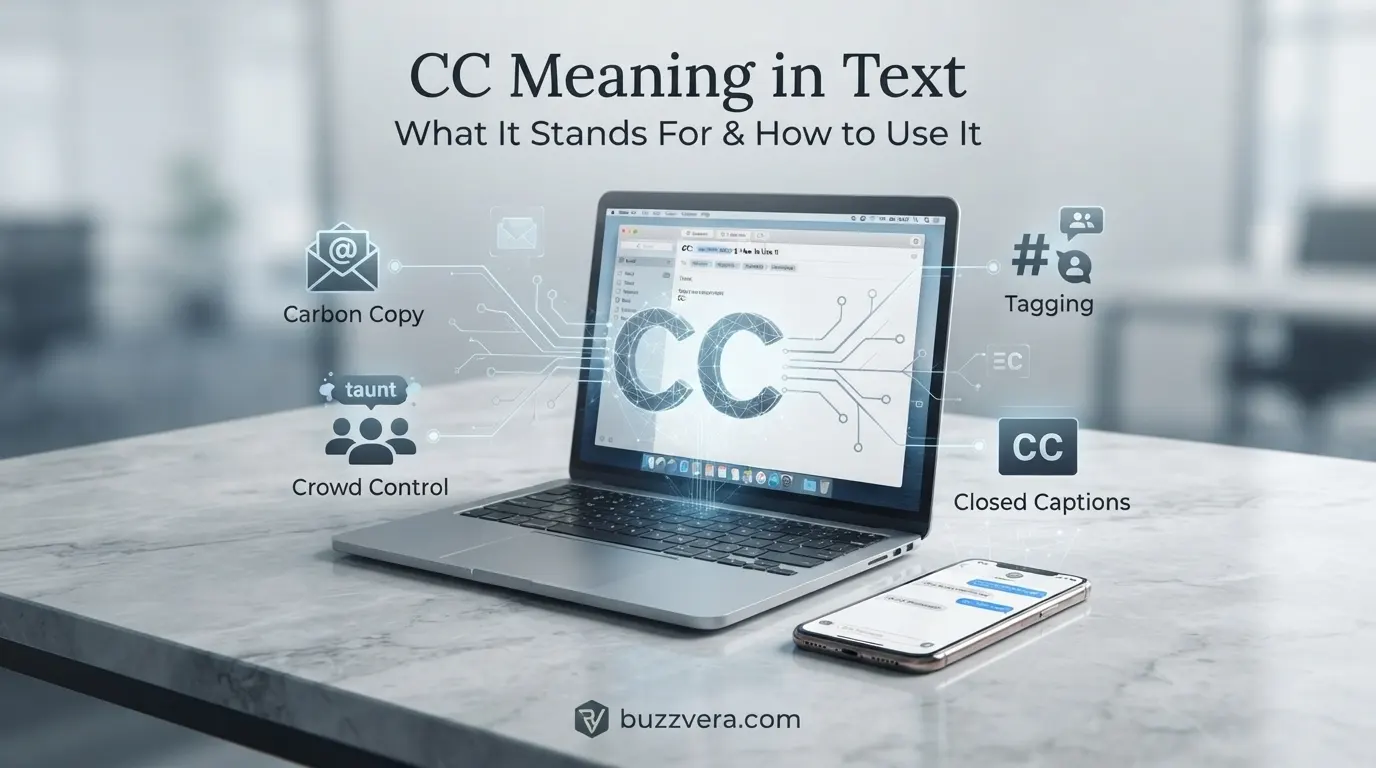
CC most often means carbon copy. It is one of the oldest abbreviations still alive in modern texting, email, and social media. It comes from typewriters, of all things and it never went away.
But CC has other lives too. In gaming, it can mean crowd control. In K-pop fandoms, it can mean closed captions. Context always decides.
Knowing CC matters because it shows up everywhere school, work, group chats, memes. Miss the meaning once, and you might tag the wrong person or misread a joke. This guide sorts out every version so you never get caught off guard.
What Does CC Mean in Text?
Start with the classic. It’s simpler than it sounds.
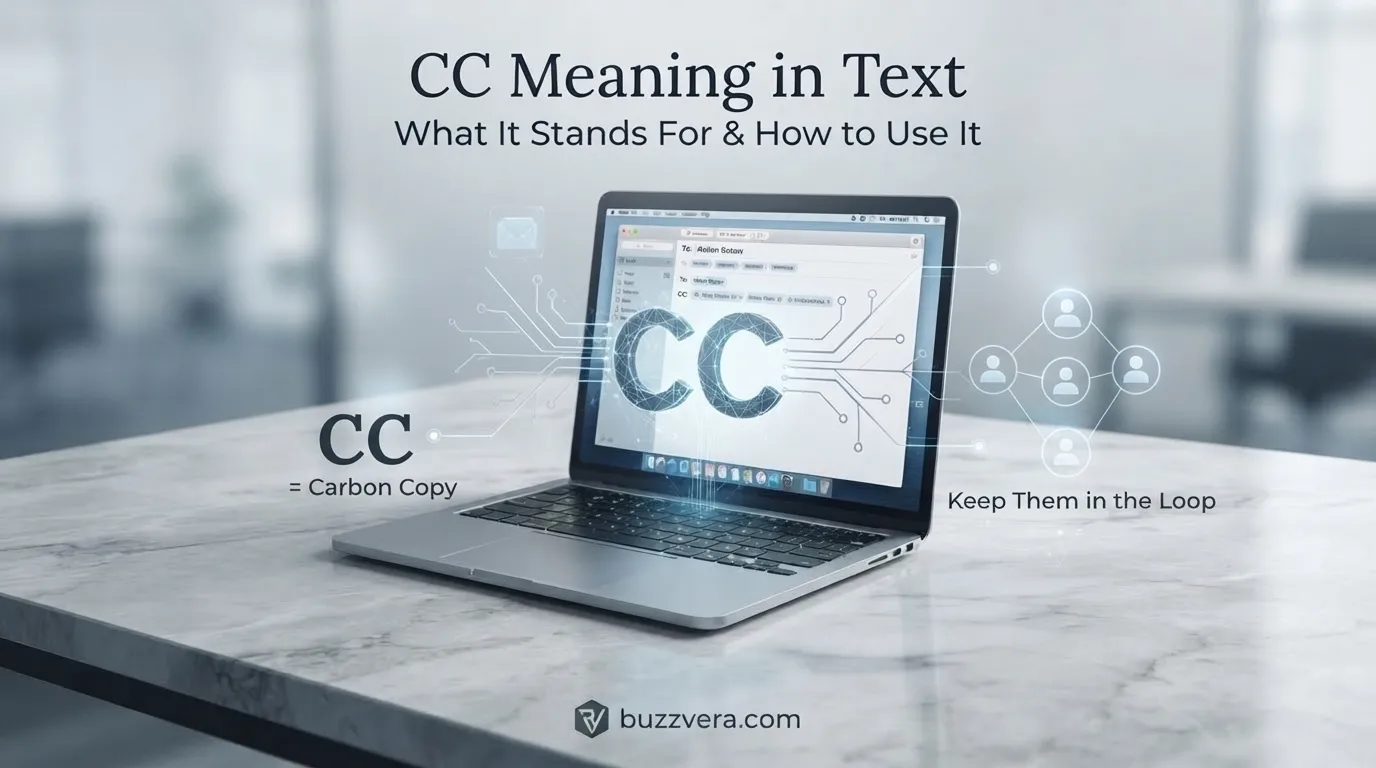
CC stands for carbon copy. It means adding someone to a message so they can see it without being the main person you’re talking to.
The main person is in the To field. The extra people go in CC. They are looped in, but not expected to reply.
Key point: CC = keep them in the loop.
Real examples in text
Example 1 Work email
Subject: Project Update
To: Manager
CC: Whole team
Body: Just sending this so everyone’s on the same page.
Example 2 A casual chat
Jenna: sending the invite now
Jenna: cc your mom so she gets the date too
You: good call, doing that
Example 3 A joking use
Dev: why does no one ever read my messages
Friend: cc the whole group chat next time 😂
Dev: truly might have to
CC as a verb
People use CC as a verb now, not just a noun.
- CC me on that email.
- Don’t forget to CC the client.
- She CC’d her boss on the complaint.
The casual social meaning
On social media, CC sometimes just means tagging you in on this even outside of email.
Post: this meme is so us 😭 cc @bestfriend
💡 Quick tip: If it is in an email, CC almost always means carbon copy. If it is in a caption or a meme, it usually means tagging you.
Background and History of CC
This one has a wild origin story. Buckle up.
Where carbon copy really came from
Before computers, before printers, people used carbon paper. You placed a sheet of carbon-coated paper between two sheets of blank paper. When you typed or wrote on the top sheet, the pressure created a copy underneath.
That copy was literally called a carbon copy. Offices used this for decades to send the same letter to multiple people without retyping it.
The jump to email
When email systems were built in the 1970s and 1980s, engineers needed a way to send a message to a main person and loop others in.
They borrowed the old office term. The CC field was born, sitting right next to To and, soon after, BCC (blind carbon copy more on that later).
By the time email went mainstream in the 1990s, CC was standard. Every office worker knew it.
The texting shift
Texting did not really need CC group chats did that job. But the word still leaked into casual speech, because email habits carried over into everyday talk.
By the 2010s, cc started popping up in texts and social captions as shorthand for including you or tagging you.
Where CC lives today
- Email its true home
- Work Slack and Teams messages informal CC mentions
- Texting cc mom on this
- Social captions cc @friend
- Gaming a totally different meaning (see below)
💡 Quick tip: CC is nearly 100 years old in spirit. Few slang terms have that kind of staying power.
How CC Is Used in Different Contexts

Same two letters, six different rooms.
In work email
The classic use. Loop someone in without making them the main recipient.
Boss: Send the report to the client, and CC me.
You: Will do!
In everyday texting
A quick way to say make sure they see this too.
Mia: sending the group photo
Mia: cc grandma, she’ll love it
You: on it
On social media
Tagging or crediting someone.
Post: obsessed with this recipe 😍 cc @chefkate
In gaming
Here CC means something totally different: crowd control. This covers any move that stuns, freezes, roots, or slows an enemy.
Teammate: use your cc before they escape!
You: stunning now
In K-pop and fan communities
CC often means closed captions or credited content.
Post: new vlog is up, cc available in english
In customer service chats
Sometimes CC appears when a support agent loops in a manager.
Agent: I’m CC’ing my supervisor so she can follow up directly.
In casual jokes
People also use cc sarcastically, implying everyone should see this.
Friend: i just beat my own record at bowling
You: cc the hall of fame 😂
💡 Quick tip: Look at the platform first. Email and texting usually mean carbon copy. Gaming almost always means crowd control.
Common Misconceptions and Clarifications
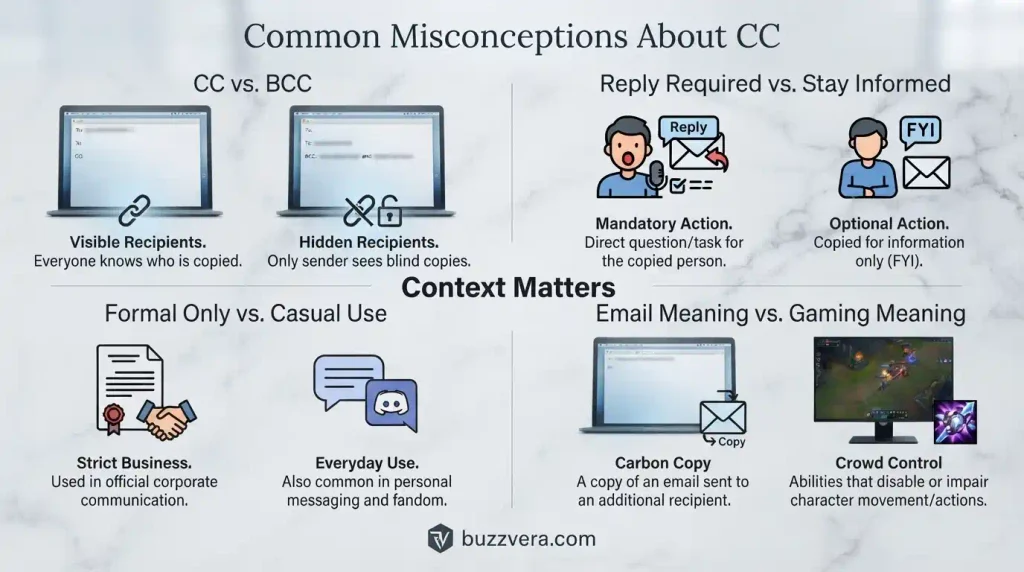
Five mix-ups, cleared up fast.
Myth 1: CC and BCC are the same thing
No. CC is visible to everyone on the message. BCC (blind carbon copy) is hidden other recipients cannot see who is BCC’d.
Rule of thumb: CC = everyone sees them. BCC = nobody sees them.
Myth 2: CC means someone has to reply
No. CC signals stay informed, not respond now. The main To person is expected to reply, not the CC’d ones.
Myth 3: CC in gaming is rare slang
Actually the opposite it is very common in team-based games like League of Legends, Overwatch, and World of Warcraft. If you play those games, you will see it constantly.
Myth 4: CC is only for formal settings
Not anymore. It slipped into texting and memes years ago. cc @friend is completely normal in casual captions.
Myth 5: CC’ing someone is passive-aggressive
Sometimes true, sometimes not. In offices, CC’ing a manager on a tense email can be a subtle pressure move it says someone senior is watching this thread.
But most of the time, CC is just practical. Don’t assume bad intent right away.
When it can get confusing
If a message says cc with no other context, ask yourself: Is this email? Is this gaming? Is this a caption? The setting nearly always clears it up.
💡 Quick tip: When unsure, ask. Wait, cc as in email or crowd control? 😂 is a totally normal question.
Similar Terms and Alternatives
Words that live in CC’s neighborhood.
| Term | Meaning | Where it’s used |
| CC | Carbon copy | Email, texting |
| BCC | Blind carbon copy | |
| FYI | For your information | Email, texting |
| Loop in | Add someone to a conversation | Work chats |
| Tag | Mention someone on social media | Instagram, Twitter/X |
| CC (gaming) | Crowd control | Team-based games |
| Reply-all | Respond to everyone on a thread | |
| Cc’d | Past tense of being CC’d | Email, casual speech |
A few notes
FYI and CC often travel together. You might CC someone and write FYI in the body so they know why they were included.
Email: CC’ing Priya here FYI, this affects her team too.
Loop in is the spoken version of CC. People say it out loud more than they say CC.
Coworker: can you loop in the design team on this?
Tag is CC’s social media cousin. Both mean make sure this person sees it, just on different platforms.
💡 Quick tip: If you are unsure If to CC or just tag someone, ask yourself: is this a formal record (email) or a casual mention (social post)? That decides the tool.
How to Respond to CC

Five situations, five smooth replies.
1. Casual acknowledgment
When someone CC’s you on a group text or email.
Text: cc’d you on the plan, check when you can
You: got it, thanks!
2. Professional response
Standard at work short, clear, forward-looking.
Email: Thanks for the update noted, and I’ll follow up if I have questions.
3. When you’re CC’d but it’s not your job to act
Be polite but clear you are just an observer.
Email: Thanks for looping me in. I’ll stay tuned but will let [main person] take the lead here.
4. Funny or casual reply
Good with friends.
Friend: cc’d the whole group chat on my embarrassing story 😭
You: iconic behavior honestly
5. When you want to be removed from a thread
Totally fine to ask.
Email: Could you take me off this CC list going forward? Happy to be looped back in if needed.
What to avoid
- Replying why was I CC’d? in a sharp tone it can read as annoyed
- Ignoring a CC that actually needed action from you
- Reply-all when you meant to reply to just one person (a classic CC mistake!)
💡 Quick tip: If a CC email doesn’t clearly need your input, a short noted, thanks is always a safe, polite response.
Regional and Cultural Differences

CC is basically universal it rides on top of email itself.
United States and Canada
Extremely common in both work email and casual texting. CC me is standard office language.
United Kingdom and Ireland
Same usage. CC is a fixture in British workplace email, often used the same way as in North America.
Europe
Because email software is the same worldwide, CC stays in English even in non-English emails. A German or French business email will still say CC, not a translated version.
German email: An: Team CC: Herr Müller
South Asia
CC is widely used in professional email across India, Pakistan, and Bangladesh, especially in corporate and government communication, where CC’ing a senior person is common practice.
Latin America
Same pattern CC stays in English even inside Spanish or Portuguese emails, since it is baked into the email interface itself.
East Asia
In Japan, China, and Korea, CC appears in business email the same way, though some workplaces also use local terms like 参考までに (Japanese, for reference ) alongside it.
| Region | CC usage in email | CC usage in texting |
| USA / Canada | Very high | Common |
| UK | Very high | Common |
| South Asia | Very high | Growing |
| Europe | High | Moderate |
| East Asia | High | Low |
💡 Quick tip: CC is one of the few internet terms that barely changes across cultures because it is baked directly into the email software everyone uses.
CC Compared With Similar Terms
One table, then a quick way to tell them apart.
| Term | What it means | Visible to others? | Common setting |
| CC | Carbon copy | Yes | |
| BCC | Blind carbon copy | No | |
| To | Main recipient | Yes | |
| Loop in | Add someone informally | N/A | Work chat |
| Tag | Mention on social media | Yes | Instagram, Twitter/X |
| CC (gaming) | Crowd control | N/A | Team-based games |
| FYI | For your information | N/A | Email, texting |
The quick sort
- Is it an email? → likely carbon copy
- Is it a game chat? → likely crowd control
- Is it a social caption? → likely tagging
- Does it say hidden or private ? → that’s BCC, not CC
💡 Quick tip: CC and BCC do opposite jobs. CC is open. BCC is hidden. Mixing them up can accidentally expose someone’s email to a whole list of strangers.
CC in Online Communities and Dating Apps

Not really a dating app term but it shows up in fandoms and group spaces a lot.
On dating apps
CC rarely appears here directly, since dating apps aren’t email-based. But you might see it if someone shares a group planning doc or invite.
Match: we’re all meeting up saturday, i’ll cc you on the group chat link
On Twitter/X
CC shows up as a lightweight way to tag someone into a conversation.
Post: massive thread on this topic, cc @username you’ll want to see this
In K-pop and fan communities
As mentioned earlier, CC often means closed captions here a huge deal for international fans.
Post: finally uploaded with cc, sorry for the wait!
It can also mean credit/copyright in fan edit communities, as in cc to original artist.
Post: edit by me, cc @artistname for the base image
In gaming communities
Crowd control dominates here. You’ll see it constantly in strategy discussions.
Discord: we need more cc in this comp, we have zero peel
Tip for responding: If you’re new to a gaming server and see cc, don’t assume email. Ask or watch context it’ll click fast once you see it a few times.
General tip for any community
If CC confuses you in a new space, just ask:
You: quick q, does cc mean crowd control here or something else? 😅
Nobody will judge you for asking.
💡 Quick tip: Fandom and gaming spaces reuse a lot of office abbreviations for totally different purposes CC is one of the best examples.
Hidden or Offensive Meanings

Good news here CC is about as harmless as slang gets.
The short answer
CC has no common offensive meaning. It is one of the most neutral, practical abbreviations in the entire slang world.
The one social nuance
The closest thing to tension around CC is the workplace habit of CC’ing a manager as a pressure move.
Coworker: Per my last email (cc’ing our director here)…
This isn’t offensive, exactly, but it can feel passive-aggressive. It signals I’m making sure someone with authority sees this.
How to read it: If a CC feels pointed, it’s about workplace tension, not the term itself.
Reply-all mistakes
The real danger of CC isn’t offense it’s embarrassment. Hitting reply-all on a CC’d email by accident is a classic office blunder.
Email (meant for one person): ugh this meeting could’ve been an email
(Accidentally sent to the entire CC list, including the meeting organizer)
No hidden slang meaning
Unlike some abbreviations, CC does not have an underground or inappropriate second meaning in mainstream use. It has stayed remarkably clean for nearly a century.
💡 Quick tip: If CC ever feels loaded in a message, the tension is coming from who was CC’d, not the letters themselves.
Is CC Suitable for Professional Communication?

Yes more than almost any other abbreviation on this list.
Why CC fits at work
- It is standard business terminology, not slang
- It is used in every major email platform
- It is clear and unambiguous in a work context
- It has been used professionally for decades
How to use it well
| Situation | Example |
| Looping in a manager | CC’ing Sarah so she has visibility. |
| Including a client | I’ve CC’d our account manager for reference. |
| Passing off follow-up | CC’ing the support team to take it from here. |
| Asking to be included | Could you CC me on future updates? |
Professional examples
Email: Hi team, sending this update and CC’ing leadership for visibility. Let me know if you have questions.
Slack: I’ll CC you on the client email so you have the full context.
The one thing to watch
Don’t over-CC. Looping in too many people on every message creates clutter and can feel like you’re covering yourself rather than communicating clearly.
Better: CC only the people who genuinely need visibility.
💡 Quick tip: CC is one of the rare texting-adjacent terms you can use in a formal email with zero risk it practically lives there already.
Frequently Asked Questions
Fast answers to the questions people actually type into Google.
1. What does CC mean in a text message?
Usually carbon copy including someone so they can see the message. In gaming, it often means crowd control.
2. What is the difference between CC and BCC?
CC recipients are visible to everyone on the email. BCC recipients are hidden.
3. Does CC mean I need to reply?
No. Being CC’d usually means stay informed, not respond required.
4. What does CC mean in gaming?
Crowd control moves that stun, slow, root, or disable enemies.
5. What does CC mean on social media?
Often just tagging you in or, in fan communities, closed captions.
6. Is it rude to CC someone at work?
Not by default. It can feel pointed if used to apply pressure, but most CC’s are just practical.
7. Can I ask to be removed from a CC list?
Yes, and it’s completely normal to ask politely.
Conclusion
Here’s everything in one quick recap.
CC stands for carbon copy. It started with actual carbon paper in old-school offices, moved into email in the 1970s and 80s, and has stayed relevant ever since now showing up in texts, social captions, and even gaming chats.
The core meaning is simple: CC means keep them in the loop, without making them the main recipient.
Just remember the context shifts:
- Email/texting → carbon copy
- Gaming → crowd control
- Social captions → tagging
- Fandom spaces → closed captions or credit
Once you know that, CC never has to slow you down again If you’re writing a work email or scrolling through a fan edit online.

Mahi Aylin is a content writer and author at BuzzVera.com, with 3 years of writing experience. She specializes in texting slang, internet abbreviations, modern expressions, and text meanings, creating simple and easy-to-understand content that helps readers confidently navigate today’s digital language.