You ask a friend, can I bring my sister? They reply, ofc!! You smile. You know exactly what they mean, even without a full sentence.
OFC stands for of course. It is one of the most common abbreviations in texting today. People use it to say yes fast, to agree, or to show something is obvious.
You’ll see it everywhere texts, Instagram comments, Discord chats, even work Slack messages. It shows warmth and speed at the same time. That combo is why it never went out of style.
Understanding OFC matters because tone rides on it. A single ofc can feel warm, sarcastic, or blunt depending on the moment. Get it right, and your texts feel natural. Get it wrong, and a reply can land the wrong way.
This guide breaks down what OFC really means, where it came from, and how to use it well.
What Does OFC Mean in Text?
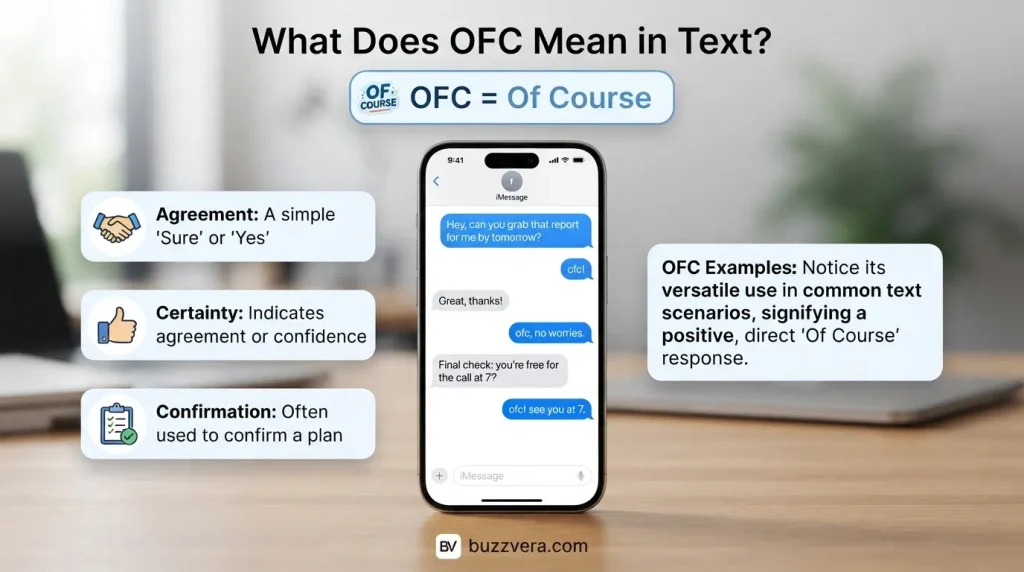
OFC = of course. It is a quick way to agree, confirm, or say something is obvious.
People use it as a short, easy yes often warmer and faster-feeling than typing the full phrase.
Key point: OFC usually means yes, definitely or that’s obvious, no need to ask.
Real examples in text
Example 1 Agreeing to help
Jade: can you cover my shift friday?
You: ofc, no worries
Example 2 Confirming plans
Marcus: still on for tonight?
You: ofc! see you at 7
Example 3 Reassuring someone
Friend: i know this is a lot to ask
You: ofc i’ll help you, don’t even worry about it
The tone spectrum
OFC can feel different depending on punctuation and context:
- ofc! enthusiastic, warm
- ofc neutral, simple agreement
- ofc. can feel flat or a little cold
- ofc obviously playful or slightly teasing
OFC as a quick filler
Sometimes people use OFC mid-sentence, almost like obviously.
You: ofc it started raining right when i left the house
Key point: The shorter the reply, the more the tone depends on the relationship and the moment.
Where Did OFC Come From?
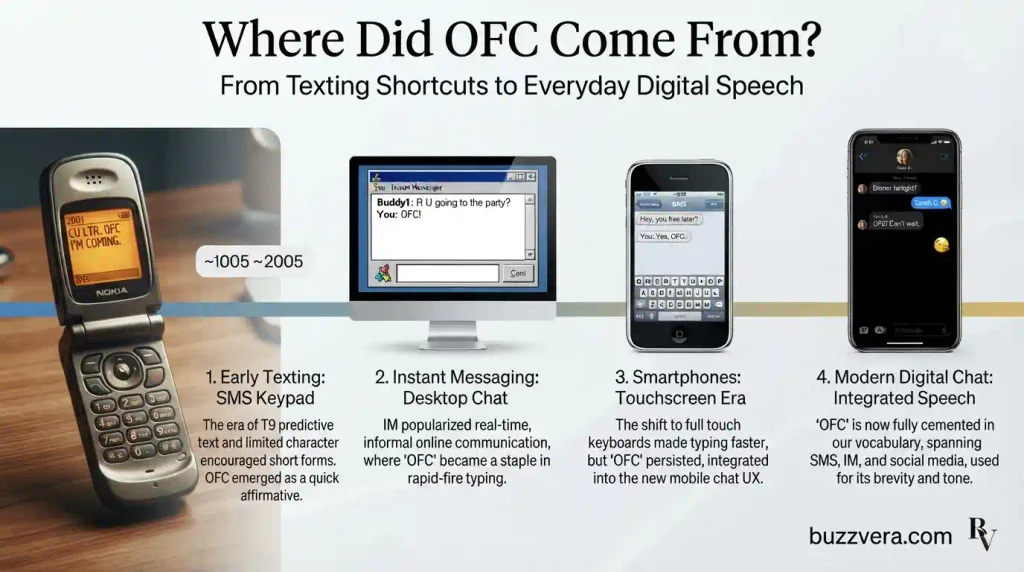
OFC is a simple shortening, but its rise says a lot about how texting culture evolved.
The texting boom
Of course is an old, common English phrase. But typing it out on early flip phones, with tiny number pads, took real effort. Abbreviations like OFC, BRB, and IDK became survival tools.
The instant messaging era
In the 2000s, AIM, MSN Messenger, and early texting culture pushed short forms everywhere. Speed mattered. Typing of course felt slow compared to three fast letters.
The rise of casual digital speech
By the 2010s, smartphones made typing faster, but the habit of shortening common phrases had already stuck. OFC became second nature, especially among younger texters who grew up chatting online.
Where OFC lives today
- Texting the most common home for OFC
- Instagram and Twitter/X comments quick agreement
- Discord and gaming chats fast confirmations
- Casual work chats Slack, Teams, informal emails
Fun fact: Even though typing full words is now effortless on smartphones, OFC survives because it carries a casual, friendly tone that of course alone doesn’t always have.
How OFC Is Used in Different Contexts
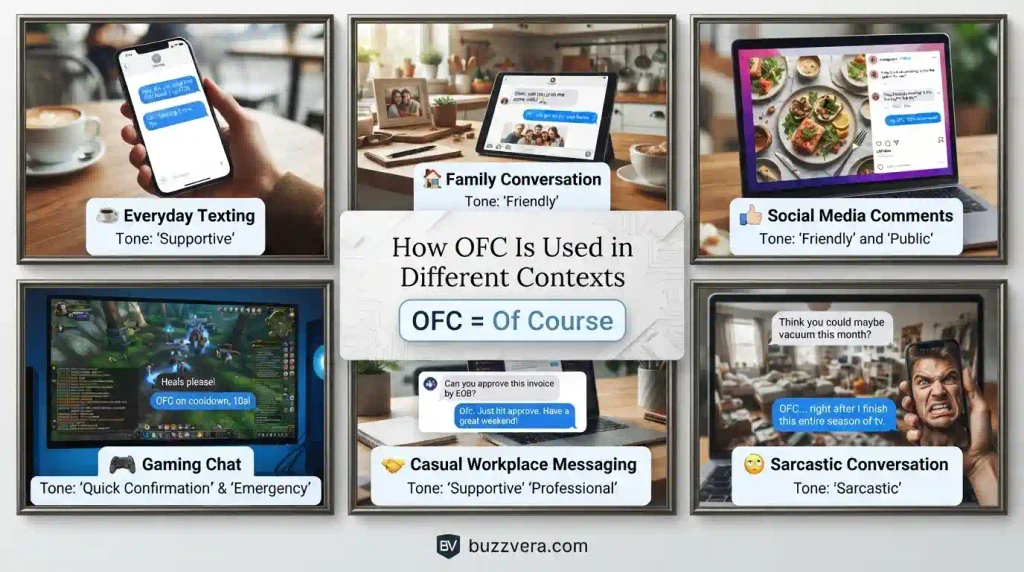
The feeling behind OFC shifts depending on where it shows up.
In everyday texting
Warm and quick the most common use.
Sam: you coming to the party?
You: ofc, wouldn’t miss it
With family
Casual and comforting.
Mom: can you call me later?
You: ofc, i’ll call after work
On social media
Used in comments to show quick agreement or support.
Comment: this looks amazing!
Reply: ofc it does, she made it herself 😍
In gaming
Fast confirmation during matches.
Teammate: cover me while i heal
You: ofc, go
At work (casual settings)
In relaxed workplace chats, OFC can show up too.
Coworker: can you send that file over?
You: ofc, sending now
In sarcastic contexts
OFC can also carry a sarcastic edge, especially when something annoying happens.
Friend: the bus was late again
You: ofc it was 🙄
Key point: The words stay the same. The punctuation, emoji, and situation shift the meaning from warm to sarcastic.
Common Misconceptions About OFC
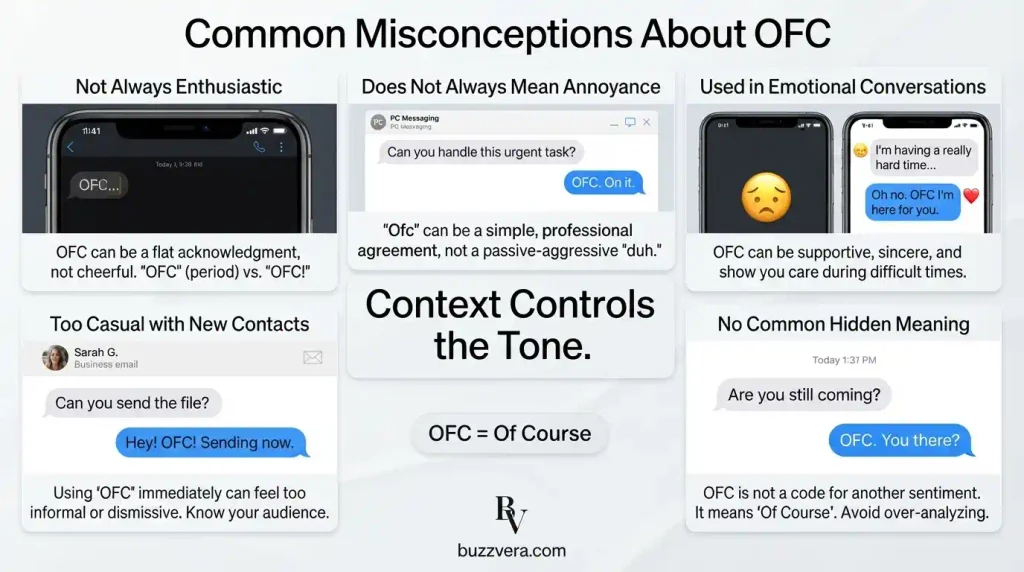
Let’s clear up a few common mix-ups.
Myth 1: OFC always sounds enthusiastic
Not true. Without an exclamation point or emoji, OFC can feel flat or dismissive, especially in a serious conversation.
Friend: i really needed that, thank you
You: ofc.
That short, period-ended reply can feel a little cold, even if it wasn’t meant that way.
Myth 2: OFC means the person is annoyed
Only sometimes. Context decides. In most cases, OFC is simply an easy yes, not a sign of irritation.
Myth 3: OFC is too casual for any serious topic
Not always true. People use OFC even in emotional or reassuring moments, like comforting a friend.
Friend: are you sure you’re not mad at me?
You: ofc not, i promise
Myth 4: OFC is rude if used with someone you don’t know well
It can feel overly casual in a first conversation with someone new, like a professional contact or an unfamiliar match on a dating app. In those cases, spelling out of course feels safer.
Myth 5: OFC has a hidden, different meaning
In everyday use, no. Unlike some other abbreviations, OFC has one clear standard meaning: of course.
Key point: If a text feels off after receiving ofc, it’s usually about tone, not a secret meaning.
Similar Terms and Alternatives
OFC has plenty of cousins that carry a similar meaning.
| Term | Meaning | Feel |
| OFC | Of course | Casual, quick |
| Yep / yup | Yes | Very casual |
| Sure | Yes, agreeable | Neutral |
| Totally | Definitely | Enthusiastic |
| Obvi | Obviously | Playful |
| Absolutely | Strong yes | Warm, sometimes formal |
| No doubt | Certainly | Confident |
| Def / defo | Definitely | Casual |
Notes on the close ones
Obvi is playful and a bit more exaggerated than OFC often used when something is very clearly true.
Friend: are you excited for the trip?
You: obvi 😄
Def or defo feels similar to OFC but leans slightly more into certainty than agreement.
Friend: you coming tonight?
You: def, wouldn’t miss it
Absolutely feels a touch more formal and can work well in professional messages where OFC might feel too casual.
Instead of: ofc, i’ll handle it
Try: Absolutely, I’ll take care of it.
Key point: Swap OFC for absolutely or certainly when writing to someone new or in a formal setting.
How to Respond to OFC
Your reply style depends on the vibe of the conversation.
1. Casual and warm
Simple, easy, friendly.
Them: ofc i’ll help you move this weekend
You: you’re the best, thank you!
2. Funny reply
Works well between close friends.
Them: ofc i remembered your birthday
You: as you should 😌
3. Reassuring reply
Good when OFC is used to comfort someone.
Them: ofc i still want to be friends
You: that means a lot, thank you for saying that
4. Professional reply
When OFC shows up in a work chat, match the tone but stay polished.
Coworker: ofc, I’ll send it over today
You: Great, thank you for the quick turnaround!
5. When the tone feels off
If ofc. feels a little cold or unclear, it’s fine to check in.
You: all good? that felt a little short haha
Key point: A short ofc rarely means something is wrong. But if you’re unsure, a light check-in clears things up fast.
Regional and Cultural Differences
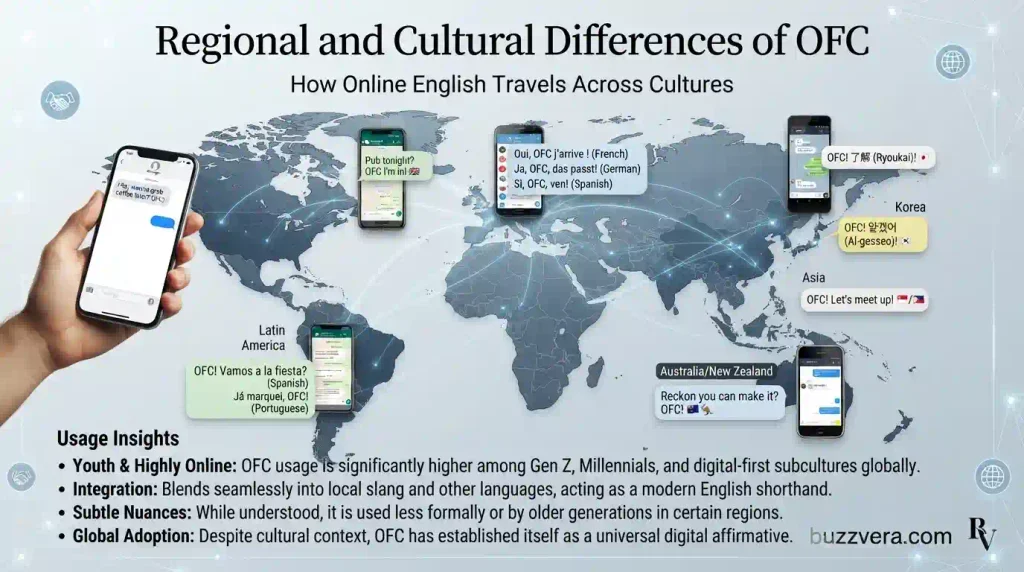
OFC is an English-based abbreviation, and its use varies a bit by region.
United States and Canada
Extremely common in texting and social media, used by nearly all age groups familiar with texting slang.
United Kingdom and Ireland
Just as common, often paired with British-style casual phrasing like ofc mate or ofc babes.
Australia and New Zealand
Widely used in texting, especially among younger users, often alongside other casual shortenings.
Non-English-speaking regions
In many European, Latin American, and Asian countries, OFC is understood mostly by younger, bilingual, or heavily online users, since it is an English phrase borrowed into local texting habits.
Spanish speaker text: ofc que sí jajaja
This kind of blending is common OFC gets mixed directly into other languages’ texting style.
Where it’s less common
In more formal or older-generation messaging habits, especially outside English-speaking countries, people are more likely to write out the full phrase in their own language instead of borrowing OFC.
| Region | OFC usage |
| USA / Canada | Very high |
| UK / Ireland | Very high |
| Australia / NZ | High |
| Non-English-speaking regions | Medium, mostly younger users |
Key point: If texting someone from a different region or older generation, spelling out of course is a safer bet.
OFC vs Similar Terms: A Clear Comparison
| Term | Meaning | Formality | Typical use |
| OFC | Of course | Very casual | Texting, social media |
| Sure | Yes | Neutral | Everyday agreement |
| Absolutely | Strong yes | Formal-friendly | Work, new contacts |
| Obvi | Obviously | Playful | Close friends |
| No doubt | Certainly | Neutral-confident | Casual conversation |
| Certainly | Formal yes | Formal | Professional writing |
The quick test
- Who are you texting? Close friend or new contact?
- What’s the setting? Casual chat or professional message?
- What tone do you want? Warm, sarcastic, or neutral?
That quick check usually points you to the right word.
OFC in Online Communities and Dating Apps
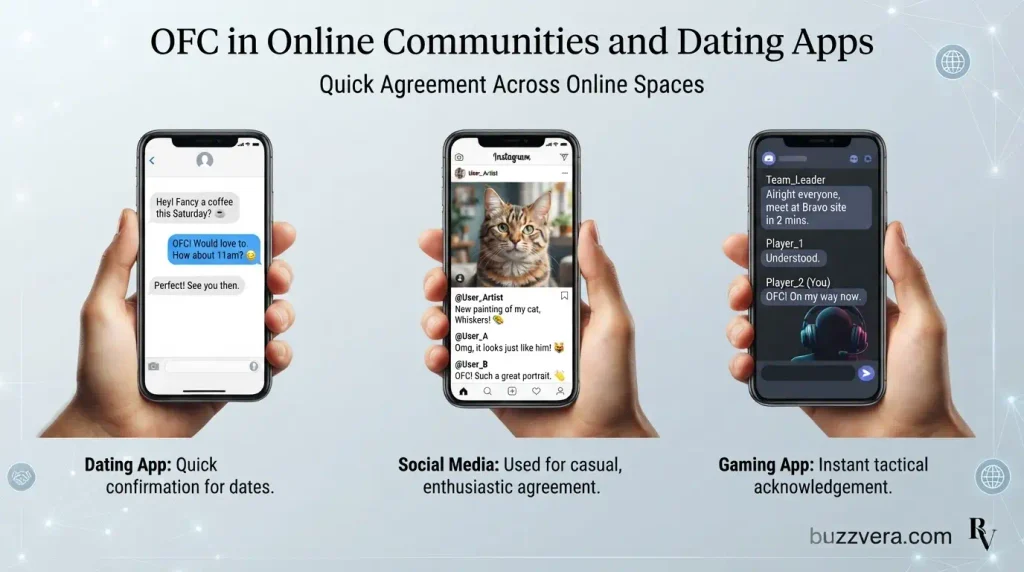
On dating apps
OFC often shows up as a quick, easy agreement once a conversation feels comfortable.
Match: wanna grab coffee saturday?
You: ofc, sounds great!
It signals interest without sounding overly eager or formal a nice middle ground for early conversations.
On Twitter/X and Instagram
People use OFC constantly in replies and comments to agree or validate a post.
Tweet: this show is so underrated
Reply: ofc, best show of the year tbh
In gaming communities
OFC is used for fast confirmations during matches or planning.
Chat: everyone ready?
You: ofc, let’s go
Tips for responding appropriately
- On dating apps, pair OFC with something specific to keep the conversation flowing.
You: ofc! i’ve been wanting to try that new café anyway
- In gaming, OFC works best short and quick no need to overthink it.
- On social media, OFC in a reply usually shows agreement or support, so match that same friendly energy back.
Key point: OFC works well as a light, easy response across almost every online space just keep an eye on tone.
Hidden or Offensive Meanings
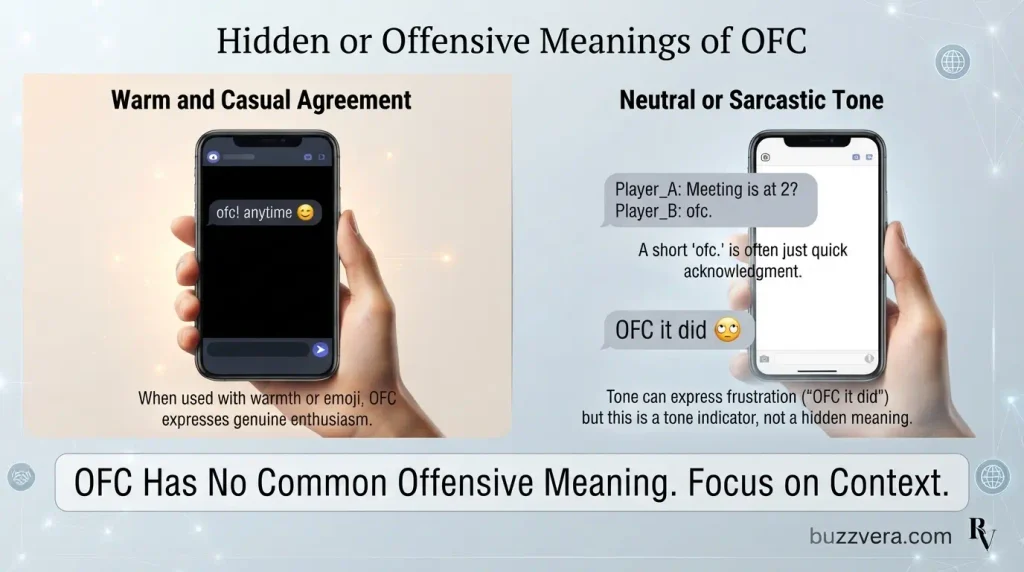
Good news: OFC carries very little risk here.
The straightforward truth
OFC has no common offensive or hidden meaning. It is one of the more neutral, friendly abbreviations in everyday texting.
The one nuance: sarcasm
The main way OFC can feel negative is through sarcastic tone, especially when something frustrating happens.
Friend: the wifi went down again
You: ofc it did 🙄
Here, OFC isn’t offensive it’s just expressing frustration about a situation, not about a person.
When OFC can feel dismissive
Without any warmth (an emoji, exclamation point, or friendly follow-up), OFC alone can occasionally feel a little flat.
Friend: thank you so much for today
You: ofc.
A period at the end, with no other context, can unintentionally feel short. Adding a little more warmth avoids this.
Better: ofc! anytime 😊
Why tone matters
Compare:
A: ofc i’ll be there, wouldn’t miss it!
versus
B: ofc.
Same two words. A feels warm. B feels short. The gap is all about what surrounds those three letters.
Key point: OFC is safe and friendly by default. Just add a little warmth in emotional or important conversations to avoid sounding too brief.
Is OFC Okay for Professional Communication?
Short answer: use with caution, and only in casual work settings.
Why it doesn’t always fit
- It is informal slang, and formal writing avoids abbreviations like this
- It can feel too casual with clients, executives, or new contacts
- It may come across as dismissive in a serious or sensitive discussion
What to write instead
| Instead of | Write this |
| ofc, I’ll handle it | Absolutely, I’ll take care of it. |
| ofc, sending now | Of course sending it over now. |
| ofc that works | That works well for me, thank you. |
Professional examples
Email: Of course, I’ll have the report ready by end of day.
Slack (casual workplace): ofc! sending the file now 👍
The one exception
In relaxed, informal workplaces startups, creative teams, close-knit small businesses OFC between familiar coworkers can be totally fine. Read the room first.
Where OFC is fine
- Texts with friends and family
- Social media comments
- Gaming chats
- Casual dating app conversations
- Relaxed workplace chats with people you know well
Frequently Asked Questions
1. What does OFC mean in a text message?
OFC means of course. It’s a quick way to agree or confirm something.
2. Is OFC rude?
Not usually. It can feel a little short without extra warmth, but it isn’t inherently rude.
3. Can OFC be sarcastic?
Yes. Depending on the situation, OFC can express mild frustration, like ofc that happened 🙄.
4. Is OFC appropriate for work emails?
Better to write of course or absolutely in formal emails. OFC fits casual workplace chats only.
5. What’s the difference between OFC and obvi?
Both mean something is obvious or certain, but obvi feels more playful and exaggerated, while OFC feels more like a simple, quick yes.
6. Should I use OFC with someone I just met?
It’s usually fine in casual settings like dating apps, but spelling out of course can feel a bit more polished with new contacts.
7. Does OFC have any hidden meaning?
No. Its meaning is consistent of course across nearly every context.
Conclusion
OFC means of course. It’s a small, simple way to say yes, agree, or confirm something quickly and it shows up everywhere from texts to gaming chats to social media comments.
The letters themselves are neutral. The tone comes from what surrounds them punctuation, emojis, and the relationship between the people texting. A warm ofc! feels completely different from a flat ofc.
Keep it casual with friends and family, add a little warmth in emotional moments, and swap it for absolutely or of course when writing to someone new or in a professional setting.
Now, whenever ofc shows up in your messages, you’ll know exactly what it means and exactly how to respond.

Mafia Noor is an experienced content writer and author at BuzzVera.com, with 3 years of experience creating helpful and easy-to-understand content. Mafia specializes in texting slang, internet abbreviations, modern expressions, and text meanings, helping readers understand today’s digital language clearly and confidently.