You’re texting a friend about weekend plans. They ask if you want to go to a party. You reply: idw tbh, I’m tired. They get it right away. But if you’re new to this kind of shorthand, that string of letters can look like a typo.
IDW is one of the many short acronyms people use to text faster. It shows up in group chats, DMs, gaming lobbies, and comment sections. Knowing what it means and when to use it helps you keep up with fast conversations and avoid sounding out of touch.
This guide breaks down what IDW means, where it came from, how people use it today, and how you can reply to it. By the end, you’ll be able to spot it in the wild and use it yourself with confidence.
Definition & Meaning
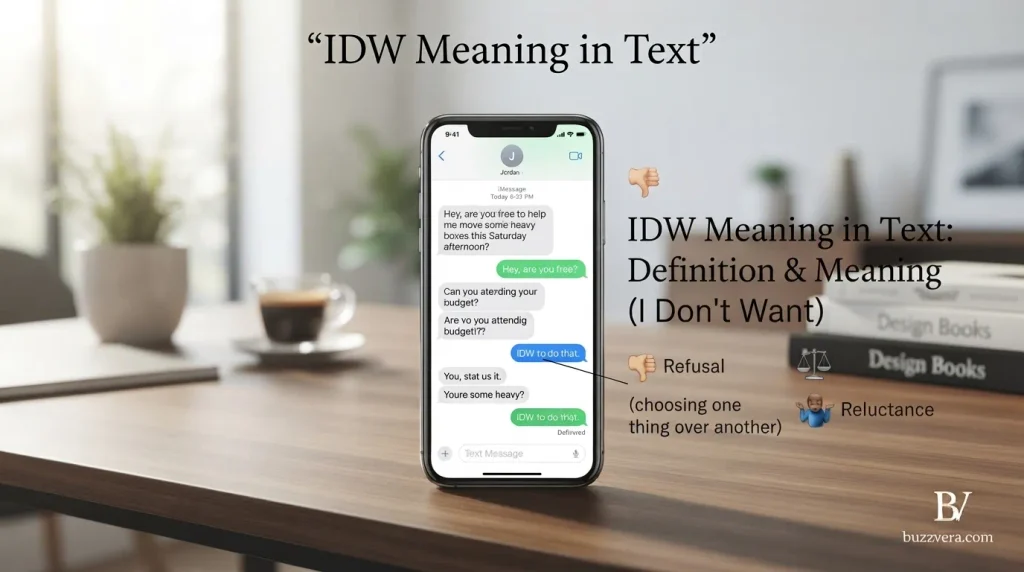
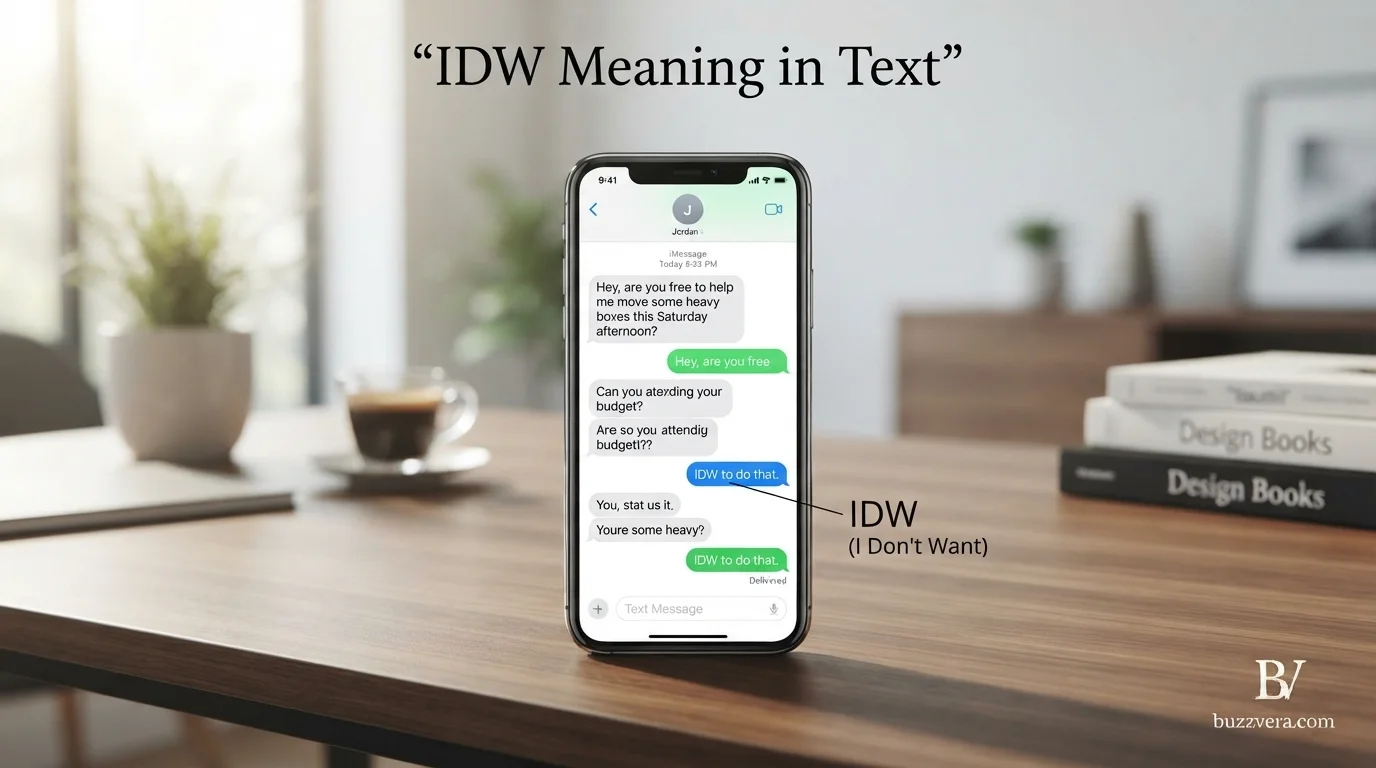
IDW stands for I Don’t Want. It’s a quick way to say you don’t want to do something, don’t want something to happen, or aren’t interested in an offer.
People type it fast, usually in lowercase, and often drop it into a sentence the same way they’d use the full phrase. It works as a standalone reply or as part of a longer message.
Here are a few real-life examples:
- Friend: Wanna come to the gym with me? You: idw, I’m exhausted.
- Sibling: Can I borrow your charger? You: idw you to lose it again lol
- Group chat: idw to be the one who tells him the trip got cancelled 😭
Notice that IDW almost always needs a bit more text after it to make full sense. On its own, idw can feel abrupt, so people usually pair it with a reason, an emoji, or a follow-up sentence.
A quick note on capitalization: IDW is nearly always written in lowercase in texting. Capitalizing it (IDW) doesn’t change the meaning, but it can read as more formal or emphatic, almost like raising your voice slightly.
A quick note on tone: Because I don’t want can sound blunt in English, people often soften IDW with tbh (to be honest), lol, or a shrug emoji, so it reads as casual rather than cold.
Background & History
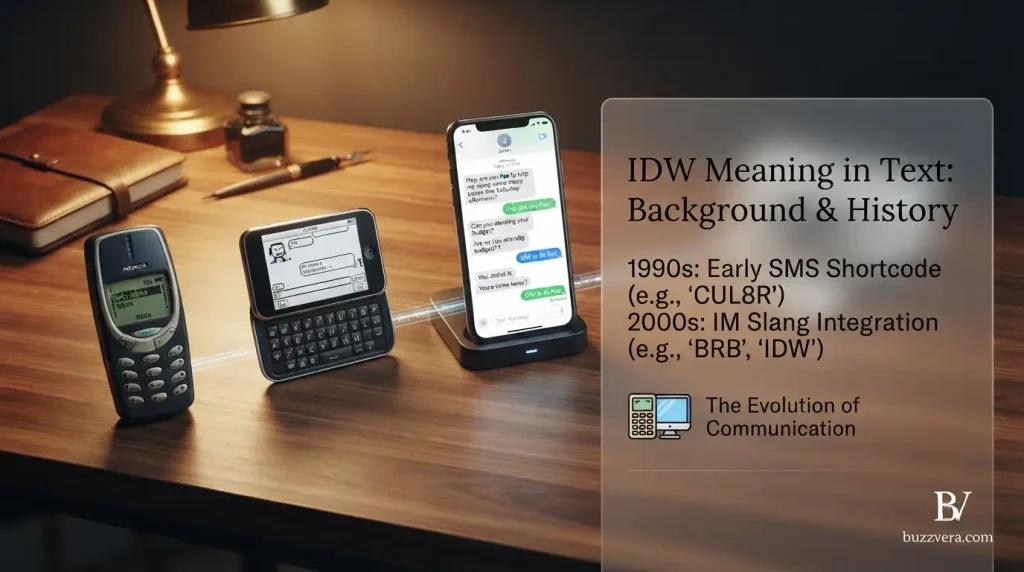
IDW belongs to a large family of texting abbreviations that grew out of one simple problem: typing on small keyboards is slow. Long before smartphones, people texting on flip phones with number pads shortened everything they could. I don’t want became idw for the same reason are you okay became ru ok.
This habit carried over from early SMS culture into instant messaging platforms like AIM and MSN Messenger, where teenagers and young adults typed quickly and casually. When smartphones and touch keyboards arrived, autocorrect made full words easier to type, but the shorthand habit stuck. It had become part of how people signaled a relaxed, informal tone, not just a way to save time.
Today, IDW shows up across texting apps, social media comments, gaming chat, and messaging platforms like Discord and WhatsApp. It’s most common among younger texters, but it’s understood widely enough that most people who text regularly will recognize it.
Unlike some slang terms that fade quickly, IDW has stayed stable in meaning. It hasn’t picked up alternate definitions the way many three-letter acronyms have. That makes it one of the more reliable, low-confusion abbreviations in everyday texting.
Usage in Various Contexts
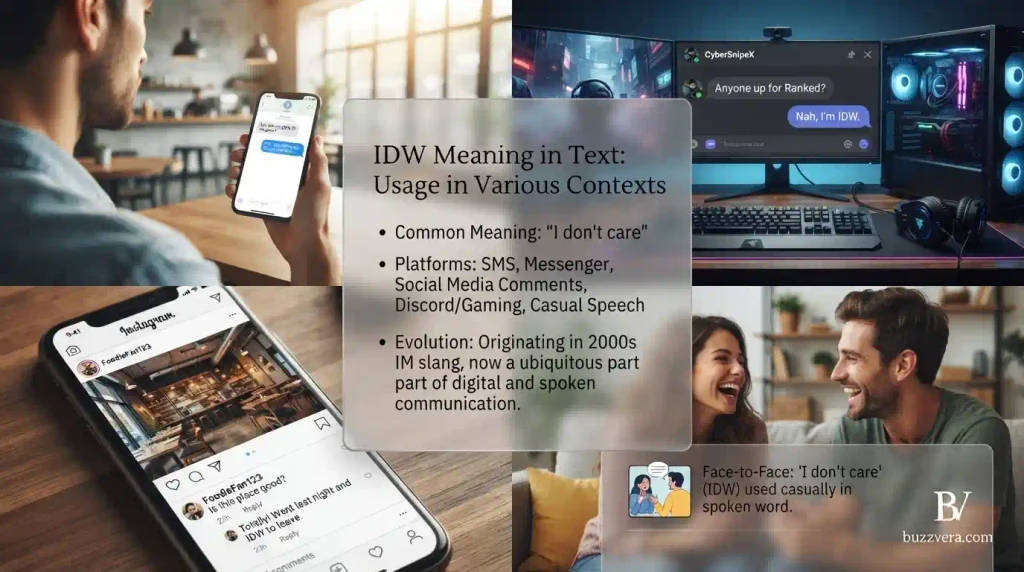
In texting, IDW usually appears when someone is turning down a plan or expressing reluctance:
Text 1: movie night at mine? Text 2: idw go out tonight, can we do it tmrw instead?
On social media, people use IDW in comments and captions to express a personal boundary or preference:
idw explain myself again, y’all can scroll past if you don’t like it
In gaming chat, IDW often signals that a player doesn’t want to take on a role, item, or task:
Player 1: who’s tanking? Player 2: idw tank this round, my connection’s bad
In casual conversation with friends, it can express hesitation about a decision:
Friend: should we tell her about the surprise party? You: idw ruin it, let’s keep it a secret a bit longer
Across all these settings, the core meaning stays the same: a short, informal way of saying I don’t want [to do this / this to happen]. What changes is the tone around it. In a group chat with close friends, IDW can be blunt and playful. In a public comment section, it often carries a slightly firmer, more defensive edge, especially when someone is setting a boundary.
Common Misconceptions & Clarifications
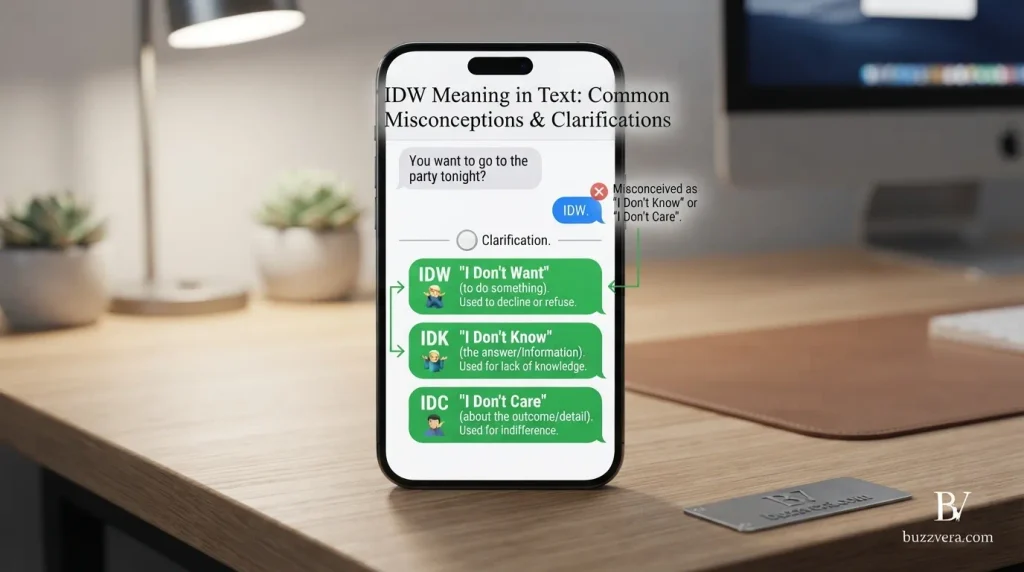
The biggest point of confusion with IDW is mixing it up with similar-looking acronyms. Here’s where people trip up:
- IDW vs. IDK: These are not the same. IDK means I don’t know, which expresses uncertainty. IDW means I don’t want, which expresses a preference or refusal. Mixing them up changes the whole meaning of a message.
- IDW vs. IDC: IDC means I don’t care. It signals indifference, not refusal. If someone texts idc where we eat, they’re fine with any option. idw eat there means they’re actively against one specific choice.
- IDW vs. Intellectual Dark Web: Outside of texting, IDW is also used online as shorthand for the Intellectual Dark Web, a term for a loose group of commentators and podcasters. This meaning shows up mostly in political or media discussions, not in personal texts, so context makes it easy to tell the two apart.
Is IDW ever rude or inappropriate? On its own, no. It’s a neutral, everyday phrase. But like any blunt statement, tone matters. idw talk to you can read as harsh depending on what came before it in the conversation. The abbreviation itself isn’t the problem; the message around it sets the tone.
Can IDW be misread as dismissive? Yes, especially in text form where tone doesn’t come through. Adding tbh, rn (right now), or a soft emoji can help make the message land the way you intend.
Similar Terms & Alternatives
Several other short phrases express similar ideas to IDW, but each has its own shade of meaning.
| Term | Full Meaning | Best Used When |
| IDW | I don’t want | You’re declining or expressing reluctance |
| IDC | I don’t care | You’re indifferent to the outcome |
| IDK | I don’t know | You’re uncertain or lack information |
| NVM | Never mind | You’re withdrawing a request or comment |
| IDGAF | I don’t give a f*** | Stronger, more emphatic indifference |
| IDTS | I don’t think so | You’re expressing doubt or disagreement |
Choosing the right one changes how your message reads. Saying idc when you actually mean idw can send the wrong signal, especially if the other person is trying to figure out what you’d prefer.
How to Respond to This Term
How you reply to IDW depends on the relationship and the setting.
Casual response, with a close friend:
Friend: idw go to the dentist tmrw You: lol fair, want me to remind you to reschedule?
Funny response, to lighten the mood:
Friend: idw do my homework You: shocking news, more at 10
Professional response, if IDW shows up in a semi-formal chat (like a coworker on Slack):
Coworker: idw join that call, can someone else take it? You: No problem, I can cover it just send me the details.
Privacy-conscious response, when someone uses IDW to set a boundary:
Friend: idw talk about it rn You: totally understand, I’m here whenever you’re ready
In general, the best response acknowledges what the other person said without pushing them to explain further. IDW is often a signal to back off gently, not an invitation to debate.
Regional or Cultural Differences

IDW is primarily an English-language abbreviation, and its use is strongest in the United States, United Kingdom, Canada, and Australia, where English-language texting culture developed similar shorthand habits over the past two decades.
In non-English-speaking countries, IDW is less common in native-language texting, but it does appear among younger, bilingual users who mix English abbreviations into their messages, especially online where English internet slang spreads quickly through gaming and social media.
There aren’t major regional variations of the term itself, unlike some slang that changes meaning by country. What does vary is how blunt it feels. In more direct texting cultures, idw reads as completely normal. In cultures where indirect refusals are the norm, the same phrase might come across as unusually straightforward, even if that’s not the intent.
Comparison with Similar Terms
Here’s a closer look at how IDW differs from terms people often confuse it with:
| Term | Expresses | Example | Key Difference from IDW |
| IDW (I don’t want) | Refusal or reluctance | idw go out | The baseline term |
| IDC (I don’t care) | Indifference | idc what we watch | No preference either way |
| IDK (I don’t know) | Uncertainty | idk what to pick | Lack of information, not refusal |
| NVM (never mind) | Withdrawal | nvm, forget I asked | Cancels a previous statement |
| SMH (shaking my head) | Disapproval | smh, why would he do that | Reaction, not a personal preference |
The pattern to remember: IDW is about what you want or don’t want. IDC is about what you’re okay with. IDK is about what you know. Keeping that distinction clear avoids most mix-ups.
Usage in Online Communities & Dating Apps
On dating apps like Tinder or Hinge, IDW often shows up in bios or messages to set expectations early:
idw anything serious rn, just here to meet people
It’s a fast way to signal intentions without writing a paragraph. If you see it in someone’s bio or a match’s message, it’s worth taking at face value they’re telling you their boundary upfront.
On Twitter/X, people use IDW in replies and quote tweets to express a strong personal stance:
idw hear another take on this, I’m exhausted
On gaming platforms like Discord, IDW is common in voice chat call-outs and text channels when players are negotiating roles or decisions:
idw play support again, can someone swap with me?
Tips for responding appropriately:
- On dating apps, respect the boundary rather than pushing back someone saying idw anything serious is giving you useful information, not an opening to negotiate.
- On social platforms, don’t assume IDW is aimed at you personally unless it’s a direct reply.
- In gaming chat, offer an alternative rather than just acknowledging it, since the person likely needs the group to solve a practical problem (like who takes a role).
Hidden or Offensive Meanings
IDW doesn’t have a widely recognized offensive or hidden meaning in standard texting use. It’s a straightforward abbreviation with one dominant interpretation: I don’t want.
The one alternate meaning worth knowing is the Intellectual Dark Web usage mentioned earlier. That version is tied to political and media commentary online and is unlikely to appear in a personal text conversation, so context almost always makes the intended meaning obvious.
Why tone still matters: Even without a hidden meaning, IDW can land harshly if it’s used without softening language, especially in a text where the other person can’t hear your voice or see your face. A message like idw with nothing else attached can feel cold, even if that wasn’t the intent. Adding a reason, a follow-up, or an emoji usually fixes this.
Suitability for Professional Communication
IDW is casual shorthand, so it’s not recommended for formal professional communication like emails, official reports, or messages to clients. In most workplaces, even informal ones, spelling out your meaning reads as more polished and reduces the chance of misunderstanding.
That said, some workplace chat tools (like informal Slack channels between close coworkers) tolerate light abbreviations. Even there, it’s worth reading the room before using it.
Professional alternatives:
- Instead of idw join that call → I’d prefer not to join that call, is there someone else available?
- Instead of idw do this task → I don’t think I’m the best fit for this task could we discuss reassigning it?
- Instead of idw alone → I’d rather not, but happy to help with something else.
The safest rule: if you’re unsure If your audience will understand or appreciate the shorthand, spell it out.
FAQs
1. What does IDW mean in a text message? IDW stands for I don’t want. It’s used to express reluctance or refusal in a quick, informal way.
2. Is IDW the same as IDC? No. IDW means I don’t want (a preference against something), while IDC means I don’t care (indifference).
3. Can IDW be used in professional settings? It’s best avoided in formal communication. Spelling out your meaning is clearer and reads as more polished.
4. Does IDW have a rude or offensive meaning? No, it’s a neutral phrase. Tone depends on the message around it, not the abbreviation itself.
5. What’s the difference between IDW and IDW in political discussions? In texting, IDW means I don’t want. In political or media commentary, IDW can also refer to the Intellectual Dark Web, a completely unrelated term. Context makes the difference clear.
6. How should I respond if someone texts me idw? Acknowledge their preference without pushing back. A simple, understanding reply usually works best.
7. Is IDW common on dating apps? Yes, it’s often used to set expectations early, such as idw anything serious rn.
Conclusion
IDW is a simple, widely understood piece of texting shorthand that means I don’t want. It shows up in casual texts, social media, gaming chat, and dating app bios as a fast way to express reluctance or a boundary. While it’s not suited for formal communication, it’s a normal, everyday part of informal digital conversation.
The key to using IDW well is pairing it with enough context so your tone comes through clearly. Once you know what it means and how people tend to use it, you’ll have no trouble spotting it or using it yourself the next time it shows up in your messages.

Mahi Aylin is a content writer and author at BuzzVera.com, with 3 years of writing experience. She specializes in texting slang, internet abbreviations, modern expressions, and text meanings, creating simple and easy-to-understand content that helps readers confidently navigate today’s digital language.