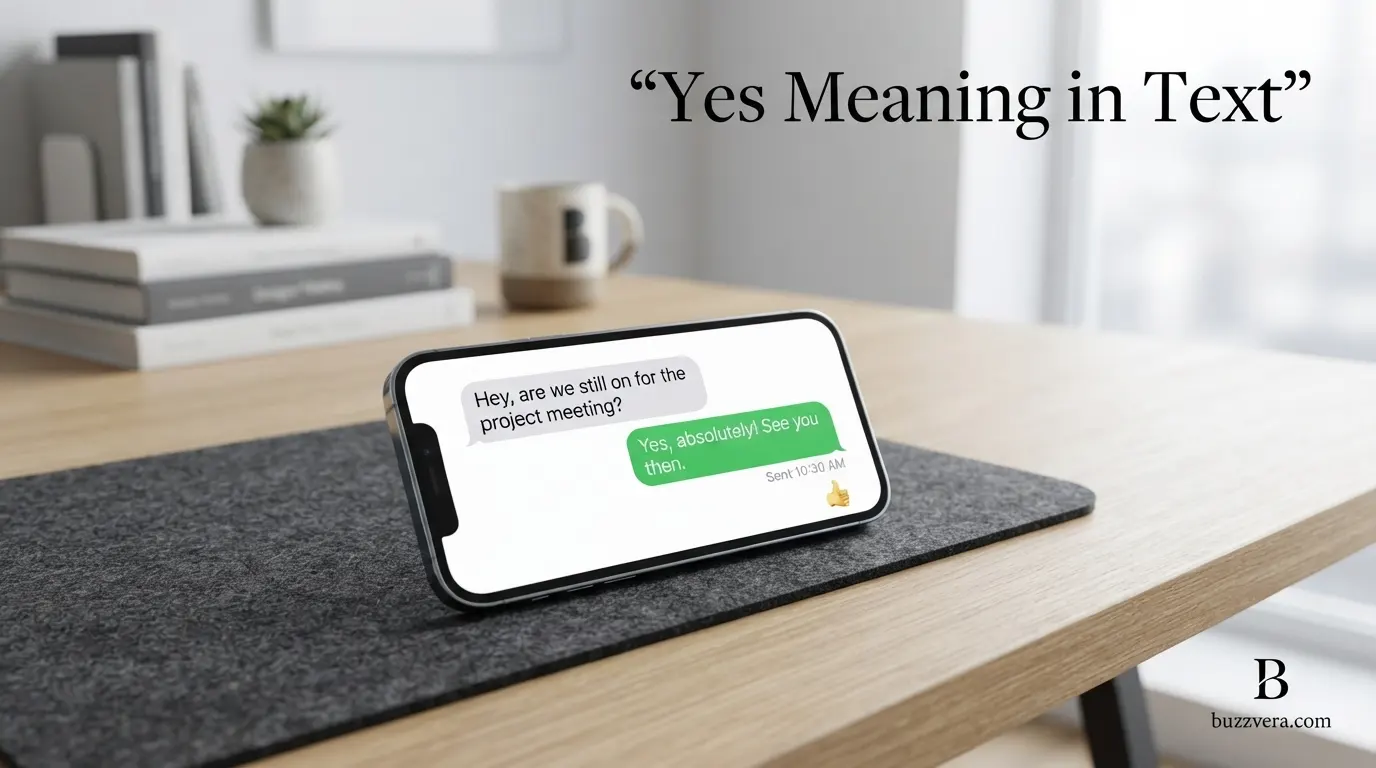
The yes meaning in text is usually simple, but the real meaning can change with the situation. When someone sends yes, they may be saying okay, I agree, I understand, or I want to do it. Sometimes, however, a short yes can sound cold, serious, excited, or even annoyed.
In daily texting, people often use yes as a quick reply. You may see it in WhatsApp chats, social media comments, gaming messages, dating apps, or work conversations. For example, if someone asks, Are you coming tonight? and you reply Yes, you are giving a clear answer.
Still, tone matters. Yes! feels more excited than yes. Yes, sure may sound friendly, while Yes. can feel more formal or distant.
Understanding the yes meaning in text helps you read messages correctly and avoid confusion. It also helps you choose the right reply when someone sends you this simple but useful word.
Yes Meaning in Text: Definition & Meaning

The basic yes meaning in text is agreement, confirmation, acceptance, or a positive answer. It is one of the most common words used when someone wants to say that something is true, correct, wanted, or acceptable.
For example:
Person A: Are you free tonight?
Person B: Yes.
Here, yes means that Person B is free.
Another example:
Person A: Do you want pizza?
Person B: Yes!
The word shows that Person B wants pizza. The exclamation mark makes the answer sound more energetic.
yes can also confirm information.
Person A: Your meeting starts at 3 PM, right?
Person B: Yes.
In this case, yes means that is correct.
The word can also show agreement with a request.
Person A: Can you send me the file?
Person B: Yes.
This means the person agrees to send the file.
Common meanings of yes in texting
- Agreement: Yes, I agree.
- Confirmation: Yes, that is correct.
- Acceptance: Yes, I will do it.
- Permission: Yes, you can.
- Positive answer: Yes, I am coming.
- Interest: Yes, I would like that.
- Excitement: YES! We won!
- Understanding: Yes, I understand.
The exact meaning depends on the message before it, punctuation, emojis, and the relationship between the people.
For example, YES!!! often shows strong excitement. yes… may suggest hesitation or uncertainty. Yes. may simply be formal, but in a casual chat it can sometimes feel serious.
So, while the dictionary meaning stays the same, the tone of yes in text can change greatly.
Yes Meaning in Text: Background & History

The word yes is not a modern texting abbreviation. It is a very old English word used to give a positive answer or show agreement. Its history goes back to early forms of English, where related forms were used to express affirmation.
Over time, yes became a standard part of everyday English. People used it in spoken conversations, letters, books, business communication, and formal writing long before phones and the internet existed.
Text messaging did not create the word. Instead, texting changed how people use and style it.
Before digital communication, people could hear a person’s voice when they said yes. Their tone could show happiness, doubt, anger, or excitement. In text, that voice is missing. As a result, people began using punctuation, repeated letters, capitalization, and emojis to show tone.
For example:
- Yes simple confirmation
- Yes! excitement or strong agreement
- YES! very strong excitement
- Yesss! playful excitement
- Yeah casual agreement
- yes… possible hesitation
- Yes 🙂 friendly agreement
Modern social media and messaging apps have also made short replies more common. People often answer with one word when the question is simple.
Person A: Are you joining the game?
Person B: Yes.
In gaming, yes can quickly confirm a plan.
Player 1: Ready?
Player 2: Yes.
In professional chats, it can confirm a task.
Manager: Can you finish this today?
Employee: Yes.
Today, yes is used across many digital spaces. The basic meaning has stayed stable, but digital communication has created many new ways to express its tone.
Yes Meaning in Text: Usage in Various Contexts

The yes meaning in text changes slightly depending on where and how the word is used.
In texting
Texting usually uses yes as a quick answer.
Person A: Are you home?
Person B: Yes.
It can also confirm a plan.
Person A: We are meeting at 7, right?
Person B: Yes.
On social media
People may use yes to agree with a post or comment.
Friend: This outfit looks amazing!
You: Yes! 🔥
Here, yes expresses strong agreement.
In gaming
Gamers may use yes to confirm instructions or plans.
Player A: Should we attack from the left?
Player B: Yes.
Because gaming chats can move quickly, short replies are useful.
In casual conversations
yes can answer everyday questions.
Friend: Want to watch a movie?
You: Yes!
The exclamation mark adds excitement.
In family chats
Family members often use yes to confirm plans.
Mom: Will you be home for dinner?
Son: Yes.
In dating conversations
yes may show interest.
Person A: Would you like to meet this weekend?
Person B: Yes 😊
The emoji can make the reply feel warmer.
In professional communication
yes can confirm a task or detail.
Boss: Can you join the meeting at 2?
Employee: Yes.
However, a more complete answer may sound more professional:
Employee: Yes, I’ll join the meeting at 2 PM.
The meaning remains positive, but the longer response provides more information.
Yes Meaning in Text: Common Misconceptions & Clarifications
One common misunderstanding is that yes always sounds happy. That is not true.
The word itself is positive, but the tone depends on context.
Compare these:
Yes!!!
This usually feels excited.
Yes.
This can feel neutral or serious.
yes…
This may suggest hesitation, doubt, or discomfort.
However, you should not automatically assume that yes. means the person is angry. Some people naturally use periods in their messages. Their normal texting style matters.
Another misconception is that yes always means I completely agree. Sometimes it only confirms part of a statement.
For example:
Person A: You finished the report and sent it to Sarah, right?
Person B: Yes.
This likely confirms the whole question, but context is still important.
yes can also mean permission.
Child: Can I go outside?
Parent: Yes.
It can mean acceptance.
Person A: Would you like some coffee?
Person B: Yes.
It can mean confirmation.
Person A: Is this your phone?
Person B: Yes.
Therefore, you should look at the question before deciding what yes means.
Another important point is that yes is normally not offensive. It is a standard English word. However, the tone may become uncomfortable if someone uses it in a rude or sarcastic way.
Yes Meaning in Text: Similar Terms & Alternatives
Many words can replace yes, but they do not always carry exactly the same tone.
| Term | Common meaning | Tone |
| Yes | Agreement or confirmation | Neutral |
| Yeah | Casual agreement | Informal |
| Yep | Quick agreement | Casual |
| Yup | Agreement | Casual |
| Sure | Agreement or willingness | Friendly |
| Okay | Acceptance or understanding | Neutral |
| Definitely | Strong agreement | Confident |
| Absolutely | Very strong agreement | Enthusiastic |
| Correct | Confirmation | Formal |
| Of course | Strong agreement or willingness | Friendly |
| Certainly | Agreement | Polite/formal |
| Indeed | Strong confirmation | Formal |
For example:
Yes, I can help.
is neutral.
Yeah, I can help.
sounds more casual.
Absolutely! I can help.
sounds more enthusiastic.
Certainly, I can help.
sounds more formal.
The best choice depends on your relationship with the person and the setting.
Yes Meaning in Text: How to Respond to This Term
If someone sends you yes, your response should depend on the conversation.
Casual response
If you are chatting with a friend, keep it simple.
Friend: Are you coming?
You: Yes.
Friend: Great! See you soon!
You can also reply:
- Awesome!
- Great!
- Perfect!
- Nice!
- Sounds good!
Funny response
If the conversation is playful:
Friend: Did you really eat the whole pizza?
You: Yes.
Friend: Respect. 😂
You could also say:
- That was a powerful yes 😂
- Short and clear!
- I’ll take that as a yes!
- YES means we are officially doing it! 😂
Professional response
At work, you may want to give more information.
Manager: Can you send the report today?
You: Yes, I’ll send it before 4 PM.
This is better than simply yes when the task needs confirmation.
Privacy-conscious response
Sometimes a question asks for personal information.
Person: Are you home alone?
You: I’d rather not share that.
You do not have to answer every question with yes or no. If a question feels too personal, you can protect your privacy.
If you are unsure
Ask for clarification.
Person: Are you okay with it?
You: What exactly do you mean?
This prevents misunderstandings.
Yes Meaning in Text: Regional or Cultural Differences
The basic word yes is widely understood in English-speaking communication. However, different regions may use other words or expressions for agreement.
For example, casual English speakers may use:
- Yeah
- Yep
- Yup
- Sure
- Absolutely
- Definitely
These alternatives can vary by age, region, personality, and situation.
Some English-speaking communities may prefer yeah in casual conversation, while yes may sound more direct or formal.
For example:
Yes, I’m coming.
and
Yeah, I’m coming.
have the same basic message, but the second sounds more relaxed.
Culture can also affect how direct a positive answer feels. In some situations, people may use softer expressions instead of a direct yes. In other settings, a clear yes is valued because it removes doubt.
When communicating across cultures, context is important. A short yes should not automatically be interpreted as excitement, agreement with every detail, or emotional warmth.
Also remember that translations of yes may have different levels of politeness or formality in other languages. A direct translation does not always carry the same social tone.
Yes Meaning in Text: Comparison with Similar Terms
The following comparison can help you understand the difference between common positive replies:
| Expression | Main idea | Typical tone | Example |
| Yes | Positive answer | Neutral | Yes, I agree. |
| Yeah | Positive answer | Casual | Yeah, sounds good. |
| Yep | Quick confirmation | Casual | Yep, I’m ready. |
| Yup | Quick agreement | Very casual | Yup, that works. |
| Sure | Willingness | Friendly | Sure, I can help. |
| Definitely | Strong agreement | Confident | Definitely! |
| Absolutely | Strong positive answer | Enthusiastic | Absolutely! |
| Okay | Acceptance | Neutral | Okay, I understand. |
| Of course | Willing agreement | Friendly | Of course! |
| Certainly | Positive answer | Formal | Certainly, I can assist. |
The important difference is tone.
If someone asks:
Do you want to come with us?
You could answer:
Yes. simple and neutral.
Yeah! casual and friendly.
Definitely! excited and confident.
Sure! willing and relaxed.
Absolutely! very enthusiastic.
Yes Meaning in Text: Usage in Online Communities & Dating Apps
The word yes is common in online communities because it is short and easy to understand.
On social platforms, users may write yes when agreeing with an opinion, reacting to an idea, or confirming something.
User A: We need more cat videos.
User B: YES 😂
Here, capitalization adds energy.
In gaming communities, yes may confirm a strategy.
Player A: Ready for the next round?
Player B: Yes.
In dating apps, yes can show interest, but context is important.
Person A: Would you like to grab coffee sometime?
Person B: Yes 😊
This is clearly positive.
However, a one-word yes does not always show strong romantic interest. It may simply answer the question.
If you want to understand someone’s intention, look at the whole conversation.
For example:
You: Would you like to meet Saturday?
Them: Yes, that sounds great!
This gives more information than:
Them: Yes.
A good rule for online communication is to avoid reading too much emotion into one word. Look at the person’s usual texting style, the previous messages, and If they continue the conversation.
Yes Meaning in Text: Hidden or Offensive Meanings
The word yes does not normally have a hidden offensive meaning. It is a basic word used to express agreement or confirmation.
Still, context can change how it feels.
For example:
Yes, boss.
Depending on the relationship, this could be sincere, playful, or sarcastic.
Another example:
Oh, yes. Great.
Depending on the conversation, this may sound enthusiastic or sarcastic.
Repeated letters can also change the emotional feeling:
- Yes neutral
- Yesss! excited or playful
- YES!!! very excited
- yes… possible hesitation
- yes 🙄 may sound annoyed or sarcastic
These are not fixed meanings. They are clues.
You should also avoid assuming that punctuation always reveals emotion. Some people use punctuation heavily, while others rarely use it.
If a message seems unclear, the safest choice is to ask.
You: Just checkingdo you mean yes to the plan?
This is better than guessing and creating a misunderstanding.
Yes Meaning in Text: Suitability for Professional Communication

Yes is completely acceptable in professional communication. However, the best wording depends on what you are confirming.
A one-word answer can sometimes be too short when a task, deadline, or decision needs detail.
For example:
Manager: Can you finish the report by Friday?
Employee: Yes.
This is understandable.
A clearer professional reply would be:
Employee: Yes, I can finish the report by Friday.
For a meeting:
Manager: Can you attend the 10 AM meeting?
Employee: Yes, I’ll be there at 10 AM.
For confirmation:
Client: Is the final version attached?
Employee: Yes, the final version is attached.
Professional alternatives include:
- Certainly
- Absolutely
- Yes, I can
- Yes, that works
- Yes, I confirm
- That is correct
- I agree
- Understood
- Confirmed
In formal emails, a complete sentence often sounds clearer than a single yes.
However, yes itself is not unprofessional. The key is clarity, tone, and enough detail for the situation.
Yes Meaning in Text: FAQs
What does yes mean in texting?
yes usually means agreement, confirmation, acceptance, or a positive answer. The exact meaning depends on the question and context.
What does yes! mean in a text?
yes! often shows more excitement or energy than a plain yes. The exclamation mark adds a positive emotional tone.
What does yes. mean in texting?
yes. normally means a positive answer. In some casual chats, the period can make it feel serious or formal, but you should consider the person’s normal texting style before assuming they are upset.
Is yes a slang word?
No. Yes is a standard English word, not slang. Casual alternatives include yeah, yep, and yup.
What does yesss mean in text?
Yesss usually expresses strong excitement, happiness, or enthusiasm. It is common in casual texting and social media.
Can yes be sarcastic?
Yes. Like many simple words, yes can be used sarcastically depending on the surrounding words, punctuation, and situation.
Is yes appropriate in professional messages?
Yes. It is appropriate, but a complete response may be better when you need to confirm a task, deadline, meeting, or important detail.
Conclusion
The yes meaning in text is usually simple: it shows agreement, confirmation, acceptance, or a positive answer. However, the tone can change depending on punctuation, capitalization, emojis, and the conversation around it.
yes can be neutral, while Yes! may sound excited and YES!!! can show strong enthusiasm. At the same time, yes… may suggest hesitation, although context is always important.
The word is useful in texting, social media, gaming, dating apps, family chats, and professional communication. If a short yes feels unclear, look at the full conversation instead of guessing.
For professional situations, adding a few extra words can make your meaning clearer. And in personal conversations, remember that you can always ask for clarification when needed.
In short, yes is a small word with many possible tones. Context is what helps you understand the real message behind it.

Mahi Aylin is a content writer and author at BuzzVera.com, with 3 years of writing experience. She specializes in texting slang, internet abbreviations, modern expressions, and text meanings, creating simple and easy-to-understand content that helps readers confidently navigate today’s digital language.